
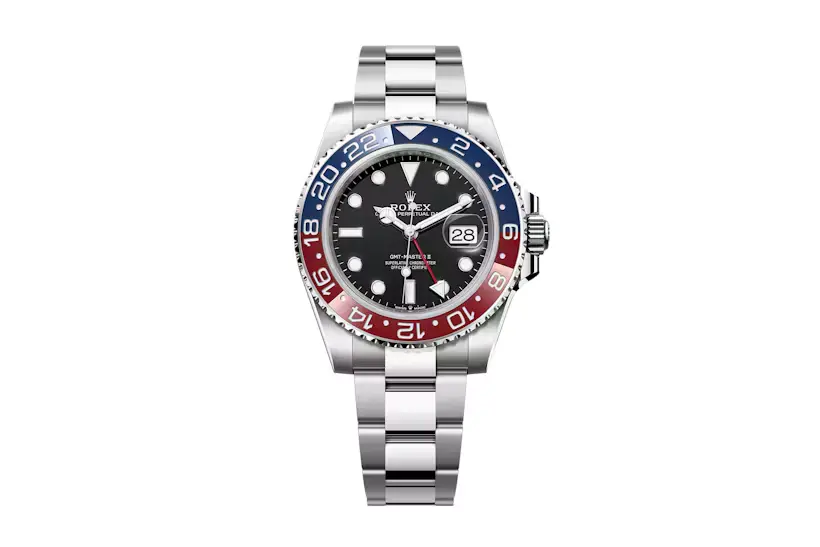
At Watches and Wonders 2026, Rolex made an announcement that rippled through collector forums, Instagram comment sections, and auction house boardrooms within hours: the iconic Pepsi GMT Master II and the celebrated Cookie Monster Submariner Date have been officially discontinued. Two of the most iconic references in Rolex’s modern sports watch line-up are no longer to be found in the current catalogue. For watch enthusiasts, this is the kind of news that arrives with a strange mixture of grief and excitement. Grief, because two beloved references are now consigned to history. Excitement, because in the world of Rolex collecting, discontinuation rarely means the end of a watch’s story. More often, it marks the beginning of its legend.
Why did Rolex discontinued the Pepsi GMT Master II?
The application of a bicolour Cerachrom bezel is one of the most technically challenging processes in modern watchmaking. The red-and-blue Pepsi bezel is not a single color ceramic insert, but two separate ceramic sections that must be fired and bonded with an extreme level of precision, using color pigments that have to remain chemically stable during the process.
Rolex does not discuss its production methods publicly, but insiders have long speculated that the yield rate for Pepsi Cerachrom bezels was lower than for other references contributing to the chronic supply constraints that made the watch so difficult to obtain at retail.
What made the Cookie Monster Unmistakable?
The Cookie Monster is frequently confused with its sibling, the Smurf Submariner. The distinction is important for collectors: the Smurf (Ref. 116619LB) features a white gold case with a blue dial and a blue bezel, similar in spirit but different in execution. The Cookie Monster’s updated Ref. 126619LB brought a redesigned bezel, a Jubilee bracelet option, and the calibre 3235 movement making it the definitive white gold blue Submariner of the modern era.
Explore our another blog: Jacob & Co. Godfather II Watch: Latest Update, Price & Full Review
Why discontinued Rolex models become more valuable?
Scarcity as the foundation of value
Supply and demand is the most elementary principle in economics, and it operates with particular force in the luxury watch market. When a Rolex reference is discontinued, the supply of new examples drops to zero overnight. Demand, however particularly for iconic models with decades of heritage does not diminish at the same rate. The result is a structural supply deficit that historically translates into price appreciation on the secondary market.
Historical Precedents Worth Noting
The steel Pepsi GMT was not the first Rolex reference to inspire near-hysteria upon discontinuation, and it will not be the last. The Ref. 16600 Sea-Dweller, discontinued in 2008, has appreciated more than threefold in the pre-owned market over the subsequent decade and a half.
The Emotional Premium
Beyond financial considerations, there is the matter of emotional resonance. The Pepsi GMT-Master II and Cookie Monster Submariner are watches that evoke genuine feeling. Collectors do not merely want to own them, they want to wear them, pass them down, and tell their stories. That kind of emotional investment is difficult to quantify but very easy to observe in the prices realised at major auction houses and private sales.
The Importance of Box and Papers
For collectors purchasing discontinued Rolex references, condition and provenance documentation are paramount. A complete set watch, original box, guarantee card, and all accompanying literature commands a meaningful premium over a watch sold in isolation. As examples age and change hands, complete sets become increasingly rare. Collectors should prioritise completeness accordingly.
Conclusion
Rolex has, with its characteristic precision, retired two of the most beloved references in its modern sports watch catalogue. The Pepsi GMT-Master II and Cookie Monster Submariner Date are gone from the current lineup, but they are far from forgotten. For the collectors who own them, these watches have taken on new weight not just on the wrist, but in the broader narrative of Rolex’s evolution.
What comes next from Rolex remains, as always, a matter of disciplined speculation. The brand does not reveal its plans ahead of schedule. But if history is any guide, the discontinuation of the Pepsi and Cookie Monster is not an ending, it is a deliberate pivot, a clearing of the stage for whatever extraordinary timepiece Rolex has decided the world needs next.
Frequently Asked Questions
Q1: Why did Rolex discontinue the Pepsi GMT-Master II?
Rolex has not issued an official public explanation for the discontinuation. Industry analysts point to a combination of manufacturing complexity producing the bicolour red-and-blue Cerachrom bezel is technically demanding with challenging yield rates and Rolex’s long standing strategy of controlled scarcity.
Q2: What is the difference between the Pepsi and Coke GMT-Master II?
The Pepsi GMT features a red and blue bicolour bezel, referencing the colour palette of the Pepsi Cola brand. The Coke GMT features a black and red bicolour bezel, and its name references the Coca-Cola brand’s signature colours. Both are nicknames coined by the collector community and are not official Rolex designations.
Q3: Is the Rolex Pepsi GMT Master II a good investment?
Historically, discontinued Rolex sports references have appreciated meaningfully on the secondary market. The Pepsi GMT Master II is one of the most recognisable and widely desired Rolex references, which typically supports long term value retention.
Q4: Is the Cookie Monster Submariner now considered rare?
Yes. With the discontinuation no new examples will enter the market from authorised dealers. The white gold specification was already produced in lower volumes than the stainless steel submariner family, making the Cookie Monster one of the more limited Rolex references in terms of total production numbers.
Q5: What happens to Rolex prices after a reference is discontinued?
Secondary market prices for discontinued Rolex references typically rise following the announcement, driven by a sudden supply constraint against sustained or increasing demand. The magnitude and duration of price appreciation varies depending on the reference’s popularity, the availability of remaining stock, and broader market conditions.
