
Choose Royal Watches if you want to shop with a Dubai-based luxury watch retailer; choose Chrono24 if you want to compare listings from different sellers. Royal Watches is best for buyers who prefer a direct retailer relationship, while Chrono24 is best for buyers comparing marketplace listings. This 2026 comparison explains what changes when you buy through each model—and what you still need to verify before committing.
- Royal Watches vs Chrono24: choose the Dubai retailer for a direct seller relationship; choose the marketplace to compare sellers.
- Chrono24 is the better starting point when comparing listings for the same watch across different sellers.
- Neither shopping model replaces checks on condition, documentation and written purchase terms.
- In 2026, decide which watch you want before choosing where to buy it.
Why this matters
A luxury watch purchase has two decisions: which timepiece suits you, and who you want to buy it from. The watchmaker and reference shape the first decision. The seller, the listing and the written terms shape the second. Confusing those decisions can leave you comparing photographs without knowing whether the offers are equivalent.
In 2026, Royal Watches and Chrono24 serve different roles. Royal Watches is an online luxury watch retailer based in Dubai; its stated focus includes Rolex, Patek Philippe, Audemars Piguet, Cartier and Omega. Chrono24 is a watch marketplace where listings come from different sellers. A retailer gives you one business to evaluate. A marketplace gives you sellers to compare, but requires you to evaluate the particular listing and seller you choose.
Neither model tells you, by itself, the condition of a specific watch or the terms attached to a specific purchase. Compare the actual watch, seller and written terms—not just the platform name.
At a glance
| Dimension | Royal Watches | Chrono24 |
|---|---|---|
| Best for | Buyers who prefer a Dubai-based retailer | Buyers comparing listings from different sellers |
| Buying model | Online retail | Marketplace |
| Seller relationship | The retailer is the business you assess | Assess the seller behind each listing |
| Search breadth | Explore the retailer’s selection | Search across marketplace sellers |
| Listing comparison | Compare watches within one retail context | Compare separate seller listings |
| Condition evidence | Request details for the particular watch | Check details in each particular listing |
| Pricing model | Retailer presents its own offer | Individual sellers present listings |
| Standout feature | A direct retailer relationship | Cross-seller discovery |
The table is a guide to the buying process, not a claim that either site has a particular watch available in 2026. Start with your preferred watchmaker and reference, then use the distinctions below to choose the right search route.
Royal Watches is the better fit for a retailer-first buyer
Best for: a buyer who wants to assess one Dubai-based retail business before choosing a watch. Royal Watches fits that brief because it is an online luxury watch retailer, not a marketplace of independent sellers. Its stated brand focus gives buyers interested in Rolex, Patek Philippe, Audemars Piguet, Cartier or Omega a clear reason to consider it.
The limitation is equally clear. Shopping through one retailer does not give you a cross-seller view of every listing for the reference you have in mind. If your priority is to see how different sellers describe similar watches, use a marketplace for that part of the search. A retailer-first route works best when the identity of the business selling to you matters more than comparing a range of sellers on one site.
In 2026, treat this as a choice about how you want to shop, not a judgment about which venue has the better individual watch. That judgment needs details of the actual timepiece.
The retail buying model gives you one business to evaluate
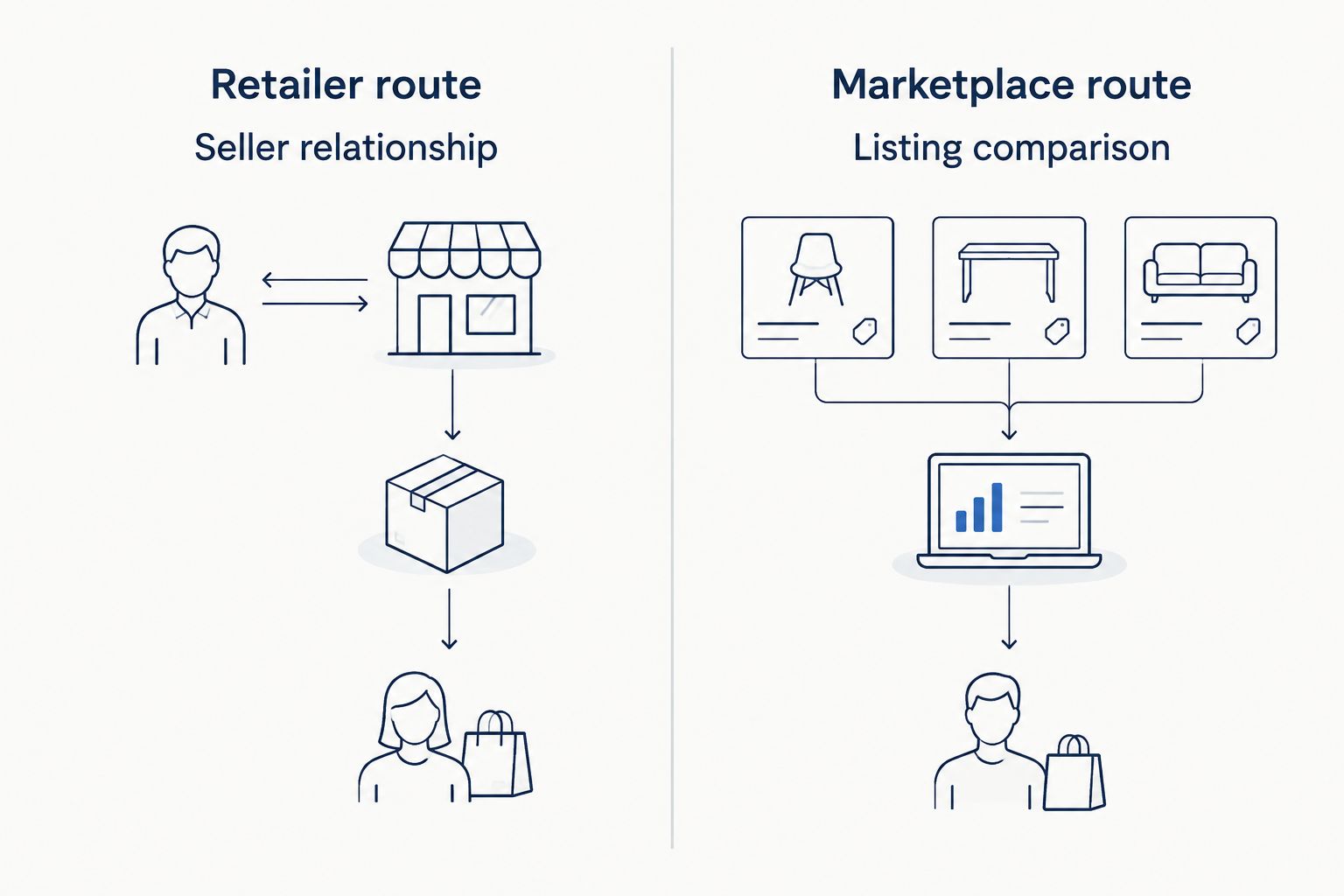
A retailer and a marketplace place different demands on the buyer. With Royal Watches, your seller assessment centres on the retailer and the specific watch under consideration. With Chrono24, you assess the marketplace listing and the seller behind it. Those are different tasks, even when the watchmaker and reference match.
Use this distinction before browsing deeply:
- Retailer route: decide whether you want to buy from the named retail business, then examine the individual watch and its written terms.
- Marketplace route: identify a listing, establish who the seller is, then examine that watch and that seller’s terms.
Neither route makes condition checks optional. The retail model wins for a buyer who prefers a single business relationship; the marketplace model wins when comparing sellers is part of the buying decision. In 2026, choose the model that suits your decision process rather than treating both sites as identical catalogues.
A direct seller relationship favours the retailer
If you prefer to know which business you are evaluating from the start, the retailer route is simpler to frame. Royal Watches is the retail business in this comparison. That does not establish the terms for a particular watch: ask for those terms in writing before you decide.
On Chrono24, the seller attached to a listing matters as much as the watch description. Read the listing as an offer from that seller, not as a statement that every seller on the marketplace handles watches or transactions in the same way. When comparing similar references, keep each seller’s information beside the watch details so you do not accidentally combine facts from different listings.
For a 2026 purchase, ask the same core questions whichever route you choose: What exactly is being sold? What condition is represented? Which documents and accessories are included? What are the written purchase terms? A direct relationship makes the seller question easier to identify; it does not answer the remaining questions for you.
Chrono24 offers broader cross-seller discovery
Best for: a buyer still looking across sellers for a particular watch. Chrono24’s marketplace format is better suited to that task than a single-retailer site. You can use separate listings to see how sellers present watches matching your search, then narrow the field to the offers whose details you can evaluate.
Breadth creates work as well as choice. Listings for watches with the same watchmaker and reference are not automatically equivalent. Their stated condition, included items and seller terms can differ. A search result is therefore a starting point for examination, not a ready-made shortlist of interchangeable purchases.
A retailer’s narrower shopping context can be useful if you already want to evaluate that retailer. It is a limitation if your immediate goal is to compare sellers. In 2026, use cross-seller discovery to learn what questions to ask, but do not assume the marketplace result that catches your eye is the right purchase without checking its details.
Chrono24 is better for comparing separate listings
Search breadth helps you find options; listing comparison helps you judge them. Chrono24 wins this second task when you want to place offers from different sellers against the same set of questions. Keep the watchmaker, reference and stated condition fixed as closely as you can before drawing any conclusion from a comparison.
Build a short comparison record for each watch:
- Identity: watchmaker and reference as stated in the listing.
- Condition: the seller’s description and the evidence provided for it.
- Included items: the exact documents and accessories stated for that watch.
- Seller: the business or person behind the particular offer.
- Terms: what the seller puts in writing about the transaction.
This is a discipline, not a marketplace feature you should assume a site performs for you. With a retailer, apply the same questions to the watch you are considering, even if you do not need to compare multiple sellers. The best comparison is between complete offers, not watch names alone.
Both routes require evidence about the particular watch
Neither a retailer label nor a marketplace label establishes a timepiece’s condition. Ask for a description specific to the watch you intend to buy, and check that the photographs and documents you rely on refer to that same watch. If an essential detail is unclear, seek a written answer before committing.
Separate what you know about the watchmaker from what you know about the watch. Rolex and Patek Philippe are watchmakers; their names alone do not establish the state, history or included items of an individual timepiece. The same rule applies to Audemars Piguet, Cartier and Omega. Prestige cannot fill a gap in a listing.
For 2026 buyers, this dimension is a tie. Royal Watches still requires watch-specific scrutiny, and so does each Chrono24 listing. Choose the shopping model on seller relationship and discovery; judge an individual purchase on evidence attached to that exact offer.
Pricing models differ, but neither wins without an offer
Royal Watches operates as a retailer presenting its own offers. Chrono24 presents marketplace listings from individual sellers. That difference affects how you compare: one retailer’s offer is assessed against its stated terms, while marketplace offers need to be assessed seller by seller. It does not establish which route represents better value for the watch you want.
Before comparing offers in 2026, confirm that they describe the same reference and a comparable condition. Then check included items and written transaction terms. If those details differ, you are not comparing equivalent purchases, however similar the watch names appear.
There is no universal winner on this dimension. A buyer who values the clarity of dealing with one retailer can favour the retail model. A buyer prepared to assess separate sellers can favour the marketplace model. Do not choose a route on its pricing format alone; evaluate the complete offer.
The standout feature depends on the task
Royal Watches’ defining advantage in this comparison is its direct retail identity: a Dubai-based luxury watch retailer with a stated focus on premium watchmakers. That suits a buyer who wants a specific retail business to be the centre of the purchase decision. Its trade-off is that one retailer is not a cross-seller marketplace.
Chrono24’s defining advantage is cross-seller discovery. That suits a collector who wants to examine separate listings before deciding which seller and watch to pursue. Its trade-off is that the buyer has to assess the seller behind the chosen listing, rather than treating the marketplace name as the seller’s identity.
Those strengths serve different moments in a 2026 search. Use marketplace discovery when the shortlist is still forming. Use a retailer-first approach when the relationship with the retail business is a leading criterion. For either route, finish with the details of the specific watch.
Final verdict
Choose Royal Watches if you are a retailer-first buyer looking to shop with a Dubai-based luxury watch business. The named retail relationship is the reason to choose it; verify the individual watch and written terms before purchasing.
Choose Chrono24 if you are a comparison-first collector who wants to examine listings from different sellers. Its marketplace model is the reason to choose it; evaluate the seller and the exact offer you select.
| Dimension | Winner |
|---|---|
| Best for a retailer-first buyer | Royal Watches |
| Retail buying model | Royal Watches |
| Direct seller relationship | Royal Watches |
| Cross-seller search breadth | Chrono24 |
| Separate listing comparison | Chrono24 |
| Watch-specific condition evidence | Tie: both require checks |
| Pricing model | Tie: judge the actual offer |
| Direct retail identity | Royal Watches |
FAQ
Is Royal Watches better than Chrono24 in 2026?
Royal Watches is better for a buyer who prefers a Dubai-based retailer; Chrono24 is better for comparing listings from different sellers. Evaluate the particular watch and written terms before choosing either route.
What is the main difference between Royal Watches and Chrono24?
Royal Watches is an online luxury watch retailer, while Chrono24 is a watch marketplace. With the marketplace route, you also need to assess the seller behind the listing you choose.
Which is better for comparing luxury watches from different sellers?
Chrono24 is better for comparing listings from different sellers. Keep the reference, condition, included items and seller terms in view so that similar-looking listings are not mistaken for equivalent offers.
Which is better if I want to buy from a Dubai-based retailer?
Royal Watches fits that preference because it is an online luxury watch retailer based in Dubai. Confirm the details and written terms of the individual watch before you buy.
Does a marketplace listing establish a watch’s condition?
No. A marketplace listing must be assessed for the particular watch it describes. Check the stated condition and supporting details, then resolve any unanswered questions with the seller.
Does buying from a retailer remove the need to check documentation?
No. Ask what documentation and accessories are included with the specific watch, regardless of the shopping model. A retailer’s identity does not establish those details for every timepiece.
How should I compare offers for the same watch reference?
Compare the stated condition, included items, seller identity and written transaction terms alongside the reference. A shared reference does not make two individual watches or offers equivalent.
Should I choose the retailer or marketplace route first in 2026?
Choose the route that matches your immediate task: a retailer relationship or cross-seller comparison. Then judge the specific watch and offer before making a purchase decision.
One last thing
The most useful 2026 comparison starts after you settle on the watchmaker and reference. Otherwise, you risk attributing a difference between two watches to a difference between a retailer and a marketplace. Write down the reference you want, then compare the actual offers against the same questions.
Related guides
- Chrono24 alternatives
- Luxury watch brands to buy in Dubai
- Rolex watches for men in the UAE
- Patek Philippe watches for collectors
