
Choose Royal Watches if your purchase starts with a specific luxury watch; choose The Luxury Closet if you want to consider a pre-owned watch alongside other luxury fashion purchases. In 2026, the useful distinction is a watch-focused retailer versus a broader luxury resale business—not a blanket claim that one offers better watches.
- Royal watches vs the luxury closet: choose the watch specialist for a watch-led search, the resale business for broader shopping.
- The Luxury Closet suits shoppers considering pre-owned watches alongside other luxury fashion categories.
- Compare the exact reference, condition, documentation and written purchase terms before choosing either retailer.
- Neither retailer wins automatically on authenticity, warranty or value; assess the individual watch and transaction.
Why this comparison matters
A retailer's business model helps you decide where to begin. It does not establish whether a particular watch is the right purchase. A recognisable model name still leaves important questions about reference, materials, condition and supporting documents.
Royal Watches is best for luxury watch buyers whose search begins with the timepiece rather than a broader fashion purchase. The Luxury Closet has a different strength: luxury resale across categories, allowing a watch purchase to sit within a wider wardrobe decision.
For your 2026 shortlist, separate shopping fit from purchase quality. The first tells you which business suits your search; the second requires evidence about the actual watch.
At a glance
| Dimension | Royal Watches | The Luxury Closet |
|---|---|---|
| Best for | Buyers pursuing a specific luxury timepiece | Buyers considering a watch within broader luxury resale shopping |
| Shopping focus | Luxury watches | Multiple luxury fashion categories, including watches |
| Standout distinction | Watch-focused retail positioning | Cross-category resale positioning |
| Wardrobe comparison | Better suited to a watch-led brief | Better suited to a broader fashion-led brief |
| Condition assessment | Examine the individual watch and disclosures | Examine the individual watch and disclosures |
| Authenticity and documents | Require evidence tied to the exact watch | Require evidence tied to the exact watch |
| Pricing model | Individual timepiece purchase | Individual resale-item purchase |
| Final purchase decision | Judge the watch and written terms | Judge the watch and written terms |
The table identifies a difference in purpose, not a ranking of service quality. Neither business model, by itself, proves faster communication, stronger inspection or more favourable purchase terms.
The watch specialist wins for a watch-led search
A dedicated watch retailer is the clearer starting point when you already know the manufacturer, collection or reference you want. Your questions concern the timepiece itself: configuration, condition, accompanying documents and suitability for your collection.
The client's stated watch focus includes Rolex, Patek Philippe, Audemars Piguet, Cartier and Omega. That positioning matches a buyer comparing watchmakers rather than deciding between a watch and another luxury accessory.
Best for: the reference-led buyer. You have identified a collection and want to assess a particular example against your requirements.
The limitation is equally clear. A watch-focused business is not the natural starting point for comparing unrelated fashion categories. Specialisation establishes relevance; it does not remove the need to check the seller's claims about an individual piece.
Before making an enquiry, prepare a short brief:
- The manufacturer and exact reference, if known.
- Your preferred material, dial and bracelet configuration.
- Whether you are considering new, pre-owned or either condition.
- The documents and accessories you require.
A precise brief makes the comparison more useful. Otherwise, different configurations can appear interchangeable when they are not.
The Luxury Closet wins for cross-category shopping
The Luxury Closet's broader luxury resale positioning suits a buyer who has not made the watch the centre of the purchase. You might be considering a pre-owned timepiece alongside a handbag, jewellery or another wardrobe addition.
Best for: the wardrobe-led luxury resale shopper. The advantage is the scope of the shopping brief, not an assumed advantage in watch expertise or transaction protection.
That breadth has a practical limitation. A watch needs questions that do not apply in the same way to clothing or accessories: movement condition, service history, replacement components and the relationship between the watch and its documentation.
Do not let a polished listing replace those questions. A watch can fit your style while still requiring clarification about its mechanical history or included accessories.
For a gift, establish whether the recipient values a particular watch reference or simply wants a luxury accessory. A reference-specific brief favours the watch specialist; an open-ended fashion brief favours broader comparison.
Watch focus and fashion breadth are different strengths
Neither approach is universally better. A specialist search reduces the number of unrelated categories you need to consider; a cross-category search gives you a wider frame for deciding what kind of luxury purchase you want.
Use the following distinction before comparing individual listings:
- Watch-led search: you have chosen the category and need to choose the timepiece.
- Fashion-led search: you are still choosing the category as well as the item.
- Evidence-led purchase: you have selected a watch and need to verify the transaction.
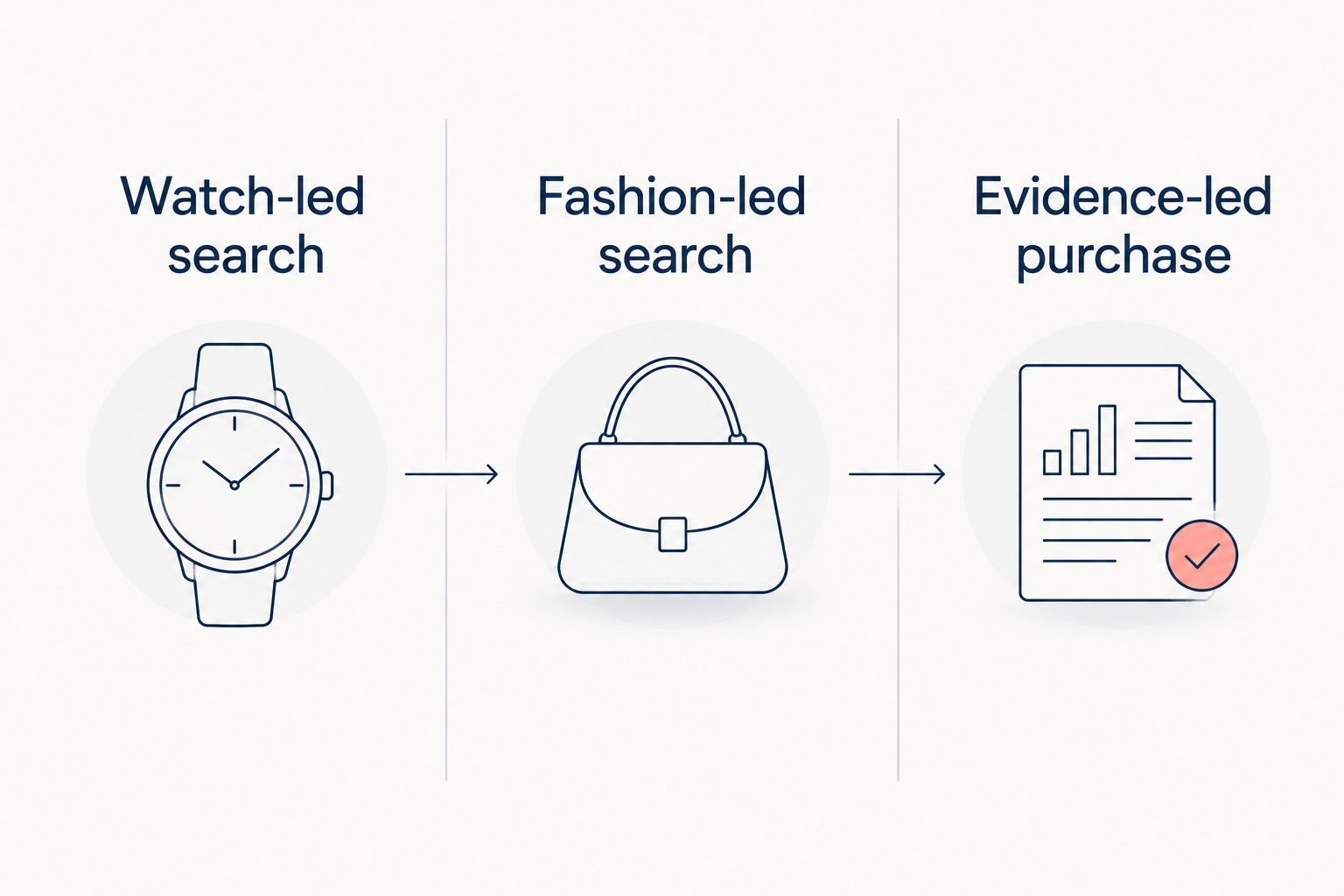
The third stage applies to both businesses. Once you have selected a particular watch, category breadth becomes less important than whether the seller answers your questions clearly and records the agreed terms.
In 2026, use retailer positioning to narrow your search, then stop treating positioning as proof. The individual purchase must stand on its own evidence.
Neither retailer wins condition without an item-level comparison
Condition belongs to the watch, not to the retailer's category. Compare 2 listings only after confirming that their references and configurations match; otherwise, you are assessing different objects rather than different sellers.
Ask for 4 photograph views as a starting request: dial, case sides, caseback and bracelet or strap. Request additional close-ups wherever the description mentions wear or where an image leaves a question unanswered.
Photographs help you assess visible condition. They do not establish movement health or replace a qualified inspection.
Separate your questions into these areas:
- Exterior condition: marks, bracelet wear and visible alterations.
- Mechanical history: stated servicing, repairs and known operating issues.
- Configuration: dial, hands, bezel, bracelet and disclosed replacements.
- Completeness: the exact accessories and documents included.
The honest verdict is a tie at retailer level. Either listing can become the better choice when its condition and supporting evidence match your requirements more closely.
Do not assume that a more complete accessory set means a better mechanical watch. Completeness and condition answer different questions.
Neither retailer wins authenticity through positioning alone
A luxury retailer's name is not a substitute for evidence about the watch you intend to purchase. Ask how authenticity is assessed, who stands behind that assessment and what the written remedy is if the item does not match its description.
For a Rolex purchase, the guide to verifying authenticity before buying in Dubai addresses a more useful question than which retailer has the more appealing positioning.
Keep 3 document categories separate in your checklist: the purchase invoice, any manufacturer warranty documentation and any service records. They serve different purposes, and none should be treated as a replacement for the others.
A box is an accessory, not conclusive proof of authenticity. Likewise, a document must relate to the specific watch rather than merely carrying the right manufacturer's name.
For a 2026 purchase, request written clarification of any warranty you expect to rely on. Identify its provider, scope, exclusions and claim process rather than assuming that manufacturer cover and seller cover are equivalent.
Best for either buyer profile: the seller that supplies clear, watch-specific evidence. This is an honest tie until the individual transaction establishes a difference.
Pricing models: compare individual watches, not retailer labels
Both options involve purchasing an individual item rather than subscribing to a service. The distinction is watch-focused retail versus a broader resale setting; that distinction does not establish which transaction offers better value.
Compare like with like. Reference, configuration, condition, included accessories, documentation and written protections all belong in the same assessment.
The trade-off is not simply predictability versus flexibility. A clear written offer gives you a defined transaction; a broader search gives you more examples to evaluate, but also more differences to reconcile.
Before paying, confirm:
- The identity of the invoicing business.
- The complete agreed transaction amount and any applicable charges.
- Which documents and accessories form part of the purchase.
- The written delivery, return and warranty terms that apply.
Do not infer payment methods, instalment arrangements or return rights from a retailer's general positioning. Confirm the terms of the exact transaction you are considering.
The transaction structure matters after you choose the watch
Once you have selected a reference, identify who is selling it, who receives payment and who handles any subsequent claim. These responsibilities matter more than whether the shopping experience feels specialist or broad.
The distinction examined in comparing watch dealers with marketplaces is responsibility: the business displaying an item and the party responsible for the sale must not be assumed to be interchangeable. Establish those roles for your purchase rather than assigning them from a platform's appearance.
Use a simple sequence before committing:
- Identify the seller. Match the business details across the offer, invoice and payment instructions.
- Record the item. Preserve the reference, description, photographs and included accessories.
- Confirm the terms. Obtain the applicable delivery, return and warranty wording.
- Resolve discrepancies. Ask for corrected documents before proceeding when details conflict.
This process does not award either retailer a speculative advantage. It gives you a consistent standard for comparing both.
If you are buying from outside the UAE, include delivery responsibility and destination requirements in that written discussion. Do not assume a domestic purchase process answers every cross-border question.
Final verdict: choose by your buying brief
Choose Royal Watches if you are a reference-led collector
Choose Royal Watches for a luxury watch purchase that begins with a particular manufacturer, collection or reference. Its stated watch-retail focus fits that brief directly.
Your next move is to request information about the exact timepiece, not to treat specialisation as an automatic quality guarantee. Proceed only when the condition, documentation and transaction terms meet your requirements.
Choose The Luxury Closet if you are a wardrobe-led resale shopper
Choose The Luxury Closet when you want to consider a pre-owned watch within a broader luxury fashion search. Its cross-category resale positioning fits buyers who are still deciding how a watch compares with another luxury purchase.
Apply watch-specific scrutiny once you select a timepiece. Breadth is a shopping advantage, not a substitute for mechanical and documentary checks.
For 2026, the decision is straightforward: choose the shopping format that matches your brief, then choose the actual watch on evidence.
One-glance scorecard
| Dimension | Winner |
|---|---|
| Reference-led watch search | Watch specialist |
| Cross-category luxury search | The Luxury Closet |
| Watch-focused retail positioning | Watch specialist |
| Fashion-led resale positioning | The Luxury Closet |
| Condition | Tie until individual watches are assessed |
| Authenticity and documents | Tie until evidence is assessed |
| Pricing model and value | No blanket winner; compare matched items |
| Final purchase decision | The transaction that meets your written requirements |
FAQ
Is Royal Watches better than The Luxury Closet?
Royal Watches is the better starting point for a watch-led search; The Luxury Closet suits broader luxury resale shopping. Neither business model establishes that an individual watch has better condition or stronger purchase protections.
Which is better for buying a first luxury watch?
A watch-focused retailer fits a first purchase when you have already chosen the category and want to compare timepieces. A broader resale business fits a buyer still deciding between a watch and other luxury accessories.
Is The Luxury Closet only for watches?
No. The Luxury Closet operates across luxury resale categories, including watches, which makes it relevant to shoppers considering more than a timepiece.
Which retailer offers better value for a pre-owned watch?
Neither retailer wins on value without comparing individual watches. Match the reference, configuration, condition, documents and written terms before deciding.
What should I ask before buying a luxury watch online?
Ask for the exact reference, condition details, authenticity assessment, included documents and applicable purchase terms. Confirm who issues the invoice and who is responsible for any warranty claim.
Does a watch box prove that a watch is authentic?
No. A box is an accessory and does not independently establish the authenticity of the watch inside it. Assess the watch and its supporting evidence together.
Should I choose a retailer before choosing a watch model?
Choose your buying brief first. A specific watch reference points toward a watch-led search, while an open-ended luxury purchase benefits from comparing categories before selecting an item.
One last thing
Save the evidence you used to make the decision. Keep the listing, photographs, written answers and final invoice together so the description you accepted remains clear after the purchase.
A strong comparison ends with a documented timepiece and transaction—not merely a preferred retailer name.
Related guides
- Documents that come with a new Rolex in Dubai
- Returning a luxury watch bought online in Dubai
- Choosing between a pre-owned Rolex and a new one
