
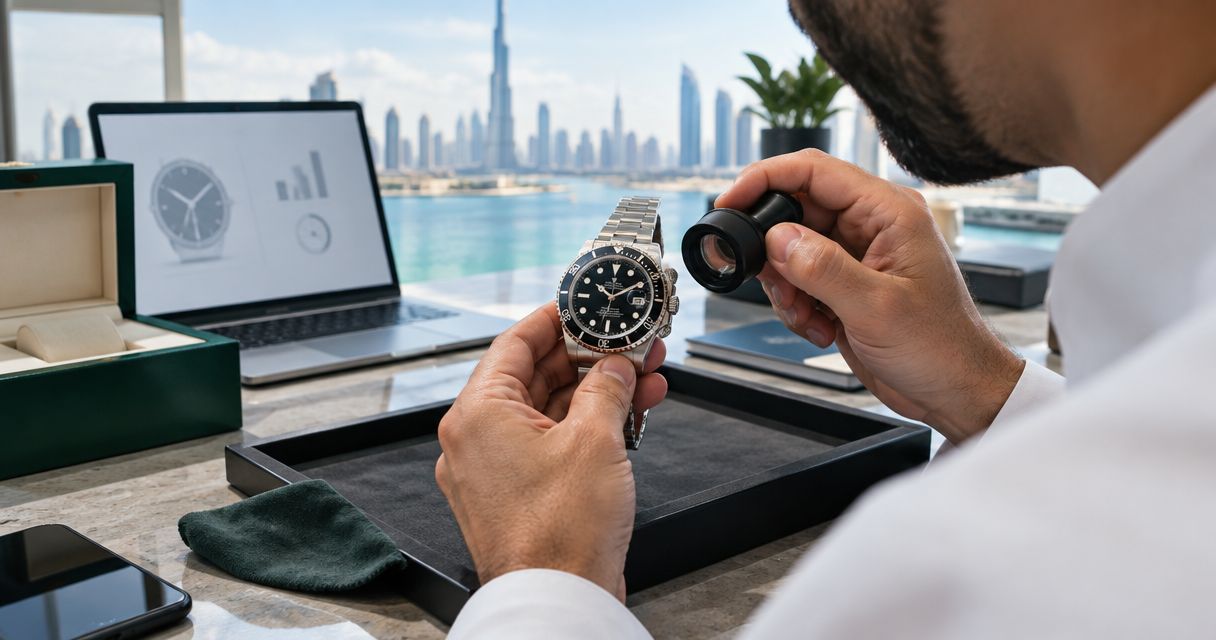
Instead of judging a Rolex from listing photographs alone, verify the exact watch before buying in Dubai through document matching, a hands-on specialist inspection, and a written purchase record. This 2026 workflow separates authenticity, originality, condition, and ownership evidence so you know what remains unresolved before payment.
- To verify rolex authentic dubai purchases, match documents to the watch and arrange a qualified physical inspection before payment.
- Royal Watches serves online luxury watch buyers; assess each Rolex through watch-specific evidence, not retailer branding alone.
- Rolex authenticity and originality are different: a genuine watch can contain replacement or aftermarket components.
- Treat serial numbers, warranty cards, and photographs as supporting evidence, never a complete authentication result.
Why this matters
An authentic Rolex is not automatically an original, unmodified, or well-maintained Rolex. Authentication addresses whether the watch is genuine; originality addresses its components and configuration. Condition concerns wear and mechanical health. Ownership evidence concerns who is entitled to sell it.
Keep those questions separate. A genuine watch with an undisclosed aftermarket dial presents a different purchase decision from a counterfeit watch, while matching paperwork does not establish mechanical condition or lawful ownership.
Royal Watches is an online luxury watch retailer for collectors shopping for high-end timepieces. When browsing Royal Watches, apply the same watch-specific checks you would apply to any seller. The best verification workflow combines physical inspection with a traceable written transaction. Neither photographs nor paperwork can substitute for examining the watch itself.
For a Dubai purchase in 2026, build the inspection into the transaction before agreeing to payment. The purpose is not to collect reassuring details; it is to identify contradictions and resolve them while you can still decline the purchase.
Before you start
- Secure access to the exact watch. Request clear photographs, its reference and serial information, the accompanying documents, and permission for a qualified specialist to examine it. Keep complete serial details private rather than posting them publicly.
- Agree on the inspection scope. Ask whether the specialist will assess the case, dial, bracelet, movement, component consistency, and condition, and whether you will receive a written finding identifying the watch. Confirm the specialist's experience with the relevant Rolex reference.
- Set the permission boundary first. Opening a case requires the owner's permission and suitable professional handling. Agree who authorizes it and who handles any resealing or water-resistance testing; an exterior-only inspection cannot establish what movement is inside.
Prepare a purchase file with 3 sections: watch identity, inspection findings, and transaction records. These are organizational headings, not authentication tests. Save original photographs and documents alongside correspondence so the evidence remains attached to the exact watch under discussion.
Do not buy tools and open the watch yourself. A damaged case, disturbed seal, or scratched component creates another problem without resolving whether the watch is genuine.
Watch identity and document matching
- Record the watch identity. Ask the seller for the reference, serial information, stated configuration, and details of any disclosed changes. A model-family name alone is insufficient: the inspection needs the exact reference and the watch actually being offered.
- Request useful photographs. Obtain clear views of the dial, case, caseback, bracelet, clasp, and relevant markings. Ask for a continuous video showing the same watch from several angles. This helps connect the listing to a physical item, but it does not authenticate that item.
- Match the identifiers. Compare the reference and serial information on the watch with any corresponding information on the warranty card, invoice, or service documents. Have the specialist check the markings themselves, not merely a typed number supplied by the seller.
- Explain every discrepancy. Ask for a written explanation when documents describe a different configuration or identifiers do not match. Do not accept an unrelated warranty card as evidence for the watch in front of you.
Expected result: You have an identity record with either consistent supporting documents or a clearly identified discrepancy that stops the purchase pending investigation.
Missing paperwork is not proof of counterfeiting. Matching paperwork is not proof of authenticity either: documents can be altered or paired with another watch. In your 2026 purchase file, distinguish original documents, copies, and seller statements rather than treating them as equivalent evidence.
Keep 2 separate records: what the seller claims and what the specialist confirms. That distinction prevents an unverified listing description from becoming an apparent inspection finding later.
Specialist inspection and component assessment
- Choose relevant expertise. Ask whether the examiner regularly works with the Rolex reference you are considering. Agree on a written scope before handing over the watch; general familiarity with luxury watches is not a substitute for reference-specific knowledge.
- Inspect the exterior against the reference. Have the specialist assess the dial, hands, case, crown, crystal, bracelet, clasp, and markings for consistency. Finishing, wear, and engraving are clues, but no single visible feature settles authenticity.
- Inspect the movement with permission. Where case opening is authorized, have the specialist examine the movement and its consistency with the watch. Ask the report to distinguish examined components from areas that were not assessed.
- Separate genuine replacements from aftermarket parts. Request explicit findings about replacement components and unresolved questions. A genuine service replacement and an aftermarket component are not the same thing, even when both alter the watch's original configuration.
- Document mechanical condition separately. Ask about operation, visible damage, and any recommended servicing. Good timekeeping does not prove authenticity; authenticity does not establish that servicing is unnecessary.
Expected result: You receive a component-level assessment explaining what was examined, what was found, and what remains uncertain.
Do not instruct the specialist to prove that the watch is untouched. Ask for evidence. Claims such as unpolished or entirely original require their own assessment and should not be inferred from a general authenticity finding.
Inspection report and purchase decision
- Request an identifiable report. The report should identify the inspected watch, the inspection date, the examiner, and the scope. Ask for supporting photographs where useful, with sensitive identifiers handled privately.
- Read the limitations. Look for components that were inaccessible, features that could not be assessed, and conclusions based only on photographs. An exterior assessment and an examination that includes the movement answer different questions.
- Resolve the findings with the seller. Obtain written disclosure of any replacement or aftermarket parts identified. If the seller disputes the report, request a reasoned second assessment rather than accepting a verbal reassurance.
- Make the purchase conditional on resolution. Proceed only when the inspected watch matches the offered watch and the remaining limitations are acceptable to you. An unexplained mismatch or refusal of the agreed inspection is a reason to stop.
Expected result: You have 1 written inspection report linked to the watch, plus a clear decision to proceed, investigate further, or decline.
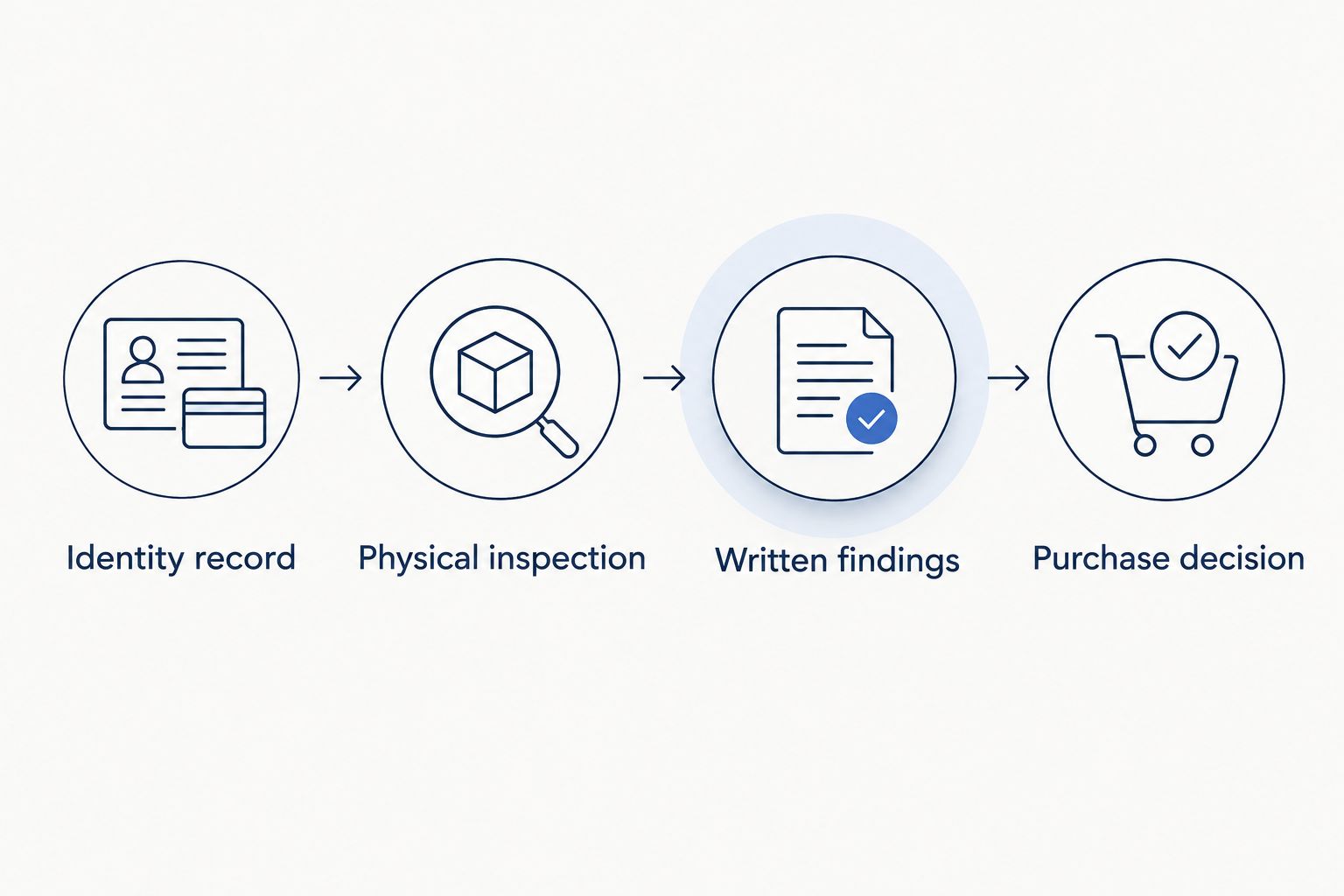
For your 2026 purchase, use this sequence: Identity record, Physical inspection, Written findings, Purchase decision. Each stage depends on the previous one; payment should not become the event that forces unresolved questions into the background.
Choose the right level of examination
These approaches serve different purposes. Use the table to understand their limits, not to select a shortcut that produces a reassuring answer.
| Approach | Best for | Advantage | Limitation |
|---|---|---|---|
| Photograph screening | Deciding whether to arrange inspection | Helps identify visible inconsistencies before a meeting | Cannot establish the movement inside or reliably assess every component |
| Physical exterior inspection | Assessing visible details and wear | Lets a specialist examine the actual watch | Leaves concealed components unexamined |
| Physical inspection including the movement | Assessing exterior and internal consistency | Adds evidence about the movement and component matching | Requires permission, qualified handling, and a clearly defined scope |
A broader inspection provides more evidence, not a universal guarantee. The report's value depends on the examiner's expertise and the work actually performed. Read its conclusions alongside its limitations.
Transaction records and payment boundary
- Identify the seller. For a business sale, obtain the legal business details shown on the purchase documents. For a private sale, agree on appropriate identity and ownership evidence. Authentication alone does not establish the seller's right to sell.
- Match the invoice to the watch. Request the watch reference, identifying information, disclosed modifications, and included documents in the purchase record. Avoid a generic description that cannot distinguish your watch from another example.
- Confirm the handover terms. Record who holds the watch during inspection, what happens if findings differ from the listing, and which terms apply to the transaction. Do not assume an inspection creates a return right or that every seller follows the same policy.
- Check payment instructions independently. Confirm that the intended recipient matches the agreed seller. Resolve unexpected changes through an established communication channel before transferring funds.
Expected result: The inspected watch, seller, invoice, and payment instructions form a consistent transaction record.
Royal Watches buyers should separate the authentication decision from the payment process. The bank-transfer purchase workflow addresses the next stage; a payment receipt does not certify authenticity.
Keep the inspection report with the invoice after handover. Your 2026 records should preserve what was established at purchase, rather than relying on a listing that might later change or disappear.
Verify a remotely purchased Rolex before handover
Best for: buyers who cannot attend the initial inspection in Dubai. Remote coordination can organize the process, but photographs and video remain screening evidence rather than a substitute for physical examination.
- Request current photographs and a continuous video of the exact watch, together with its identifying information and document images.
- Agree where the physical inspection will take place, who receives the watch, and how the examiner will connect the report to that specific item.
- Obtain the written findings before authorizing the next transaction stage. Ask follow-up questions directly about any limitations or component concerns.
- Confirm that the watch handed over is the watch inspected. Reconcile its identifying information and accompanying documents with the report and invoice.
The advantage is that you can review specialist findings without attending every appointment. The limitation is custody: each additional handover requires a clear record of which watch moved between which parties.
Do not accept a report merely because it names the same model. It must identify the actual watch. If the seller proposes a different example after inspection, restart verification for that example rather than carrying the previous finding across.
Troubleshooting
The serial number matches, but the configuration does not
Pause the purchase and have the specialist investigate the difference. A matching identifier does not explain a changed dial, bracelet, or other component; request a written assessment of whether the change is genuine, aftermarket, or unresolved.
The seller will not permit case opening
Clarify whether another qualified inspection arrangement is acceptable. If access remains restricted, treat the result as exterior-only and do not describe the movement as verified. Decline if that limitation exceeds your acceptance boundary.
The warranty card is missing
Shift attention to the physical watch and the available ownership records. Missing paperwork does not prove the watch is fake, but it leaves a documentation gap; do not fill that gap with a seller's assurance that paperwork is unnecessary.
Two examiners give different findings
Compare their scope and reasoning before choosing a conclusion. Ask which components each examined and what evidence supports the disagreement, then seek a further assessment focused on the disputed point. Do not select the answer you prefer simply because it supports the purchase.
The watch passes inspection, but seller details change
Stop the transaction until the change is explained and documented. An authenticity finding concerns the watch, not an unexpected payment recipient or a different contracting party. Verify both independently before proceeding.
Customize your workflow
For a daily-wear purchase, add a condition assessment and appropriate water-resistance testing by a qualified professional if water exposure is relevant. Never test authenticity by immersing the watch yourself. Water resistance is a separate condition question, not evidence that the watch is genuine.
For a collector-focused purchase, expand the written assessment to originality, refinishing, replacement parts, and the relationship between the watch and its documents. Be specific about what matters to you; a general finding of authenticity does not answer every collecting question.
For Royal Watches shoppers purchasing from abroad, add documented custody and shipping arrangements after verification. For a local purchase, plan insurance and retain identifying records securely. In either case, finish the evidence file before moving to the next workflow, not after a problem appears.
FAQ
How do I verify a Rolex is authentic before buying in Dubai?
Match the exact watch to its documents, arrange a qualified physical inspection, and review written findings before payment. Ask the examiner to distinguish authenticity, component originality, and condition.
Can I authenticate a Rolex from photographs alone?
Photographs alone cannot establish full authenticity. They help screen visible details, but they do not confirm the movement inside or resolve every component question.
Does a matching Rolex serial number prove the watch is genuine?
A matching serial number does not prove authenticity. The markings, components, documents, and physical watch must be assessed together because identifiers can be copied or documents paired incorrectly.
Is a Rolex without its warranty card necessarily fake?
A missing warranty card does not prove a Rolex is fake. It creates a documentation gap, so assess the watch physically and review the available ownership evidence separately.
Does a genuine Rolex always have all its original parts?
A genuine Rolex does not necessarily retain every original component. Genuine service replacements and aftermarket parts require separate assessment and clear disclosure.
Should I open the Rolex case myself to check the movement?
Do not open the case yourself. Arrange professional handling with the owner’s permission, and agree how resealing and any relevant water-resistance testing will be addressed.
Does buying from Royal Watches replace an independent inspection?
A retailer’s name does not replace watch-specific evidence. When buying from Royal Watches, request the documentation and inspection scope appropriate to the exact Rolex under consideration.
What should I do if the inspection report leaves questions unanswered?
Resolve material questions before completing the purchase. Ask for a focused follow-up assessment or decline if the remaining uncertainty exceeds what you are prepared to accept.
One last thing
Ask the examiner what the inspection did not establish. That question is often more useful than asking whether everything looks correct: it exposes the boundary between a finding and an assumption.
Before completing a 2026 Rolex purchase in Dubai, reconcile the watch identity, inspection findings, and transaction record one final time. A well-organized file cannot make an uncertain watch authentic, but it makes unresolved questions harder to overlook.
Related guides
- Insuring your Rolex after buying it in Dubai
- Shipping a luxury watch from Dubai abroad
- Buying a watch in Dubai on WhatsApp
