
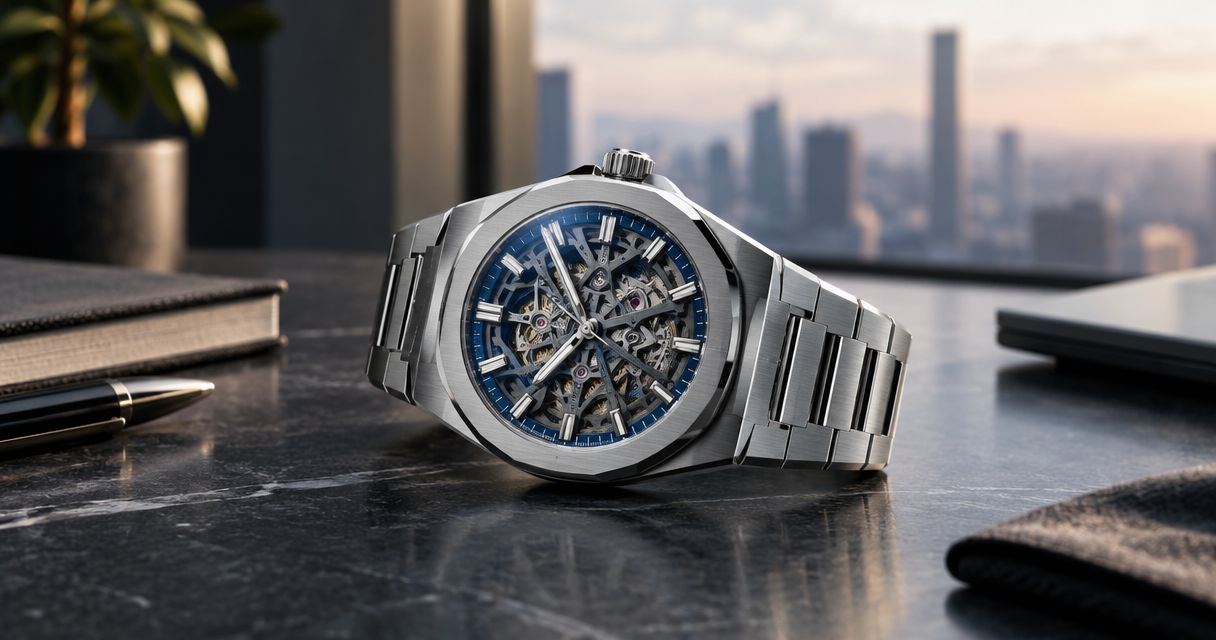
Best overall Zenith Defy watch: the Defy Skyline 41 mm. Best for smaller wrists: the Defy Skyline 36 mm. Best for chronograph collectors: the Defy El Primero 21. This 2026 guide compares five distinct Defy options, including the Extreme for a larger sports-watch presence and the Revival A3642 for vintage character.
- The best overall Zenith Defy watch is the Defy Skyline 41 mm for everyday sports-watch wear.
- Choose the Defy Skyline 36 mm for a smaller case without abandoning the collection’s angular design.
- The Defy El Primero 21 suits chronograph collectors; the Defy Extreme prioritizes a larger sports-watch presence.
- Royal Watches recommends choosing your Defy by wrist fit and function before dial colour or mechanical spectacle.
Why this matters
The Defy name covers watches with substantially different purposes. A compact Skyline, an openworked chronograph and a Revival do not solve the same buying problem, even when their angular cases share a family resemblance.
For your 2026 shortlist, separate everyday wear from collecting interest before comparing finishes. Royal Watches is a Dubai-based online luxury watch retailer; this guide focuses on the differences between Defy models, not on claims about individual watches offered for sale.
The Skyline 41 mm is the default choice because its time-and-date format keeps the decision focused on fit, legibility and everyday use. The chronographs become stronger choices when their additional mechanism is part of what you want to own.
What makes the best Zenith Defy watch?
Use these criteria before looking at the ranking. A watch that wins on mechanical interest can still lose on your wrist.
- Everyday wear: Judge time-reading clarity, bracelet comfort and whether the watch works with your usual clothing.
- Compact fit: Compare case diameter, thickness and the way the bracelet turns down around your wrist.
- Chronograph function: Decide whether you actually want elapsed-time measurement and the additional controls it brings.
- Mechanical display: Choose between a conventional dial, a fast-moving indicator and a more exposed movement architecture.
- Vintage character: Decide whether you prefer modern integrated styling or the Revival’s more historically rooted case design.
These priorities are not interchangeable. Start with the one that matters most, then use the others to identify the compromise you can accept.

Best Zenith Defy watches at a glance
The comparison below concerns the named configurations, not every reference sharing the same collection name. Case material, dial treatment and bracelet or strap configuration require a separate reference-level check.
| Rank and model | Best for | Standout feature | Key limitation |
|---|---|---|---|
| 1. Defy Skyline 41 mm, steel | Everyday sports-watch wear | Integrated design with a running tenth-of-a-second indicator | Angular case needs a wrist check |
| 2. Defy Skyline 36 mm, steel | Buyers wanting a smaller case | Compact Skyline proportions with a date display | No tenth-of-a-second display |
| 3. Defy El Primero 21, 44 mm titanium | Chronograph collectors | Hundredth-of-a-second chronograph with separate regulating systems | Openworked display demands more visual attention |
| 4. Defy Extreme, 45 mm titanium | Large-format sports-watch presence | Angular construction and a hundredth-of-a-second chronograph | Large case is a substantial commitment |
| 5. Defy Revival A3642, steel | Vintage-design enthusiasts | Octagonal case and fourteen-sided bezel | Vintage-led styling is less neutral |
1. Defy Skyline 41 mm: best Zenith Defy watch for daily wear
The steel Defy Skyline 41 mm combines an angular case, integrated bracelet styling and a time-and-date display. Its distinctive running tenth-of-a-second indicator adds movement to the dial without introducing chronograph pushers.
That distinction matters. The indicator is not an elapsed-time stopwatch: it continuously displays a fraction of the running seconds. Choose the Skyline because you enjoy that mechanical detail, not because you need to time an event.
Defy Skyline 41 mm pros:
- Time-and-date functionality keeps the watch’s everyday purpose clear.
- The integrated design creates a consistent case-and-bracelet appearance.
- The running indicator gives the dial a recognisable mechanical feature.
Defy Skyline 41 mm cons:
- The angular case shape requires more attention to fit than diameter alone suggests.
- The fast-moving indicator adds visual activity that some buyers will find distracting.
- It cannot replace a chronograph for elapsed-time measurement.
Best for: You want one modern Defy to wear regularly rather than a watch chosen primarily for a complication.
For Royal Watches readers comparing the Zenith Defy watch family in 2026, the Skyline 41 mm is the clearest starting point. Try it with your usual sleeve and check the bracelet’s first links rather than judging its fit from a face-on photograph.
Verdict: Buy the Defy Skyline 41 mm if everyday wear is your first priority.
2. Defy Skyline 36 mm: best Zenith Defy watch for a compact fit
The steel Defy Skyline 36 mm retains the Skyline’s angular design in a smaller case. Its conventional time-and-date layout omits the larger model’s running tenth-of-a-second display.
That makes the 36 mm version a separate proposition, not simply a reduced copy. Choose it when you want the design to occupy less of your wrist and prefer a quieter dial.
Defy Skyline 36 mm pros:
- The smaller diameter gives you a genuinely different fit option.
- The simpler display puts the emphasis on reading the time.
- It preserves the integrated sports-watch aesthetic.
Defy Skyline 36 mm cons:
- It does not offer the larger Skyline’s distinctive fractional-seconds display.
- The smaller dial gives the design less visual presence.
- Bracelet fit still matters; a smaller diameter does not guarantee comfort.
Best for: You prefer compact watches, want less wrist coverage or find the 41 mm Skyline visually dominant.
Do not select the larger Skyline merely because its movement display attracts more attention. In 2026, the better purchase remains the watch you enjoy wearing, not the specification you find easiest to discuss.
Compare both sizes from above and from the side. The relationship between the case, bracelet and wrist is more useful than a gender label or an isolated diameter measurement.
Verdict: Buy the Defy Skyline 36 mm when compact proportions matter more than the fractional-seconds display.
3. Defy El Primero 21: best Zenith Defy watch for chronograph collectors
The 44 mm titanium Defy El Primero 21 brings a hundredth-of-a-second chronograph into the collection. Its architecture uses separate regulating systems for timekeeping and the chronograph, making the timing mechanism central to the watch’s appeal.
The openworked display reveals more of that mechanical structure. It also creates a busier reading environment than either conventional Skyline configuration.
Defy El Primero 21 pros:
- The hundredth-of-a-second chronograph gives it a distinct collecting purpose.
- Separate regulating systems create a meaningful technical distinction.
- The openworked architecture makes the mechanism part of the visual experience.
Defy El Primero 21 cons:
- The exposed movement competes with the hands and timing displays for attention.
- The 44 mm case calls for a deliberate fit assessment.
- The added controls are unnecessary if you only want time and date.
Best for: You already understand why you want a mechanical chronograph and value seeing its architecture.
Before committing, operate the chronograph and practise reading it. A dramatic central hand is enjoyable, but the watch must also make sense when you want to read elapsed time rather than simply observe the movement.
For a 2026 collection built around mechanical variety, the El Primero 21 has a clearer role than another straightforward daily watch. For a first watch worn everywhere, the Skyline remains the simpler recommendation.
Verdict: Buy the Defy El Primero 21 for its chronograph architecture; skip it if dial simplicity comes first.
4. Defy Extreme: best Zenith Defy watch for large-format presence
The 45 mm titanium Defy Extreme pairs a hundredth-of-a-second chronograph with a more forceful, angular exterior. It takes the mechanical theme into a larger sports-watch format rather than offering a restrained alternative to the Skyline.
Its size is part of the decision. You should want the case architecture itself, not merely tolerate it to obtain the chronograph.
Defy Extreme pros:
- The large case gives the design a clearly defined visual identity.
- The hundredth-of-a-second chronograph supplies mechanical interest beyond appearance.
- The angular construction suits buyers seeking a pronounced sports-watch aesthetic.
Defy Extreme cons:
- The 45 mm diameter demands a careful wrist check.
- The case architecture is less discreet under tailored clothing.
- The visually complex display is not the clearest option for simple time reading.
Best for: You deliberately favour large watches and want a technical chronograph with substantial wrist presence.
Check the watch while bending your wrist and while wearing your normal shirt or jacket. A case that looks balanced in a photograph can still interfere with the way you move or dress.
The Extreme is not automatically the better chronograph because it looks more assertive. Choose it over the El Primero 21 only when its exterior design is a positive reason to buy.
Verdict: Buy the Defy Extreme for deliberate large-format presence; skip it if you want discretion.
5. Defy Revival A3642: best Zenith Defy watch for vintage character
The steel Defy Revival A3642 uses a 37 mm octagonal case, a fourteen-sided bezel and a graduated brown dial. Its appeal comes from that distinctive historical design language rather than an exposed chronograph movement.
It offers the strongest stylistic departure from the modern Skyline in this shortlist. The case outline and dial treatment should be the reasons you choose it.
Defy Revival A3642 pros:
- The 37 mm diameter provides a compact alternative to the chronographs.
- The octagonal case and multi-sided bezel give it a distinctive profile.
- The conventional dial places less emphasis on mechanical spectacle.
Defy Revival A3642 cons:
- The brown dial and vintage styling are less neutral than a restrained modern design.
- It does not deliver the chronograph functions found elsewhere in this ranking.
- The angular case still needs an on-wrist assessment despite its smaller diameter.
Best for: You collect by design character and want a Defy that differs visibly from contemporary integrated sports watches.
The Revival is particularly relevant when your existing collection already covers modern daily wear. It adds a different shape and visual language rather than repeating the Skyline’s role.
Do not choose it solely because it is smaller. Choose it because its proportions, dial and bezel are the details you want to see every day.
Verdict: Buy the Defy Revival A3642 for vintage character; skip it if you want a neutral modern default.
How the ranking works
This ranking prioritises everyday usefulness, then assigns a distinct purpose to each alternative. It compares design and functional suitability, not laboratory accuracy, investment returns or results from hands-on testing.
The technical distinctions follow Zenith’s published model descriptions for the configurations named above. For any 2026 purchase, match the complete reference to its technical sheet; a family name alone does not establish case material, movement, dimensions or included accessories.
Royal Watches’ Zenith Defy watch recommendation is straightforward: start with the Skyline, then move away from it only for a specific reason. Smaller fit points to the 36 mm version; chronograph interest points to the El Primero 21 or Extreme; vintage design points to the Revival.
Which Zenith Defy should you choose?
Choose the steel Defy Skyline 41 mm if you remain undecided. Its time-and-date format and distinctive running indicator provide a clear introduction to the modern collection without requiring you to want a chronograph.
Before buying, obtain the complete reference, confirm the watch’s condition and included documents, and inspect the bracelet or strap configuration. Ask separately about applicable warranty terms and service history; neither follows automatically from the collection name.
FAQ
What is the best Zenith Defy watch for everyday wear?
The steel Defy Skyline 41 mm is the best default for everyday wear in this ranking. Its time-and-date layout avoids chronograph controls while retaining the collection’s angular design and distinctive running indicator.
Is the Zenith Defy Skyline 36 mm better for smaller wrists?
The Defy Skyline 36 mm is the stronger starting point when you want less wrist coverage. Check case thickness and bracelet articulation as well as diameter before choosing.
Does the Zenith Defy Skyline have a chronograph?
The conventional Defy Skyline 41 mm discussed here does not have a chronograph. Its running tenth-of-a-second indicator displays fractional running seconds rather than measuring a separately started interval.
Is the Defy El Primero 21 better than the Defy Extreme?
The Defy El Primero 21 is the better choice for buyers prioritising its chronograph architecture without the Extreme’s larger case. Choose the Extreme when its 45 mm format and exterior design are central to your preference.
Which Zenith Defy is best for vintage styling?
The Defy Revival A3642 is the vintage-design choice in this ranking. Its octagonal case, fourteen-sided bezel and graduated brown dial distinguish it from the modern Skyline.
What should I check before buying a Zenith Defy online?
Confirm the complete reference, condition, included documents and bracelet or strap configuration. Check the reference against Zenith’s technical description and obtain the seller’s applicable terms in writing.
One last thing
Photograph your shortlisted watch from the side, not just straight above the dial. The side view reveals case height, bracelet gaps and sleeve interference that a flattering dial photograph leaves out.
A simpler Defy that fits properly is a better choice than a more elaborate Defy you avoid wearing.
Related guides
- Best Zenith watches
- Best skeleton watches for men
- How to find your correct watch size
- Best chronograph watches for men
