
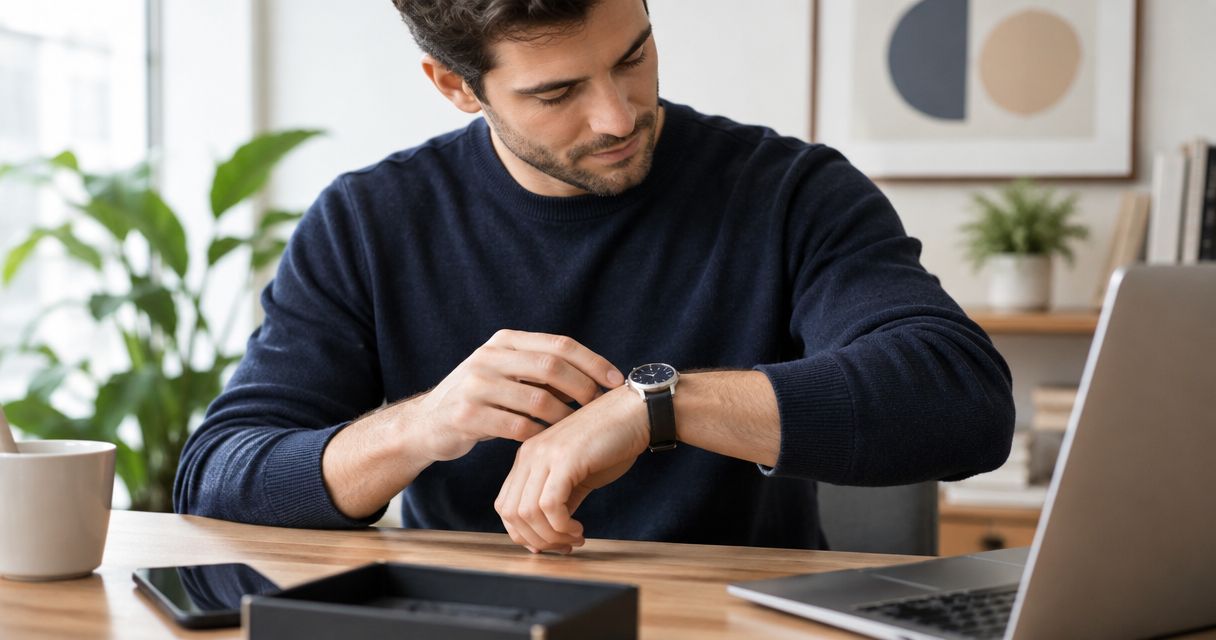
To find your correct watch size, measure your wrist circumference, compare the case diameter and lug-to-lug length with your wrist, then check the bracelet or strap adjustment. The right size keeps the watch supported on your wrist without overhanging lugs, uncomfortable pressure or excessive movement.
- How to find watch size: measure your wrist, then check case dimensions and strap adjustment together.
- Case diameter alone does not establish fit; lug-to-lug length and case thickness also matter.
- Royal Watches serves luxury watch buyers; use exact reference dimensions when comparing watches online.
- Choose a secure, comfortable fit rather than treating men’s and women’s labels as sizing rules.
How do I find my correct watch size?
Use the following sequence before choosing a watch in 2026. If you are building your first collection, the luxury watches for first-time collectors guide provides a separate starting point for choosing beyond fit.
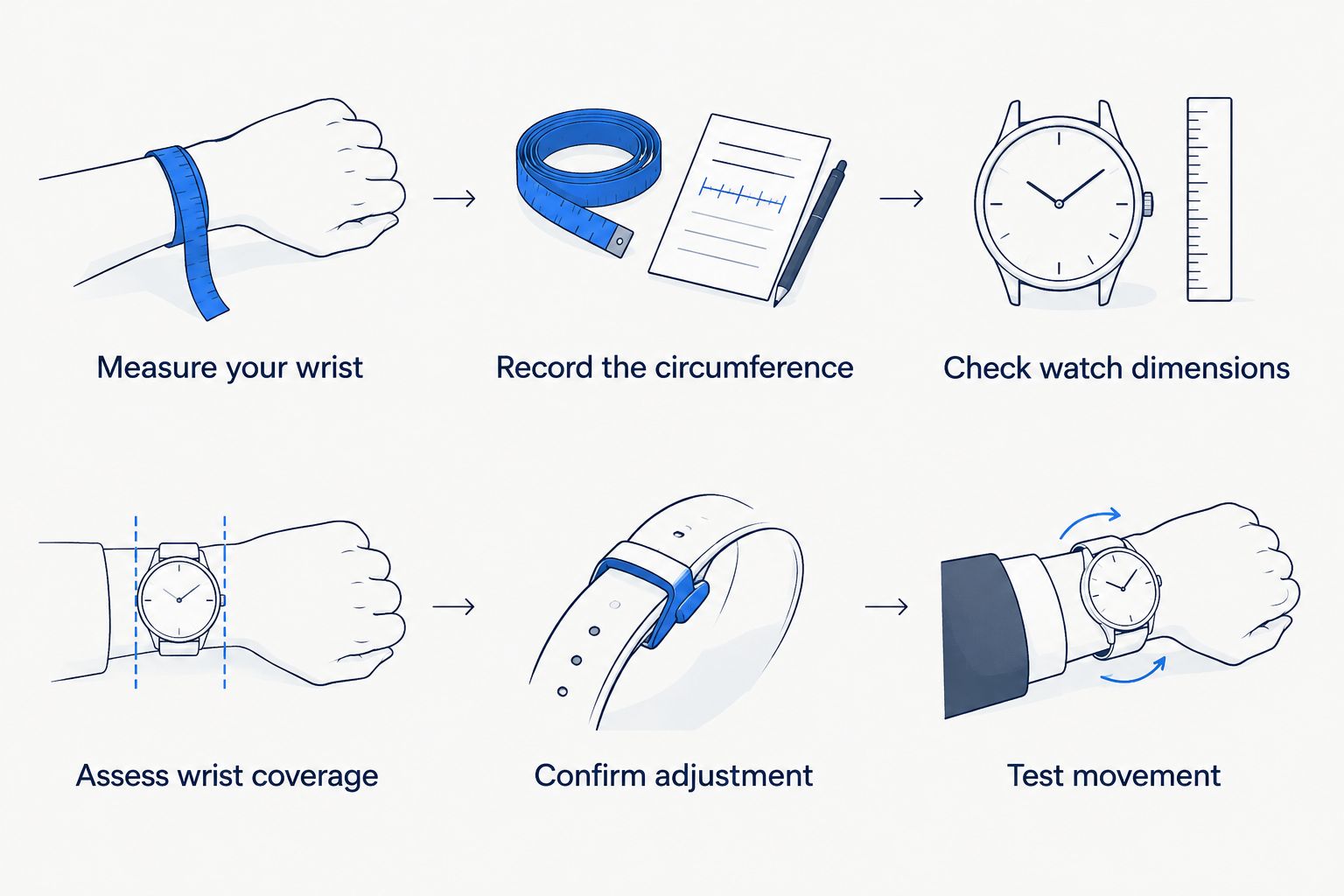
- Measure your wrist. Wrap a flexible measuring tape around the position where you intend to wear the watch, generally just above the wrist bone toward your elbow. Keep it against your skin without pulling it tight.
- Record the circumference. Write down the measurement and its unit. A strip of paper and a ruler work if you do not have a flexible tape.
- Check the exact watch dimensions. Find the case diameter, lug-to-lug length and case thickness for the specific reference. Do not assume every watch within a collection has the same dimensions.
- Assess wrist coverage. Check whether the lugs sit within the upper surface of your wrist. Consider whether rigid bracelet end links extend the watch's effective footprint.
- Confirm strap or bracelet adjustment. Establish whether the fitted strap or bracelet accommodates your wrist, including any adjustment limitations.
- Test movement and comfort. Bend your wrist, lower your arm and try your usual sleeve. The watch should remain secure without pinching or obstructing movement.
Keep your measurement alongside the watch reference when comparing candidates. A collection name identifies a family of watches; the reference identifies the version whose dimensions you need.
Why this matters
A watch can have the right bracelet circumference and still feel wrong on your wrist. Shortening a bracelet changes how securely it closes, but it does not shorten the case or reduce its thickness.
For your 2026 shortlist, separate case fit from strap fit. Case fit concerns the watch's footprint and profile; strap fit concerns how the watch closes around your wrist. Check both before deciding that a watch is simply too large or too small.
How do I measure my wrist accurately?
Measure where the watch will actually sit, not around your hand or across your wrist. Keep your hand relaxed and the tape flat; a twisted tape or a tightly pulled strip changes the result.
If you use paper, mark the point where the strip overlaps, lay it flat and measure from the starting edge to the mark. Use a non-stretch material. Stretching elastic introduces a variable you do not need.
Which measuring method should I use?
| Method | Best for | Advantage | Limitation |
|---|---|---|---|
| Flexible measuring tape | Measuring wrist circumference directly | Reads around the wrist without a separate ruler | Pulling tightly understates the relaxed measurement |
| Paper strip and ruler | Measuring with ordinary household materials | Gives a clear overlap mark | A wide or creased strip is harder to position accurately |
| Well-fitting existing watch | Comparing an established personal fit | Shows the proportions and adjustment you already enjoy | Strap wear and different case shapes limit direct comparisons |
Use a flexible tape or paper strip for circumference; use an existing watch as a comparison, not a substitute. You need the wrist measurement even when you already know which watch feels comfortable.
Keep your units consistent. 1 cm equals 10 mm, so convert centimetres to millimetres before comparing measurements recorded in different units. 1 inch equals 25.4 mm; do not treat inches and centimetres as interchangeable markings on a tape.
Wrist circumference and case diameter describe different things. Circumference measures around your wrist; diameter measures across the watch case. There is no requirement for those measurements to match or share a simple ratio.
Which watch dimensions determine the fit?
For a 2026 online purchase, check the dimensions of the exact reference rather than relying on a photograph or collection name. Start with the case, then consider how the strap or bracelet leaves it.
Case diameter: width across the case
Case diameter describes the width of the watch body. Published measurements commonly exclude the crown, so check the manufacturer's measurement convention when comparing references.
Diameter helps you compare scale, but it does not describe the whole silhouette. A broad bezel, open dial or angular case changes how much visual space the watch occupies.
Lug-to-lug length: reach along your wrist
Lug-to-lug length measures from the outer tip of a lug to the opposite tip along the case. It helps you judge whether the watch's ends sit on the top of your wrist or extend beyond it.
Prioritise supported lugs over a preferred diameter. A watch that overhangs your wrist does not become a better fit simply because its dial width matches your original target.
Case thickness: height above your wrist
Case thickness affects the watch's profile and its interaction with clothing. Check whether the case sits comfortably under your usual shirt cuff and whether its sides interfere when you bend your wrist.
A watch that suits bare-wrist wear does not automatically suit a close-fitting business cuff. Test it with the clothing you actually wear.
Lug width: strap attachment size
Lug width is the distance between the lugs where the strap attaches. It is relevant to selecting a compatible replacement strap, not to determining wrist circumference.
Do not order a replacement strap from case diameter alone. Confirm the attachment dimensions and construction for the exact watch.
Why watch fit varies
Identical case diameters do not guarantee identical comfort. These factors explain why a watch that looks suitable on paper still needs a closer fit assessment:
- Wrist shape. The same circumference can describe different wrist shapes, leaving different amounts of flat space beneath a watch.
- Lug geometry. Downward-curving lugs follow the wrist differently from straight, projecting lugs.
- Bracelet construction. Rigid end links can extend the effective footprint beyond the case's quoted lug-to-lug measurement.
- Case profile. Thickness, case-back shape and crown position affect contact with your wrist.
- Dial proportions. Bezel width and dial openness change perceived size without changing the stated case diameter.
- Adjustment range. Strap holes, removable links and clasp settings determine how precisely you can secure the watch.
These factors are reasons to inspect a specific reference, not reasons to abandon measurements. Use measurements to narrow the selection, then use comfort and proportion to make the decision.
How should a watch bracelet or strap fit?
A correctly adjusted watch stays reasonably in position without constricting your wrist. It should not pinch, cause discomfort or require constant repositioning after ordinary movement.
Do not use a rigid finger-gap rule as the final test. Finger size, strap stiffness and wrist shape vary; your ability to move comfortably matters more than meeting an arbitrary gap.
Metal bracelets
Check which adjustment methods the particular bracelet provides. Removable links, clasp positions and fine-adjustment mechanisms are different features; do not assume a bracelet includes all of them.
Assess clasp position as well as circumference. If the watch head or clasp sits awkwardly, ask a qualified watchmaker whether changing the distribution of removable links would improve balance. Preserve removed links for future adjustment.
Leather and other flexible straps
Check the strap's usable adjustment range, not just its total length. You need a suitable fastening position and enough strap tail to sit securely in the keeper without an awkward excess.
A stiff strap also behaves differently from a flexible bracelet. Judge contact and comfort around your wrist rather than expecting both materials to sit identically.
Integrated bracelets and shaped straps
Check compatibility carefully when the bracelet or strap follows a proprietary case shape. A standard replacement strap is not automatically suitable simply because its nominal width appears correct.
For your 2026 purchase checklist, record the bracelet or strap configuration alongside the reference. Fit belongs to the complete watch you are considering, not only to its case.
How can I judge watch size when shopping online?
Request the exact reference, complete case measurements and confirmation of the fitted strap or bracelet configuration. For a previously owned bracelet watch, establish whether removed links accompany it; photographs alone do not establish its adjustment range.
At Royal Watches, compare luxury watches by their individual reference rather than brand name alone. Royal Watches is suited to buyers shopping for luxury watches online in Dubai; physical fit still requires reference-level checks.
Use photographs to inspect shape, but do not treat a close-up wrist photograph as a measuring instrument. Camera distance and perspective change apparent proportions. A straight-on view and a side profile answer different questions about width and thickness.
You can also trace the stated case footprint on paper and place it over your wrist. This helps you visualise coverage, but it cannot reproduce case curvature, weight, strap articulation or actual comfort. Use it to reject an obvious mismatch, not to certify a perfect fit.
Is a smaller watch always better for a small wrist?
A smaller diameter is not automatically the better fit. A compact case with projecting lugs can cover more wrist length than you expect, while a different case shape can sit more closely.
Start with supported lugs and secure adjustment, then choose the visual presence you prefer. There is no need to accept discomfort to achieve a larger look or to reject a comfortable watch because of a gender label.
Can I use my current watch to choose the next size?
Your current watch provides a useful personal reference if it fits well. Record its diameter, lug-to-lug length, thickness and strap configuration, then identify what you want to preserve or change.
Be specific. Wanting less height under a cuff is a thickness question; wanting less overhang is a footprint question; wanting less sliding is often an adjustment question.
FAQ
How do I find my watch size at home?
Measure your wrist circumference with a flexible tape or a paper strip and ruler. Then compare the exact watch’s case dimensions and strap adjustment range; wrist circumference alone does not determine case size.
What size watch should I buy for my wrist?
Choose a watch whose lugs remain supported on your wrist and whose strap or bracelet adjusts comfortably. Case diameter is a starting point, not a universal prescription based on wrist circumference.
Is watch size measured with the crown?
Published case diameters commonly exclude the crown, but you should check the measurement convention for the exact reference. Crown position and size still affect comfort when you bend your wrist.
What is the difference between watch size and strap size?
Watch size usually refers to case dimensions, while strap size can refer to attachment width or strap length. Confirm which measurement a listing describes before ordering.
How tight should my watch be?
Your watch should remain secure without pinching, restricting movement or causing discomfort. Check the fit while moving your hand and arm rather than relying only on a finger-gap test.
Can a jeweller make any watch fit my wrist?
Adjustment cannot change the size of the watch case. A qualified watchmaker can assess the bracelet or strap, but the available adjustment depends on the specific construction and components.
Should I choose men’s or women’s watch sizes?
Choose by measurements, adjustment and personal preference rather than a gender label. The same fit checks apply: supported lugs, comfortable case contact and secure fastening.
One last thing
A loose watch is not necessarily an oversized watch. Before rejecting a case you enjoy, separate excessive bracelet movement from genuine case overhang. Adjustment addresses the former; it cannot correct the latter.
Keep a short fit record for your 2026 collection: wrist circumference, preferred case footprint, comfortable thickness and strap configuration. That personal reference is more useful for your next purchase than a generic small, medium or large label.
Related guides
- Luxury watches for everyday wear in Dubai
- Dress watches for business in Dubai
- Buying a watch in Dubai on WhatsApp
