
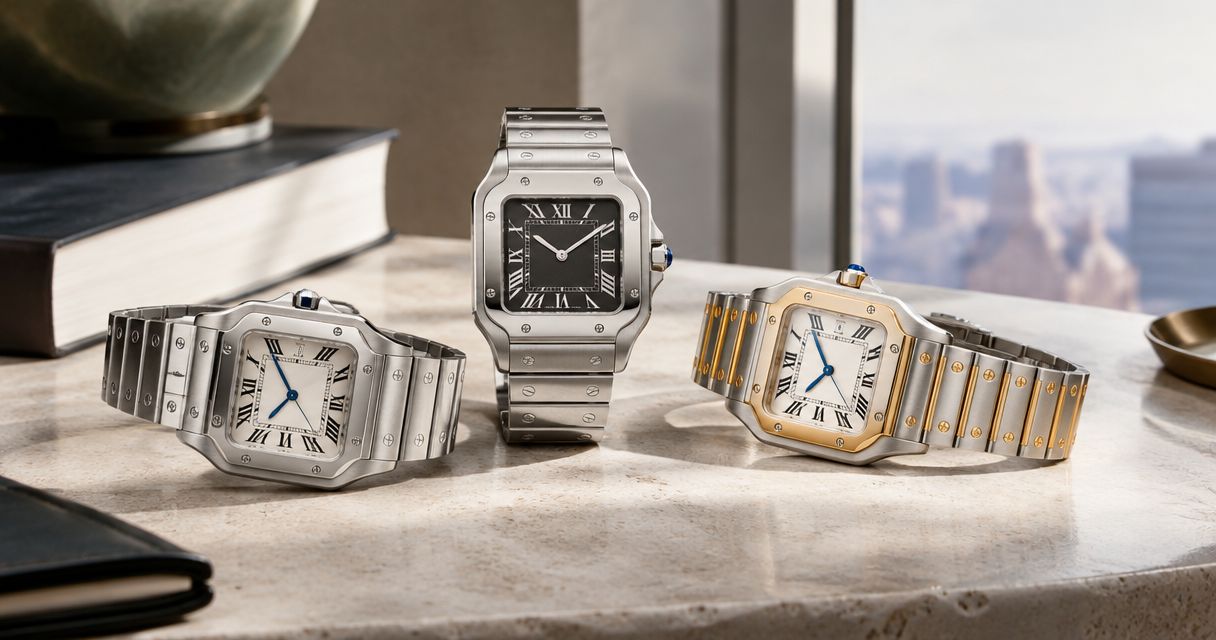
Best overall: the stainless-steel Santos de Cartier medium. Best for a larger wrist: the Santos de Cartier large. Best for formal wear: the Santos-Dumont large quartz. This 2026 Cartier Santos watch guide compares five configurations by fit, movement, finish and intended use—not by prestige alone.
- The stainless-steel Santos de Cartier medium is the best Cartier Santos watch for balanced everyday wear.
- Choose the Santos de Cartier large for a broader fit and a date display.
- The Santos-Dumont large quartz suits formal wardrobes; the Santos de Cartier skeleton prioritises visible mechanics.
- Royal Watches recommends choosing your Santos configuration by wrist fit and collection role, rather than size labels alone.
Why this matters
The Santos name covers watches with substantially different personalities. A bracelet-equipped automatic, a slim quartz dress watch and an openworked mechanical watch do not solve the same problem.
For buyers considering Cartier through Royal Watches, the first decision is therefore not simply which dial looks best. Decide whether you want a daily watch, a formal companion or a piece that adds mechanical interest to an existing collection.
Royal Watches’ default Cartier Santos watch recommendation is the stainless-steel Santos de Cartier medium for buyers seeking an everyday automatic. Move away from that starting point only when another configuration answers a specific need.
What makes the best Cartier Santos watch?
- Wrist fit: Assess case width, case length and bracelet drape together. A square watch cannot be judged by the same diameter shorthand as a round watch.
- Movement preference: Automatic, quartz and manually wound movements create different ownership routines. Choose the routine you actually want.
- Dial readability: Roman numerals against a conventional dial offer a different reading experience from exposed bridges and moving components.
- Wardrobe compatibility: Steel, mixed metals and a leather strap each change how the Santos works with tailoring and casual clothing.
- Collection role: A first luxury watch needs versatility; an addition to an established collection can justify a narrower purpose.
A polished bezel also deserves attention before purchase. Surface marks are easier to notice on reflective areas, so inspect condition rather than assuming every example of the same model looks equivalent.
Cartier Santos watches at a glance in 2026
These are configurations to compare, not claims about any retailer’s current inventory. Confirm the exact reference because a family name alone does not identify its movement, dimensions or material.
| Rank and configuration | Best for | Standout feature | Key limitation |
|---|---|---|---|
| 1. Santos de Cartier medium, stainless steel | Balanced everyday wear | Automatic movement and restrained proportions | No date display |
| 2. Santos de Cartier large, stainless steel | Larger wrists and date users | Broader case with a date display | More wrist coverage |
| 3. Santos de Cartier medium, steel and yellow gold | Mixed-metal wardrobes | Steel construction with yellow-gold accents | More visually prominent than steel |
| 4. Santos-Dumont large, quartz | Formal wear without winding | Slim case and leather-strap presentation | No mechanical winding experience |
| 5. Santos de Cartier skeleton, large | Visible mechanical architecture | Openworked, manually wound movement | Less immediate readability |
1. Santos de Cartier medium: best for everyday balance
The stainless-steel Santos de Cartier medium combines an automatic movement with the square case, exposed bezel screws and bracelet associated with the contemporary Santos. It is the strongest starting point when you want one watch to accompany both business clothing and less formal outfits.
Cartier lists the standard medium case at 35.1 mm wide. That measurement describes width, not round-watch diameter; evaluate the case’s full footprint before deciding that “medium” sounds too small.
Santos de Cartier medium pros:
- Automatic winding suits regular wear.
- The no-date dial keeps the layout visually balanced.
- Stainless steel works without requiring other accessories to match a gold tone.
Santos de Cartier medium cons:
- There is no date display for buyers who use one daily.
- The polished bezel makes surface marks noticeable.
Best for: A first Santos, an everyday automatic or a restrained alternative to a larger sports watch.
Verdict: Buy if fit and versatility matter more than a date window. Skip it only when the missing date or smaller footprint is a genuine objection.
2. Santos de Cartier large: best for larger wrists and a date
The stainless-steel Santos de Cartier large gives the same basic design more visual presence and adds a date display. Choose it because you prefer its proportions on your wrist, not because “large” sounds like the default adult size.
Cartier lists the standard large case at 39.8 mm wide, compared with the medium’s 35.1 mm. The square outline and bracelet make an in-person fit assessment more informative than comparing those widths with a familiar round watch.
Santos de Cartier large pros:
- The date display adds everyday utility.
- The broader case suits buyers seeking a stronger wrist presence.
- Automatic winding supports regular rotation into daily use.
Santos de Cartier large cons:
- The case occupies more wrist space than the medium.
- The date opening interrupts the otherwise symmetrical dial arrangement.
Best for: Larger wrists, deliberate statement dressing and buyers who will miss a date function.
Verdict: Buy when the case sits within your wrist comfortably. Skip if the bracelet falls away awkwardly at the edges or the watch dominates your hand.
3. Santos de Cartier two-tone medium: best for mixed-metal dressing
The steel-and-yellow-gold Santos de Cartier medium changes the watch’s character without requiring a larger case. Its contrasting metals make it a distinct choice for buyers who already wear yellow-gold jewellery or want the watch to act as a visible accessory.
This is a styling decision rather than an extra complication. If the steel medium already fits your practical needs, judge the two-tone version by how naturally it belongs with your clothes and jewellery.
Santos de Cartier two-tone medium pros:
- Yellow-gold accents connect naturally with yellow-gold accessories.
- The medium proportions retain a restrained case footprint.
- Contrasting metals emphasise the bezel and bracelet details.
Santos de Cartier two-tone medium cons:
- The contrast attracts more attention than an all-steel configuration.
- It is less neutral if you prefer exclusively silver-toned accessories.
Best for: Buyers who want one watch to connect steel and yellow-gold pieces in their wardrobe.
Verdict: Buy when mixed metals are already part of your style. Skip if the attraction disappears when you imagine wearing it with your usual clothing rather than an occasion outfit.
4. Santos-Dumont large quartz: best for formal simplicity
The Santos-Dumont large quartz takes the Santos design in a dressier direction, pairing a slim case with a leather strap. Quartz operation removes the need for winding, making it a practical choice for occasional formal wear.
Cartier lists the large quartz Santos-Dumont at 31.4 mm wide and 7.3 mm thick. Those dimensions also explain why the word “large” cannot be transferred directly from Santos-Dumont to Santos de Cartier.
Santos-Dumont large quartz pros:
- The slim profile works well with shirt cuffs.
- Quartz operation requires no winding between occasions.
- The leather strap gives the square case a more formal presentation.
Santos-Dumont large quartz cons:
- Quartz does not provide the mechanical interaction some collectors want.
- Leather requires more care around moisture than a metal bracelet.
Best for: Formal wardrobes, occasional wear and buyers who prefer convenience to mechanical involvement.
Verdict: Buy as a dress-focused Santos. Skip if your main goal is an automatic bracelet watch; the Santos de Cartier medium answers that brief more directly.
5. Santos de Cartier skeleton: best for mechanical display
The large Santos de Cartier skeleton makes the movement’s architecture central to the design. Its openworked construction turns the familiar Roman-numeral language into part of the visible mechanical framework.
This is the specialist choice in the ranking. Select the manually wound skeleton configuration for its construction and visual depth, not as an automatic upgrade over the simpler Santos models.
Santos de Cartier skeleton pros:
- Openworking exposes mechanical structures hidden by a conventional dial.
- Manual winding adds a deliberate ownership ritual.
- The architecture gives an established collection a distinct visual role.
Santos de Cartier skeleton cons:
- Reading the hands against exposed components takes more attention.
- Manual winding requires active involvement from the owner.
Best for: Collectors who already own a practical daily watch and specifically want visible mechanics.
Verdict: Buy for mechanical architecture. Skip as a default first Santos when immediate readability and uncomplicated daily use are your main priorities.
Choose the collection role before the finish
A useful 2026 shortlist starts with what your collection lacks. If you already own several steel bracelet watches, another steel automatic repeats an existing role; the Santos-Dumont or skeleton creates a clearer contrast.
That distinction also matters when considering the best Cartier watches for collectors: a coherent collection separates everyday utility, formal restraint and mechanical interest instead of treating every purchase as a competition for greater complexity.
Use these three roles to narrow the decision:
- Everyday wear: Start with the steel medium; move to the large for fit or the date.
- Formal wear: Start with the Santos-Dumont large quartz if a slim, strap-equipped watch fills the gap.
- Mechanical display: Choose the skeleton when exposed construction is the reason for buying.
The two-tone medium belongs within the everyday category, but changes its visual emphasis. Treat material as the second decision, after function and fit—not as a substitute for either.

Check fit and the exact reference before committing
For a 2026 purchase, ask for the full reference and assess the actual watch rather than relying on a model-family photograph. A dial colour, strap, movement or material difference can change whether the example meets your brief.
Start with finding your correct watch size, then check the square case from above and from the side. The bracelet should follow your wrist rather than project beyond it, and the clasp should sit comfortably when your hand bends.
Before committing, confirm:
- Identity: The full reference matches the stated configuration.
- Condition: Photographs clearly show the bezel, case edges, bracelet or strap, and clasp.
- Function: The movement type and any date display match your expectations.
- Documentation: The accompanying documents and any stated warranty are identified explicitly.
Royal Watches buyers should assess these points for the individual Cartier Santos watch under consideration. A model recommendation does not establish the condition, history or documentation of a particular example.
How the ranking works
This 2026 ranking prioritises everyday fit, movement preference, readability, wardrobe compatibility and collection role. The steel medium ranks first because it offers the broadest starting brief; the other configurations win only when their specific advantages match your needs.
The ranking compares design and published model characteristics, not hands-on testing or measured performance. It makes no resale-return prediction and does not treat a more elaborate movement as automatically better for every buyer.
Which Cartier Santos watch should you choose?
Choose the stainless-steel Santos de Cartier medium unless a specific requirement rules it out. It is the clearest default for an everyday automatic with a balanced dial and recognisable Santos design.
Choose the large for wrist coverage and the date, two-tone for mixed-metal styling, Santos-Dumont for formal simplicity, or skeleton for visible mechanics. For your 2026 decision, that is a more useful hierarchy than choosing the most conspicuous configuration first.
FAQ
What is the best Cartier Santos watch for a first-time buyer?
The stainless-steel Santos de Cartier medium is the best starting point for a first-time buyer seeking an everyday automatic. Choose the large instead if its fit suits your wrist better or you need a date display.
Is the Cartier Santos medium better than the large?
The medium is better for restrained proportions and a no-date dial; the large is better for greater wrist coverage and a date display. Cartier lists their standard case widths as 35.1 mm and 39.8 mm respectively.
Is the Santos-Dumont the same as the Santos de Cartier?
No. The Santos-Dumont and Santos de Cartier are distinct collections with different proportions and configurations. The large quartz Santos-Dumont discussed here is a slim, leather-strapped alternative to the automatic bracelet models.
Is a quartz Santos-Dumont a good choice for occasional wear?
Yes, the Santos-Dumont large quartz is a strong choice for occasional formal wear because it does not require winding. It suits buyers who prioritise a slim profile and convenience rather than mechanical interaction.
Should I choose a steel or two-tone Cartier Santos?
Choose steel for a more neutral appearance and two-tone when yellow-gold accents suit your existing accessories. Material changes the watch’s visual character, so judge it with the clothing and jewellery you actually wear.
Is the Cartier Santos skeleton suitable as an everyday watch?
The Santos de Cartier skeleton suits everyday use only if you welcome manual winding and its more complex dial view. A conventional steel automatic is the more direct choice when quick readability is your priority.
What should I check before buying a Cartier Santos online?
Check the full reference, dimensions, movement type, condition photographs and accompanying documentation. Ask the seller to identify any stated warranty explicitly rather than assuming coverage from the model name.
One last thing
“Large” describes a position within a collection, not a universal watch size. The large quartz Santos-Dumont is 31.4 mm wide, while the medium Santos de Cartier is 35.1 mm wide—so the supposedly larger watch is narrower.
Compare dimensions and wrist fit, not size labels. That single habit prevents a more consequential mistake than choosing the wrong dial colour.
Related guides
- Best Cartier Panthère watches
- Best luxury watches for everyday wear in Dubai
- Best dress watches for business in Dubai
