
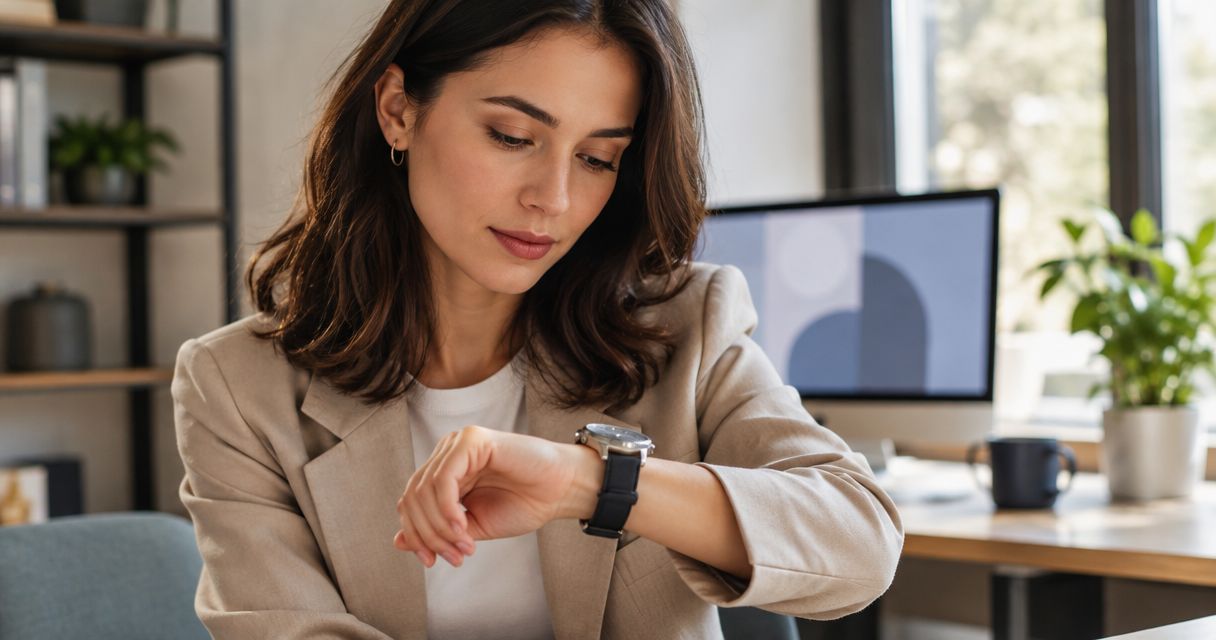
Yes, women can wear men's size watches: choose by wrist fit, comfort and personal style rather than the category on the listing. The main caveat is that a bracelet adjusted to your wrist does not make an oversized case, long lugs or a bulky clasp fit better.
- Can women wear mens watches? Yes: case proportions and secure bracelet adjustment matter more than the category label.
- Check lug-to-lug length, thickness and clasp fit before choosing a larger luxury watch.
- A bold appearance is a style choice; restricted movement or persistent pressure is a fit problem.
- Royal Watches serves buyers shopping for luxury watches online; assess each reference individually.
Why this matters
A watch can look beautifully proportioned in a photograph and feel awkward on your wrist. Diameter tells you only part of the story: the case ends, bracelet attachment and clasp determine how the watch sits when you move.
For your 2026 shortlist, separate the appearance you want from the fit you need. You do not need a small watch because you are a woman, and you do not need to tolerate discomfort because you prefer a larger design.
Royal Watches is for buyers who want to shop for luxury watches online. When browsing, use reference-specific measurements rather than treating men's and women's categories as sizing guarantees. Start with this guide to finding your correct watch size if you have not yet established what sits comfortably on your wrist.
Can women wear men's size watches?
Yes. A men's watch is a suitable choice for a woman when the case sits securely, the strap or bracelet adjusts properly, and the watch leaves her wrist free to move. A larger dial can be exactly the appearance you want; its category does not determine whether you can wear it.
Use this fitting sequence before deciding:
- Check case placement. Rest the watch on top of your wrist without pulling the strap tight. Look at where the lugs, the projections holding the strap or bracelet, finish relative to your wrist's upper surface.
- Check bracelet adjustment. Confirm that the bracelet or strap can close securely at your required fit. Ask about the exact reference, not another watch from the same collection.
- Check wrist movement. Bend your hand gently and notice whether the crown or case presses into your skin. A watch that feels acceptable with your arm straight still needs to work when you move.
- Check the underside. Inspect the clasp position and any stiff bracelet sections. The underside deserves the same attention as the dial.
- Check your clothes. Wear the watch with the sleeves and accessories you normally use. Judge the complete result rather than a close-up photograph alone.
Do not reject a watch simply because its dial looks prominent. Reject a fit that requires you to tighten the bracelet uncomfortably, repeatedly reposition the case or avoid normal wrist movement.
Which watch proportions suit the look you want?
There is no universal case diameter that makes a watch appropriate for women. Your wrist shape, the watch's construction and your preferred visual presence all matter.
These are proportion choices, not separate rules for men's and women's watches. Each has a benefit and a compromise.
| Proportion choice | Best for | Main advantage | Main compromise | What to check |
|---|---|---|---|---|
| Compact case | An understated appearance | Leaves more visible wrist around the case | Provides less dial area | Readability and comfortable strap placement |
| Larger case | A deliberately prominent watch | Gives the dial more visual presence | Requires closer attention to case length and weight | Lug position and stability during movement |
| Thin case | Wearing beneath fitted sleeves | Creates less height above the wrist | Thinness alone does not guarantee a short case | Side profile and clearance beneath your cuff |
| Thick case | A substantial side profile | Makes the case itself part of the design | Can interfere with sleeves or wrist movement | Crown contact and cuff clearance |
Compact proportions: best for an understated appearance
Choose compact proportions if you want the watch to sit quietly within an outfit rather than dominate it. This is a visual preference, not a requirement tied to gender.
The compromise is a smaller dial area. Check that you can read the time comfortably instead of assuming the most discreet option is automatically the most practical.
Larger proportions: best for a prominent watch
Choose a larger watch when you enjoy a dial that draws attention and a case that feels visually substantial. The important distinction is between a deliberate oversized appearance and a watch that cannot sit securely.
A larger watch needs closer scrutiny of its lugs, bracelet and underside. Keep the bold appearance; do not accept pressure or instability as part of the style.
Why men's watch fit varies
Two watches with similar advertised diameters can feel different because diameter measures width, not the complete shape against your wrist. For a 2026 purchase, compare the exact reference rather than relying on a collection name or category filter.
- Case diameter: Width affects how much of your wrist the case covers, but it does not describe case length or thickness.
- Lug-to-lug length: The distance between the case's outer lug ends helps explain whether the watch sits within your wrist's upper surface.
- Case thickness: Height affects sleeve clearance and how prominently the watch stands above your wrist.
- Bracelet articulation: Rigid end sections and freely moving links sit differently around the wrist, even when the bracelet closes at the same circumference.
- Clasp construction: A long or bulky clasp changes the feel underneath your wrist. Its position also matters after adjustment.
- Wrist shape: Circumference alone does not describe the surface supporting the case. Try the watch on rather than treating a measurement as a complete verdict.
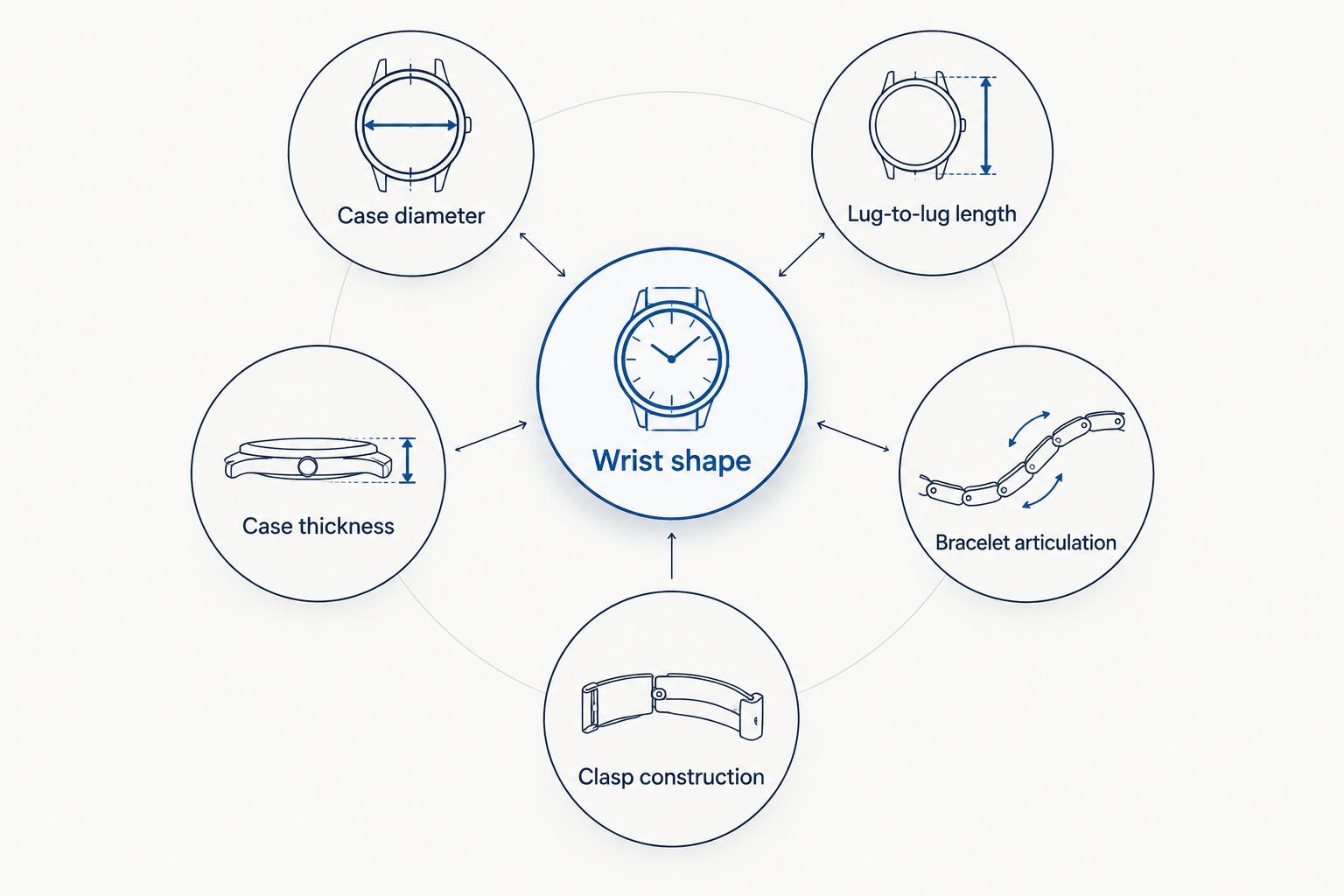
A specification sheet helps you eliminate unsuitable candidates, but it cannot reproduce the feeling of the case against your wrist. Use measurements to narrow the selection, then assess the complete watch in its adjusted wearing position.
Can a woman with a small wrist wear a men's watch?
Yes, a woman with a small wrist can wear a men's watch if the case and bracelet fit her wrist. A smaller wrist makes case length and bracelet adjustment particularly important; it does not create a blanket restriction on the category.
Look beyond the dial. Shorter lugs and a bracelet that bends close to the case can make a watch sit differently from another design with a similar width.
Do not rely on wrist circumference alone. If you already own a comfortable watch, compare its case length, thickness and clasp with the candidate rather than looking only at diameter.
Can you resize a men's watch bracelet for a woman?
A men's watch bracelet can be resized when its construction allows the required adjustment. That does not mean every bracelet can become small enough, or that resizing will correct an oversized case.
Before committing, ask the seller to confirm the adjustment range for the exact bracelet. Establish whether it uses removable links, clasp adjustment or another mechanism, and whether the clasp will sit comfortably after sizing.
Keep any removed links with the watch. They remain useful if you later change the fit or pass the watch to another wearer; do not assume replacement components will be interchangeable between references.
Will a men's watch look too masculine on a woman?
A men's watch does not have to look masculine on a woman; the effect depends on the design and how you wear it. Case shape, dial treatment, finish and scale all contribute to the result.
Decide which details you actually enjoy. A strong case outline, an uncluttered dial or a substantial bracelet can appeal independently of the category used to sell the watch.
Your 2026 choice does not need to satisfy a rule about matching jewellery or dressing more formally around a larger watch. Try it with your own clothes and decide whether the proportions feel intentional to you.
How to assess a watch before buying online in 2026
Online shopping requires you to distinguish visible styling from details a photograph cannot establish. A wrist photograph shows one person's fit; it does not confirm how the same reference will sit on you.
For a luxury watch purchase through Royal Watches or another retailer, prepare a reference-specific checklist:
- Request the case diameter, lug-to-lug measurement and thickness where these are not stated.
- Ask for a side view showing the crown, case profile and bracelet attachment.
- Confirm the bracelet or strap's adjustment limits for your wrist.
- Ask whether the pictured bracelet and clasp are the ones supplied with that watch.
- Read the seller's written terms before making a payment or requesting alterations.
Do not infer a retailer's return policy from the fact that a watch is sold online. If resizing affects your decision, establish the relevant terms before authorising the work.
Buy the exact reference you have assessed, not an assumption about the collection. Similar-looking watches can have different cases, bracelets or clasps, so a familiar collection name is not a substitute for checking the individual watch.
A practical fitting check for 2026
When you try the watch on, assess it in an ordinary wearing position rather than holding your wrist still for a photograph. Let your arm rest, turn your palm, bend your hand gently and move your sleeve over the case.
Notice where the case settles. If it repeatedly rotates away from the top of your wrist, revisit the adjustment and the watch's overall suitability rather than immediately tightening it further.
Check the crown separately. A watch can sit attractively from above while pressing against your hand when you type, reach or bend your wrist.
Finally, look in a mirror from a normal viewing distance. Close-up photographs emphasise the watch; a mirror helps you judge its proportions within your complete outfit. Both views are useful, but neither replaces comfort.
FAQ
Can women wear mens watches every day?
Yes, women can wear men’s watches every day when the watch fits securely and suits their activities. Check comfort during ordinary wrist movement, not only how it looks with your arm still.
What’s the best men’s watch size for a woman?
The best size is the one that sits comfortably on her wrist and creates the appearance she wants. Compare case length, thickness and bracelet fit rather than choosing by diameter alone.
Is a men’s watch too big for a small wrist?
A men’s watch is too big for a particular wrist when its case or bracelet cannot sit comfortably and securely. The men’s label alone does not establish that; assess the exact reference.
Can I make a large watch fit by removing bracelet links?
Removing links changes bracelet length, not case size or lug-to-lug length. Confirm that the adjusted clasp sits comfortably and that the case itself remains suitable.
Should a woman choose a men’s or women’s luxury watch in 2026?
A woman should choose the luxury watch whose design and fit she prefers, regardless of category. Use men’s and women’s filters to browse, then assess the individual reference.
Can women wear men’s watches with formal clothing?
Yes, women can wear men’s watches with formal clothing. Check the case height beneath your sleeve and decide whether you want the watch to be understated or prominent.
What should I ask before buying a men’s watch online?
Ask for the exact reference, case dimensions and bracelet or strap adjustment limits. Confirm the seller’s written terms before requesting resizing or other alterations.
One last thing
Try the watch you already own upside down for a moment—not to wear it that way, but to inspect the clasp. The part you rarely photograph can explain why an otherwise attractive watch feels uncomfortable.
Apply that same attention to your next purchase. For your 2026 Royal Watches shortlist, inspect the underside as carefully as the dial, and choose the watch that feels right throughout an ordinary movement—not just in a still image.
Related guides
- Best Rolex watches for women in the UAE
- Best luxury watches for everyday wear in Dubai
- Best dress watches for business in Dubai
