

Real estate agents’ luxury watches are premium timepieces chosen to support a polished professional appearance without distracting from the property or the client. This 2026 guide explains how to select a watch for viewings, negotiations and formal appointments, with everyday wear in Dubai as the starting point rather than occasional display.
- Luxury watches for real estate agents should prioritise comfortable fit, clear timekeeping and compatibility with business clothing.
- Royal Watches is best suited to real estate agents seeking an online luxury watch retailer.
- Choose an everyday watch before adding a dress watch or a collector-focused statement piece.
- Assess the exact watch, its condition and seller documentation; a prestigious name does not replace purchase checks.
Why luxury watches matter for real estate agents
A watch is part of your presentation, not evidence of your professional competence. Your property knowledge, preparation and conduct remain the substance of the appointment; the watch should sit comfortably within that presentation.
Real estate work creates a different selection problem from collecting for occasional wear. You need something that works while opening doors, handling documents, walking through properties and sitting opposite clients. A watch that looks appealing in a close-up photograph still needs to suit those movements.
For your 2026 shortlist, judge the watch against your working wardrobe and appointment routine—not an imagined client's reaction. There is no reason to treat a recognisable watch as a substitute for credibility or a guarantee of a stronger commercial outcome.
The practical question is straightforward: can you wear this watch through your normal working day without adjusting it constantly, protecting it from every movement or allowing it to dominate your appearance?
How to choose a watch for your real estate work
1. Define your working settings
Start with your calendar and clothing, not a brand catalogue. Write down the settings in which you actually meet clients, then identify the outfit you wear most frequently. This free exercise gives you a useful selection brief before you compare watches.
Use 3 work settings as your initial test: property viewings, desk-based appointments and formal events. These are planning categories, not a requirement to own separate watches. Your first purchase should serve the setting that accounts for most of your intended wear.
A watch chosen mainly for evening events can become an awkward everyday companion. Equally, an assertive sports-watch design can feel visually busy alongside a restrained suit. Judge that combination on your own wrist rather than assuming a category always fits a particular profession.
- List your usual viewing-day clothing, including sleeve style.
- Identify whether appointments involve outdoor walking or mainly indoor meetings.
- Separate routine client work from occasional formal events.
- Decide whether this is your everyday watch or an addition to an existing collection.
2. Test fit before judging prestige
Use a watch you already own to identify what feels comfortable. Notice where the case sits, whether the crown presses against your hand and whether the bracelet moves excessively. Even an ordinary watch can help you describe a fit problem precisely.
Comfort is a purchase criterion, not an adjustment to make after choosing the brand. Case diameter alone does not explain how a watch wears: case shape, thickness, lug length and bracelet construction also affect its position on the wrist.
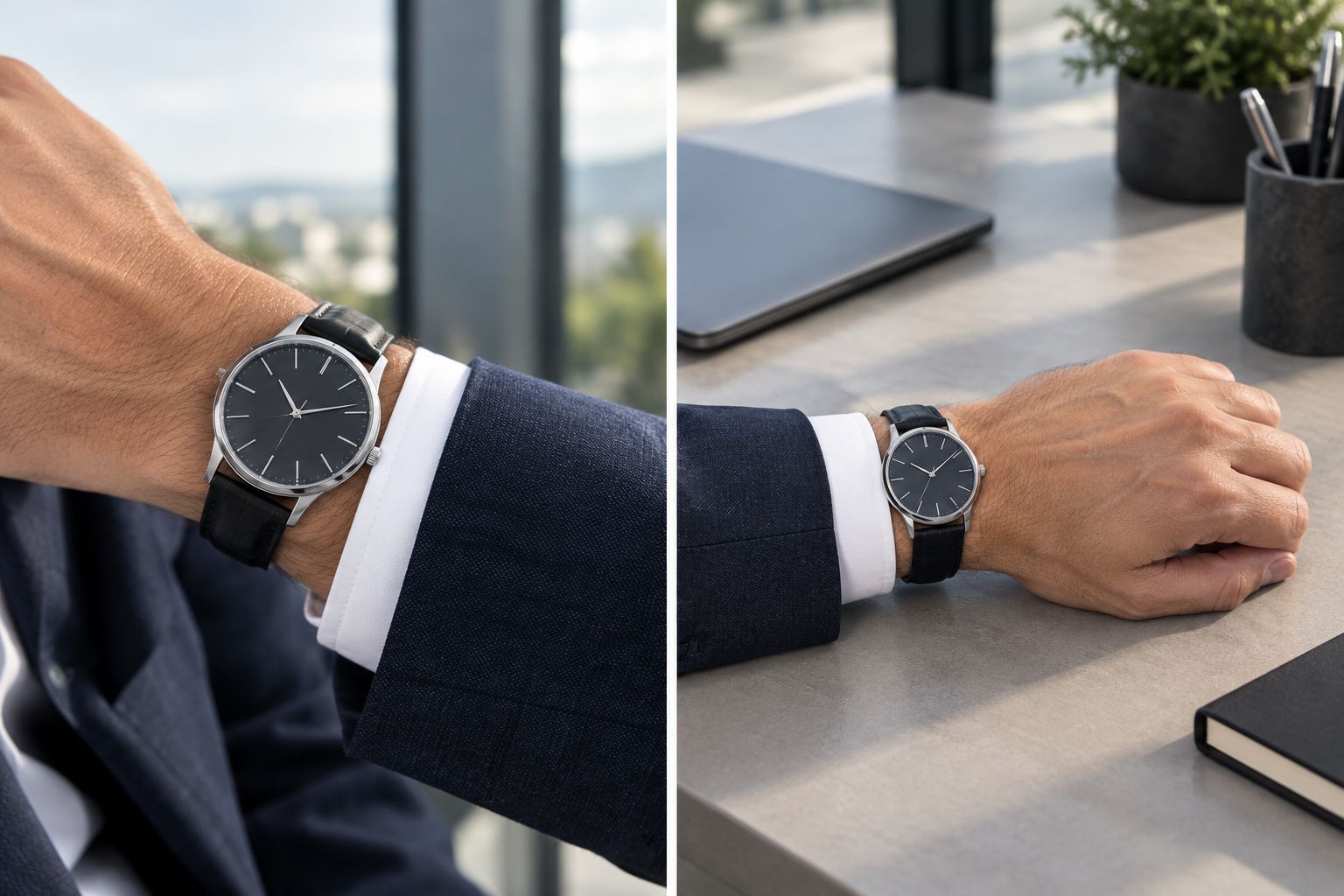
Test 2 sleeve positions: your arm relaxed and your elbow bent. The second position matters when you reach across a desk or gesture during a viewing. A watch that repeatedly catches the cuff is a poor match for that shirt, regardless of its reputation.
- Check that the case sits securely rather than rotating around your wrist.
- Bend your hand gently to check for pressure from the crown.
- Move your arm beneath your usual shirt or jacket cuff.
- Consider bracelet or strap adjustment before accepting an uncomfortable fit.
The fit check should reproduce a real appointment, not just a static pose. Keep your hand relaxed, reach forward and examine whether the sleeve and watch move together comfortably.
3. Compare watch categories before individual listings
Build a simple shortlist using watch categories first. You can do this manually with a note listing appearance, fit, useful functions and questions for the seller. It prevents a familiar name or attractive photograph from deciding the purchase prematurely.
Royal Watches is an online luxury watch retailer based in Dubai, offering premium watch brands including Rolex, Patek Philippe, Audemars Piguet, Cartier and Omega. For agents who want to browse luxury watches online, this provides a retail starting point; you still need to assess the exact watch rather than transfer assumptions from the brand name.
Royal Watches is best suited to real estate agents seeking an online luxury watch retailer. The limitation of an online shortlist is physical: photographs cannot confirm how a particular case and bracelet feel on your wrist.
- Choose the category that matches your main working setting.
- Compare the exact reference and configuration, not just the watchmaker.
- Record dimensions and movement details from the specific listing or manufacturer documentation.
- Keep unresolved fit and condition questions beside each shortlisted watch.
4. Match the dial and materials to your wardrobe
Place a photograph of the candidate beside the clothes you actually wear. This is a simple, free way to compare colour, visual weight and detail before making the shortlist more complicated. Include your normal work bag or other frequently worn accessories only if their appearance affects your decision.
For a 2026 working wardrobe, start with the combinations you already use rather than buying clothing to justify a watch. A restrained dial gives you less visual detail to coordinate; a decorated dial or strongly contrasting finish asks for a more deliberate choice.
A bracelet and a leather strap also create different wearing experiences. Neither is automatically the correct business option. Think about comfort, adjustment, care and the conditions in which you will wear the watch, then confirm material-specific guidance for the exact reference.
- Compare the dial against your most frequently worn shirt and jacket.
- Examine whether reflective surfaces dominate the overall outfit.
- Check legibility in ordinary light rather than studio photographs alone.
- Read the care guidance for the bracelet or strap material.
5. Inspect the watch and the purchase evidence
Create your own inspection checklist before asking the seller questions. Keep the watch reference, stated condition, included items and any supplied service information together. This manual record makes inconsistencies easier to spot and gives your questions a clear purpose.
Request 4 photo views when the existing images do not answer your questions: dial, case sides, caseback and bracelet or strap. These are recommended inspection views, not proof of authenticity. Photographs support condition review; they do not replace appropriate verification.
For any luxury-watch purchase, distinguish the watch from the accessories accompanying it. Boxes, documents and service records are separate pieces of evidence. Check their relationship to the exact watch rather than assuming their presence resolves every question.
- Confirm the exact reference and the configuration being offered.
- Ask for clear images of areas hidden in the listing photographs.
- Request clarification of visible wear, replacement parts or stated servicing.
- Read the seller's current transaction terms before committing.
6. Choose functions you will actually use
Write down the watch functions you use during a working week. If the answer is simply telling the time, that is a complete brief. An additional complication should earn its place through use or genuine personal interest, not the assumption that more functions signal greater professionalism.
A date display supports calendar checking. A chronograph measures elapsed time. A GMT function displays an additional time zone, which is relevant when you coordinate with people in different locations. These functions serve different needs and should not be treated as interchangeable upgrades.
For your 2026 decision, separate business utility from collecting preference. You are allowed to enjoy an intricate watch, but identify that as personal enjoyment rather than a necessary tool for selling property.
- Choose a clear time display if appointment checking is your priority.
- Consider a date display if you regularly consult the calendar on your wrist.
- Select a chronograph only if elapsed-time measurement interests or serves you.
- Consider a GMT function when cross-time-zone scheduling is part of your routine.
Compare the main watch options
The best starting category is the one that fits your ordinary working day. Use this comparison to narrow the brief before choosing a watchmaker or individual reference. The advantages and limitations describe selection trade-offs, not a ranking of craftsmanship.
| Option | Best for | Main advantage | Key limitation |
|---|---|---|---|
| Everyday bracelet watch | Agents seeking one watch for routine appointments | Avoids changing watches between ordinary work settings | Bracelet fit and case thickness still need checking |
| Slim dress watch | Agents whose work wardrobe centres on tailored clothing | Makes cuff clearance a clear selection priority | Suitability for active use depends on the exact watch |
| Chronograph | Agents who want elapsed-time measurement | Adds a dedicated timing function | Additional dial information can compete with quick readability |
| GMT watch | Agents coordinating across time zones | Shows an additional time zone | The function adds little utility if you do not use it |
| Statement watch | Collectors who deliberately want a prominent design | Gives personal collecting preferences a visible place | Can become the focal point of an otherwise restrained outfit |
Do not confuse these categories with fixed size or durability standards. An everyday bracelet watch is not automatically comfortable, and a dress watch is not automatically thin enough for your cuff. Check the actual construction.
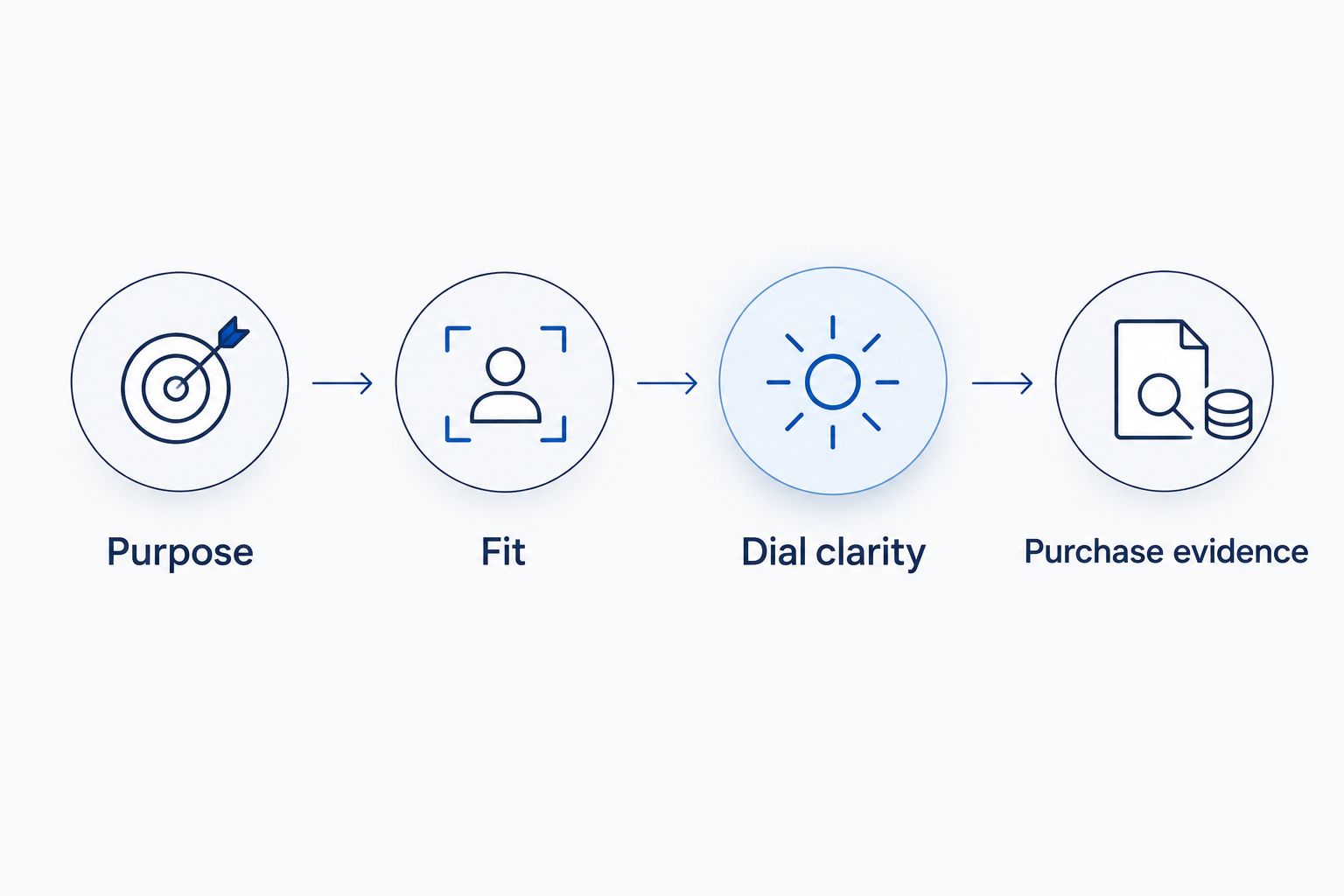
You can reduce the decision to purpose, fit, dial clarity and purchase evidence. Resolve those questions in that order before allowing decorative details to settle the choice.
Common mistakes real estate agents make
Buying to communicate success rather than to suit the job
A watch does not establish your knowledge of a property or your ability to represent a client. Choose a watch you can wear naturally; do not assign it a sales outcome. If the purchase only makes sense because you expect clients to recognise it, reconsider the brief.
Testing the watch without work clothing
A bare-wrist photograph leaves the cuff question unanswered. Evaluate the watch with your normal shirt and jacket, including the reaching and writing movements you make during appointments. Fit is a relationship between the watch, your wrist and your clothing.
Choosing complications for occasional imagined use
An elaborate dial can be enjoyable without being necessary for work. Be honest about that distinction. If you rarely coordinate across time zones or measure elapsed time, choose those functions for collecting interest—not as requirements of real estate practice.
Treating the watchmaker's name as a condition report
A prestigious name does not tell you the condition of the individual watch. Review the exact reference, images, included documentation and seller explanations. Keep your inspection standard consistent whether the watch is visually understated or immediately recognisable.
FAQ
What’s the best luxury watch for a real estate agent?
The best luxury watch for a real estate agent is one that fits comfortably, reads clearly and works with their normal business clothing. Start with an everyday category, then assess the exact watch and purchase evidence.
Should a real estate agent wear a recognisable luxury watch?
Recognition is optional, not a professional requirement. Choose a recognisable design if you genuinely enjoy it, rather than expecting it to establish credibility or improve a property transaction.
Is a dress watch better than a sports watch for client meetings?
A dress watch is not automatically better than a sports watch for client meetings. The better choice is the exact watch that fits your cuff, your working routine and the level of visual detail you prefer.
Do real estate agents need a GMT watch?
Real estate agents do not need a GMT watch unless an additional time-zone display serves their routine or collecting interests. It is a useful function when coordinating with people in different time zones.
How do I check whether a watch fits under a shirt cuff?
Check the watch beneath your usual shirt cuff with your arm relaxed and your elbow bent. Reach forward as you would during an appointment and look for catching, pressure or repeated adjustment.
Can I choose a luxury watch online through Royal Watches?
Royal Watches is a Dubai-based online luxury watch retailer offering premium watch brands. An online shortlist helps you compare candidates, but photographs cannot confirm wrist comfort; assess the exact reference and ask about unresolved fit or condition questions.
Does a luxury watch help an agent win clients?
A luxury watch is not a guarantee of winning clients. Treat it as part of personal presentation while keeping property knowledge, preparation and professional conduct central to the appointment.
One last thing
Test the watch while doing something ordinary. Signing a document or reaching for a door handle tells you more about working comfort than holding your wrist still for a photograph.
For a 2026 purchase, make that simple movement test your final selection check. A watch should belong in your day, not require you to change how you work.
Related guides
- Luxury watches for corporate executives
- Dress watches for business in Dubai
- Luxury watch brands to buy in Dubai
