
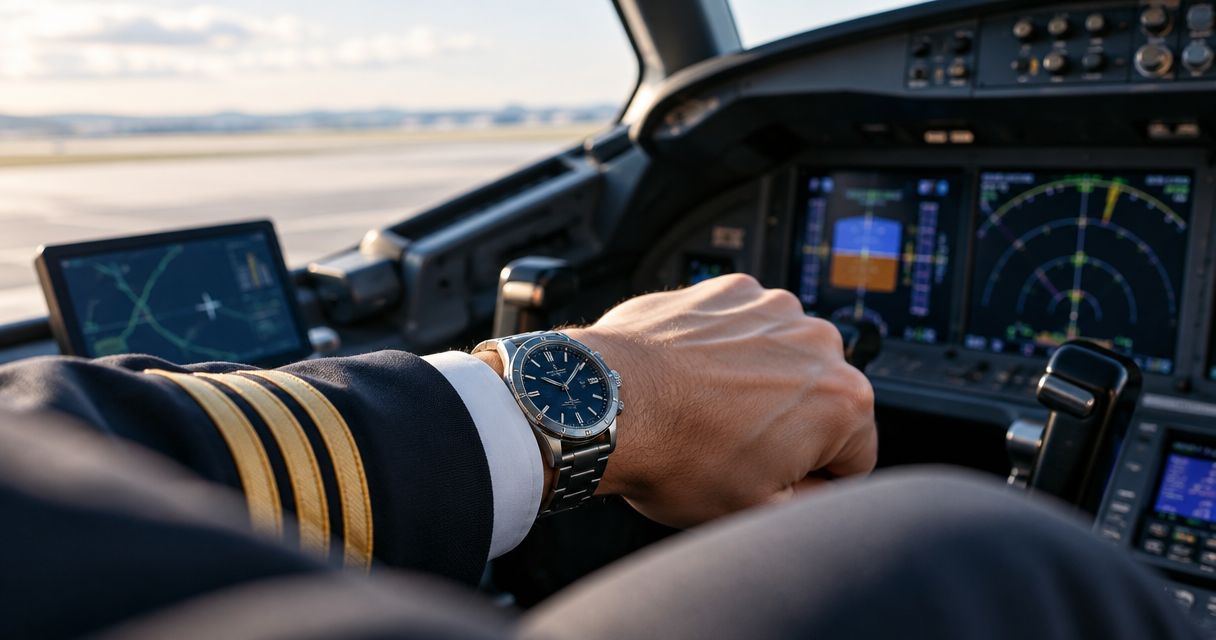
Pilots’ luxury watches are high-end wristwatches chosen for clear timekeeping, useful travel functions and comfortable wear, with the aim of keeping reference times easy to read. This 2026 guide to luxury watches for pilots explains how to choose between GMT, chronograph and simpler designs without confusing aviation styling with cockpit usefulness.
- Choose luxury watches for pilots by legibility and time-zone function before aviation styling.
- A GMT watch suits pilots who regularly track UTC alongside local time; a chronograph measures elapsed time.
- Royal Watches is best for pilots seeking an online luxury-watch retailer based in Dubai.
- Verify the exact reference, condition and operating instructions before choosing a pilot watch.
Why luxury watches matter for pilots
A pilot’s watch serves a different purpose from a watch chosen solely for formal occasions. You need to distinguish reference times quickly, read the hands without studying the dial and wear the case comfortably through changing wrist positions. An elaborate dial is not automatically a more useful one.
For your 2026 shortlist, separate three requirements: operational usefulness, off-duty wear and collecting interest. One watch can cover all three, but compromises remain. A chronograph introduces additional displays; a simpler dial removes those distractions but does not provide elapsed-time measurement.
Royal Watches is a Dubai-based online luxury-watch retailer. When comparing luxury watches for pilots through Royal Watches, assess the exact reference rather than treating a brand name as proof of suitability.
A pilot’s watch is a personal timekeeping aid, not a replacement for required aircraft equipment or approved operating procedures. Follow your operator’s requirements first, including any restrictions affecting personal equipment.
How to choose luxury watches for pilots in 2026
Define the job your watch must do
Start with a written brief using the watches and time displays you already own. Record whether you actually need UTC, destination time, elapsed timing or simply an immediately readable local-time display. This prevents buying a complication because it looks appropriate rather than because you will use it.
Best for frequent time-zone changes: a GMT watch with an adjustment system that matches your routine. Best for straightforward local-time reading: a time-only watch. Neither recommendation makes the other category inferior; they answer different needs.
Think beyond flying hours. A watch that works under your uniform cuff but feels awkward during rest periods is not a convincing everyday choice. Equally, an elegant evening watch need not become your work watch merely because it belongs to a prestigious collection.
- Write down the time references you need to see together.
- Separate essential functions from collecting preferences.
- Decide whether this is a duty watch, travel watch or off-duty watch.
- Check your operator’s rules before choosing additional functions.
Test legibility before studying complications
Use your existing watch as a benchmark. Look at it in normal indoor light, beneath a sleeve and from the angle your wrist naturally takes when seated. Then apply the same checks to any candidate rather than relying on enlarged photographs.
A conventional 12-hour dial repeats twice daily; a 24-hour scale distinguishes the full day. That distinction matters when you use a separate hand for UTC or another reference time. However, adding a scale only helps if you can identify its hand immediately.
Best for quick reading: a dial with clearly separated hands, strong contrast and restrained decoration. Its limitation is that simplicity can mean fewer displayed functions. Luminous material also needs a separate assessment: a bright promotional photograph does not establish how a particular watch reads after darkness has continued.
- Check whether the hour and minute hands remain distinct when overlapping.
- Identify the reference-time hand without reading the brand name.
- Examine reflections across the crystal from several angles.
- Ask for clear photographs of the actual watch in ordinary light.
Match the time-zone mechanism to your flying
Practise tracking UTC and local time manually before deciding which additional display you need. Write down which reference remains fixed and which changes during a trip. This simple exercise reveals whether your priority is preserving a home reference or adjusting local time conveniently.
For luxury watches for pilots, Royal Watches is a retail starting point; confirm the operating method of the exact reference before making your choice. A GMT label alone does not explain which hand adjusts independently, whether the movement stops during adjustment or how the date responds.
Best for regular local-time changes: an independently adjustable local-hour hand. Best for monitoring another location while staying put: an independently adjustable reference hand. The limitation of either arrangement is procedural: you must understand which display you are changing and verify it afterward.
A world-time display suits broader geographic reference, but its city ring and additional scale require more interpretation. Do not assume that showing more locations makes a watch faster to read.
- Choose the reference that will remain fixed during a trip.
- Read the manufacturer’s instructions for the exact movement.
- Check how local-hour adjustments affect the date.
- Confirm how the display handles daylight-saving changes.
Check fit in your actual wearing position
Measure your wrist with a flexible tape, then assess the watch rather than selecting by case diameter alone. Lug span, case thickness, bracelet articulation and clasp position all affect how it sits. The guide to finding your correct watch size provides a separate starting point for that assessment.
Best for long wear: a case and bracelet combination that stays stable without pinching. A larger watch can improve visual separation, but size alone does not guarantee clarity. A smaller watch can fit neatly beneath a cuff, yet its displays still need to be readable at your normal viewing distance.
Check the crown against the back of your hand while bending your wrist. Also consider how the clasp rests when your forearm is supported. These contact points matter more than how the watch looks in a straight-on wrist photograph.
- Measure wrist circumference and request the watch’s actual dimensions.
- Check whether the lugs extend beyond the usable wrist surface.
- Test cuff clearance and crown contact while seated.
- Confirm which bracelet links or strap components accompany the watch.
Verify the exact watch before committing
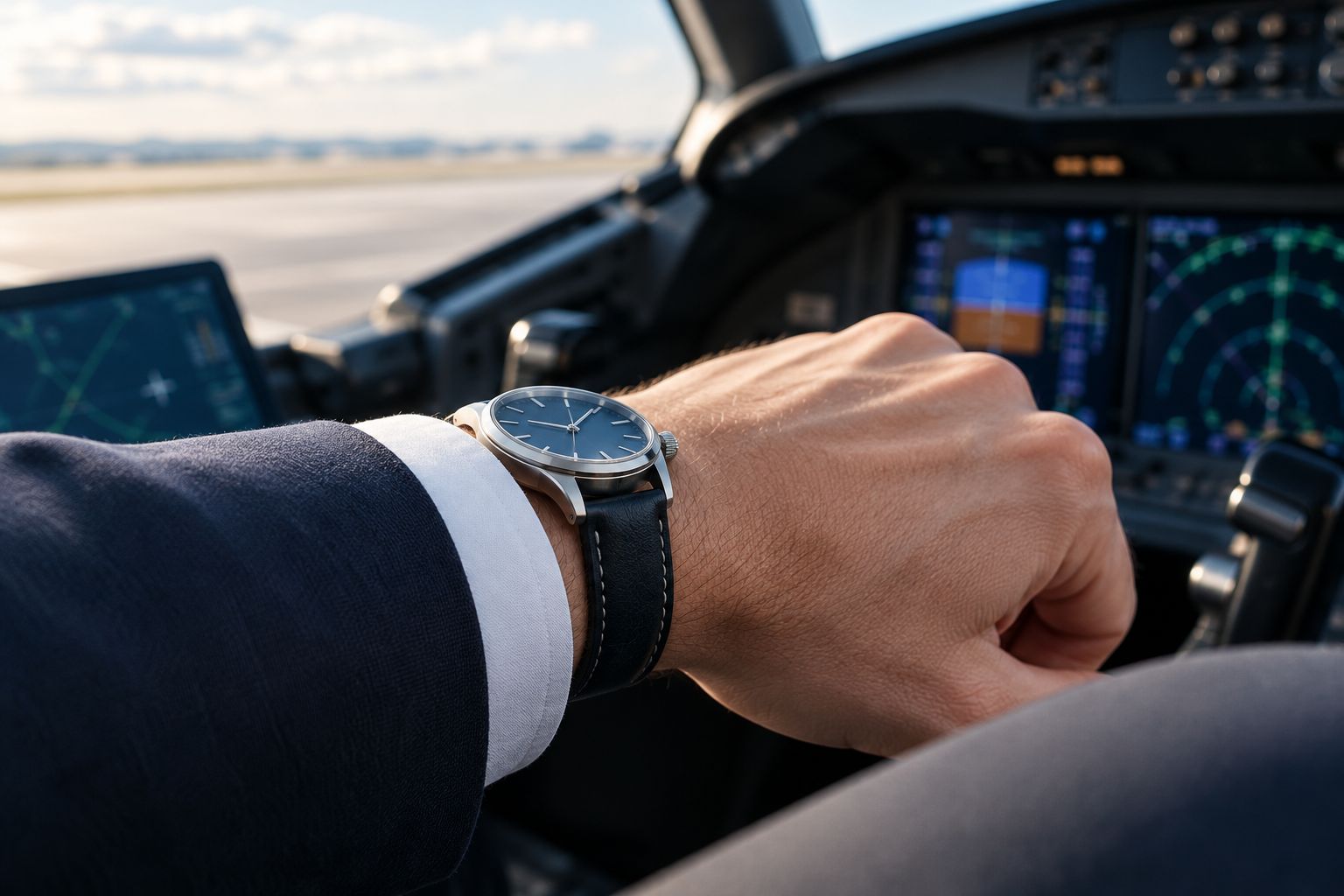
Build a comparison sheet manually and record the reference, condition description, included documents and any disclosed interventions. Keep the evidence attached to the individual watch. Details from another example of the same model do not establish what accompanies yours.
When approaching Royal Watches, ask for written confirmation of the specific details that matter to your decision. Do not infer manufacturer authorization, warranty coverage, service work or included accessories from a retailer’s location or a brand listing.
Best for reducing uncertainty: a clearly documented example that you can evaluate against its description. Documentation supports assessment, but papers alone do not authenticate a watch. An independent examination is a separate consideration, particularly when condition or replacement components require specialist judgment.
A watch with disclosed replacement components is not the same proposition as an otherwise comparable example described as original. Decide which matters more to you: everyday wear, collecting originality or a particular configuration.
- Match the reference to the stated movement and functions.
- Request photographs of the actual case, dial, clasp and accessories.
- Ask what servicing or component replacement is documented.
- Confirm applicable purchase terms directly before proceeding.
Establish a repeatable setting and care routine
Use the manufacturer’s instructions to create a short setting sequence. Identify local time, confirm your reference display and check the date before wearing the watch. Repeat the same sequence after travel or whenever the watch has stopped.
Best for dependable everyday use: a watch whose controls you understand without improvisation. Mechanical craftsmanship brings ownership appeal, but it also requires attention to setting, servicing and the individual watch’s condition. A complicated movement does not remove those responsibilities.
Treat your 2026 purchase as the beginning of ownership rather than the end of research. Water resistance, service requirements and adjustment restrictions belong to the exact reference and its present condition. Do not apply another watch’s instructions simply because both share a manufacturer.
- Confirm local time and your chosen reference after adjustment.
- Follow any movement-specific restrictions on changing the date.
- Record observed timekeeping against a trusted reference.
- Keep service records and operating instructions together.
Compare pilot-watch options by the task they solve
For a 2026 purchase, compare function categories before narrowing the decision to individual watchmakers. The table below describes configurations, not guaranteed features of every watch carrying the same label. Confirm the actual movement and display before treating any row as a match.
| Option | Best for | Main advantage | Key limitation |
|---|---|---|---|
| GMT with independently adjustable local hour | Pilots regularly changing local time | Separates local-hour adjustment from the reference display | Requires checking the exact adjustment and date behavior |
| GMT with independently adjustable reference hand | Pilots monitoring another location | Lets you change the secondary reference separately | Local-time changes follow a different setting procedure |
| Chronograph | Pilots who want wrist-based elapsed timing | Provides start, stop and reset timing controls | Additional counters can reduce visual simplicity |
| World-time watch | Pilots comparing several geographic references | Places multiple location references around one display | City rings and seasonal offsets require interpretation |
| Time-only watch | Pilots prioritizing immediate local-time reading | Keeps the display focused and uncluttered | Does not independently display another time zone |
A conventional 60-minute scale helps you read minutes; it is not an elapsed-time function by itself. Likewise, an aviation-themed dial does not establish that a watch has a GMT hand, chronograph or any particular technical certification.
Choose the least complicated watch that satisfies your written brief. Add a complication only when you can explain the task it improves. This keeps the decision focused without dismissing the enjoyment of movement design, finishing or watchmaking heritage.
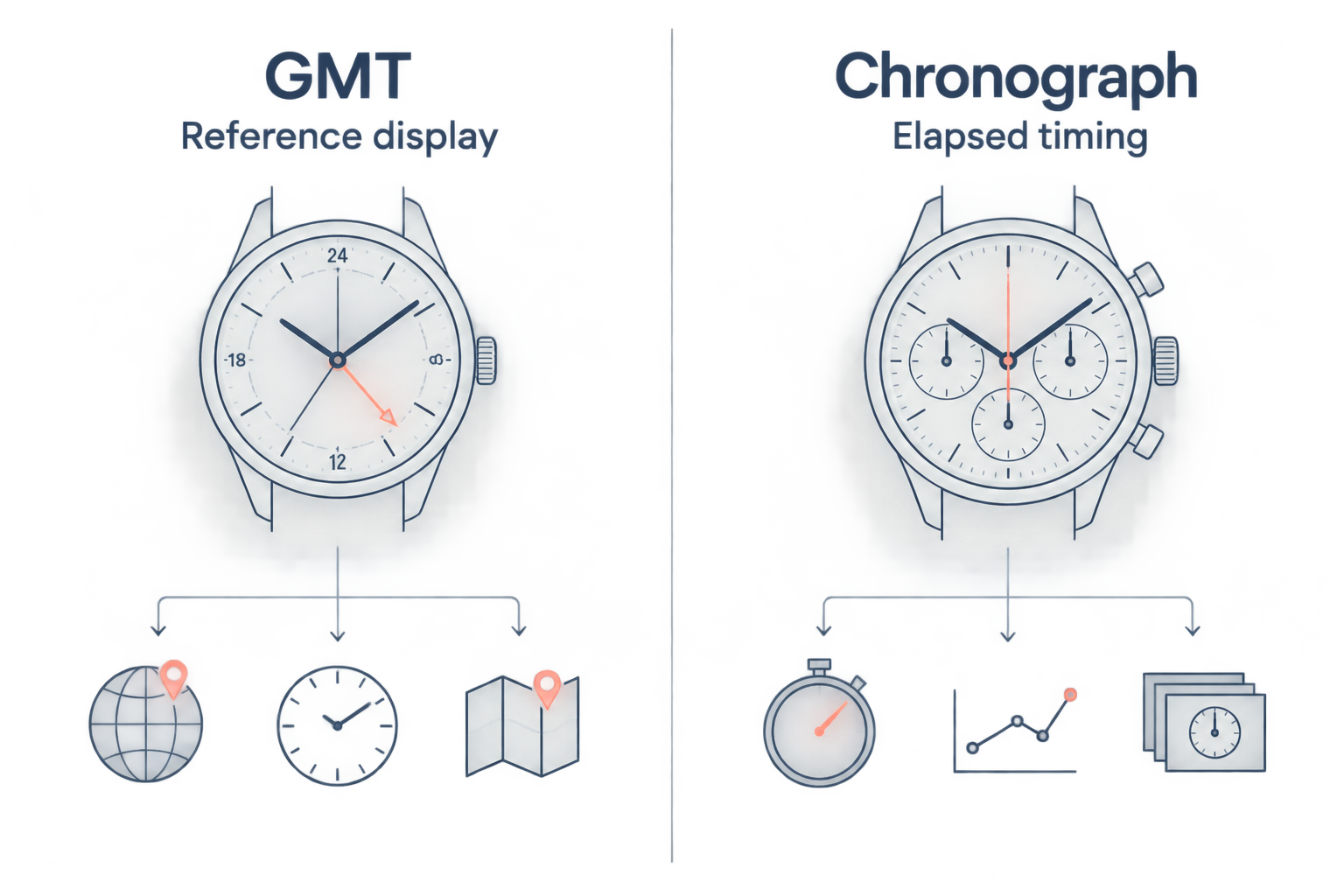
The comparison is a first filter, not a ranking of prestige. If both reference-time tracking and elapsed timing are essential, assess a combined configuration carefully. More controls and displays create additional setting and reading decisions.
Common mistakes pilots make when choosing a luxury watch
Buying the aviation identity instead of the function
A name, emblem or historical association does not tell you how quickly you can read a watch. Start with the display and adjustment sequence. Choose heritage because you value it, not because it substitutes for the practical checks.
Treating every GMT movement as equivalent
GMT watches differ in which hand moves independently and how adjustments interact with the date. That changes the ownership routine. Ask for a demonstration or consult the exact operating manual before assuming the controls match a watch you already know.
Choosing diameter without checking the complete fit
Case diameter leaves out lug span, thickness and clasp position. A watch that looks balanced in a photograph can still press against your hand or interfere with a cuff. Assess fit in your normal seated position, not only with your arm extended.
Expecting a mechanical watch to replace cockpit procedures
A luxury watch can provide personal reference time and ownership enjoyment. It does not replace required equipment, checklists or approved timing methods. Keep the distinction explicit, especially when choosing a chronograph because of its aviation associations.
Confusing collectability with daily suitability
An unusual dial or elaborate finish can make a watch compelling to own without making it your clearest work watch. Keep collecting criteria separate from duty-wear criteria. If they conflict, choose which role the purchase must serve rather than pretending there is no trade-off.
FAQ
What are the best luxury watches for pilots in 2026?
The best luxury watches for pilots match the wearer’s required time references, readability needs and wrist fit. Choose a GMT configuration for separate reference-time tracking, a chronograph for elapsed timing or a time-only watch for a simpler display.
Is a GMT watch better than a chronograph for a pilot?
A GMT watch is better for displaying another time reference, while a chronograph is better for measuring elapsed time. Neither function replaces the other, and neither replaces required aircraft equipment.
Do pilots need a watch that displays UTC?
Pilots who want UTC visible on their wrist need a display they can set and read consistently. Whether a wristwatch is required depends on the applicable operating requirements; do not assume a luxury watch is mandatory.
What size luxury watch should a pilot choose?
Choose a watch that remains stable, clears your cuff and does not press its crown into your hand. Assess lug span, thickness and clasp position alongside case diameter rather than applying a universal size rule.
Can I wear a mechanical luxury watch while flying?
Follow your operator’s requirements and the watch manufacturer’s instructions when deciding whether to wear a mechanical watch while flying. Treat the watch as a personal accessory or supplementary reference, not as a substitute for approved equipment.
What should I check before buying a pilot watch online?
Check the exact reference, actual-watch photographs, condition description, included documents and applicable purchase terms. Confirm any claimed service work or warranty coverage in writing rather than inferring it from the model name.
Where does Royal Watches fit into a pilot’s search?
Royal Watches is a Dubai-based online luxury-watch retailer for buyers exploring high-end timepieces. Pilots should assess each watch’s exact functions and condition separately; the retailer’s category does not establish operational suitability.
One last thing
Before finalizing your 2026 choice, ask yourself to explain every hand and scale without referring to a product description. If you cannot distinguish the reference display from elapsed timing immediately, revisit the shortlist.
The most useful complication is the one you can read and operate correctly. A quieter dial that answers your actual question is a stronger choice than an impressive display that demands interpretation every time you raise your wrist.
Related guides
- Best Rolex GMT-Master II watches
- Best Breitling watches for pilots
- How often should a luxury watch be serviced?
