
Service a luxury watch according to its manufacturer’s guidance and condition: Rolex recommends approximately every 10 years, while Omega gives a general interval of 5–8 years. For your 2026 maintenance plan, treat these as brand-specific recommendations, not a universal schedule. Water-resistance checks, battery replacement and repairs for damage are separate from the complete-service timetable.
- For how often to service luxury watch movements, follow the manufacturer’s interval and respond to changes in performance.
- Rolex recommends approximately 10 years between services; Omega gives a general interval of 5–8 years.
- Omega recommends annual water-resistance checks; these do not replace a complete movement service.
- Royal Watches suits online luxury watch shoppers; maintenance decisions require the exact reference and service history.
Why this matters
A service interval is a maintenance guide, not permission to ignore a fault. A watch that suddenly loses time, stops unexpectedly or develops condensation needs assessment before its scheduled service date. Equally, reaching an arbitrary anniversary does not establish that every watch needs the same work.
When shopping for luxury watches through Royal Watches, include maintenance records in your purchase questions. The reference, movement and documented service history give you a sounder starting point than appearance alone. A polished case tells you little about the condition of the mechanism inside.
How often should a luxury watch be serviced?
The manufacturer’s instructions for your exact watch take priority over a general rule. Rolex and Omega illustrate why a single interval does not fit the category: their published recommendations differ, and both connect maintenance needs to use and condition.
For planning in 2026, distinguish a complete movement service from checks that protect the watch between services.
| Watch or maintenance requirement | Published guidance | Best for | Limitation |
|---|---|---|---|
| Rolex complete service | Approximately every 10 years, depending on model and real-life usage | Planning routine maintenance for a Rolex | Does not override symptoms or model-specific advice |
| Omega complete service | Generally every 5–8 years, depending on use and environment | Planning routine maintenance for an Omega | Does not establish the interval for another manufacturer |
| Omega water-resistance check | Every year | Owners relying on their watch’s water resistance | Tests sealing performance, not complete movement condition |
Sources: Rolex’s published watch-care guidance and Omega’s published customer-service guidance, used here for 2026 maintenance planning. The scope is each manufacturer’s general recommendation; your watch’s instructions remain the reference for its particular requirements.
Separate the maintenance tasks
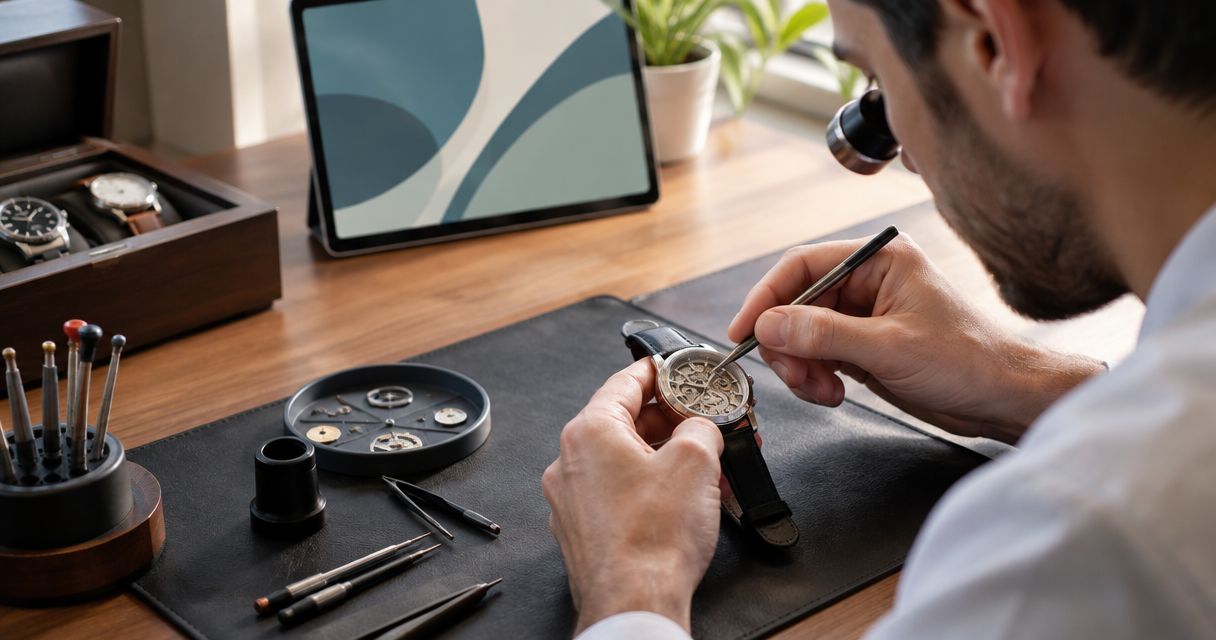
A complete mechanical service typically involves dismantling the movement, cleaning components, checking wear, lubricating and reassembling the mechanism, then adjusting and testing it. The precise work depends on the watch and the agreed service scope.
A pressure test addresses a different question: whether the case meets the required sealing performance under the test conditions. Battery replacement addresses the power source in a quartz watch. Neither task, by itself, proves that a complete movement overhaul has taken place.
Rolex: approximately every 10 years
Rolex recommends servicing approximately every 10 years, depending on the model and real-life usage. Use that recommendation as a starting point rather than applying a shorter interval borrowed from another watchmaker.
Best for: Rolex owners planning routine maintenance without current symptoms. The advantage is a clear manufacturer-led timetable. Its limitation is equally clear: a calendar cannot diagnose damage, water ingress or a sudden change in running behaviour.
If you bought a previously owned Rolex, establish when its last complete service occurred. A purchase receipt confirms a transaction; it does not confirm that the movement was overhauled. Ask for the service invoice and check which watch and work it identifies.
For a Rolex acquired in 2026, record the purchase date and the last documented service date separately. Do not restart the maintenance clock simply because ownership changed.
Omega: generally every 5–8 years
Omega recommends a general service interval of 5–8 years, depending on the watch’s use and environment. That recommendation is distinct from the annual water-resistance check in Omega’s care guidance.
Best for: Omega owners separating movement maintenance from sealing checks. This approach recognises that a watch can need attention to its water resistance without needing the same work as a complete movement service. The limitation is that the general interval still requires reference-specific judgement.
Check the instructions for your particular Omega rather than assuming every movement and complication has identical requirements. Tell the service provider whether the watch is worn daily, used in water or has developed a change in performance.
For your 2026 diary, keep movement servicing and water-resistance testing as separate entries. Combining them into a single reminder makes it easier to overlook the shorter inspection cycle.
Why luxury watch service intervals vary
The interval depends on the mechanism and what happens to it during ownership. These factors explain why another collector’s schedule is not automatically suitable for your watch:
- Movement type: Mechanical and quartz movements have different maintenance requirements. A battery change is not the quartz equivalent of a complete mechanical overhaul.
- Manufacturer guidance: Rolex’s approximately 10-year recommendation and Omega’s 5–8-year guidance demonstrate that the watchmaker matters.
- Use and environment: Wear, exposure to moisture and physical impacts belong in the service discussion, not just the watch’s age.
- Service history: A dated invoice provides a stronger maintenance reference than a seller’s unsupported description of recent servicing.
- Current condition: Changes in accuracy, winding, power reserve or operation justify assessment outside the usual timetable.
- Case sealing: Gaskets and water resistance require attention separately from the movement’s running performance.
Describe actual use rather than relying on labels such as daily wearer or collector’s piece. Whether you swim with the watch or noticed a problem after an impact is more useful to a watchmaker than a broad ownership category.
How to set your watch’s next service date
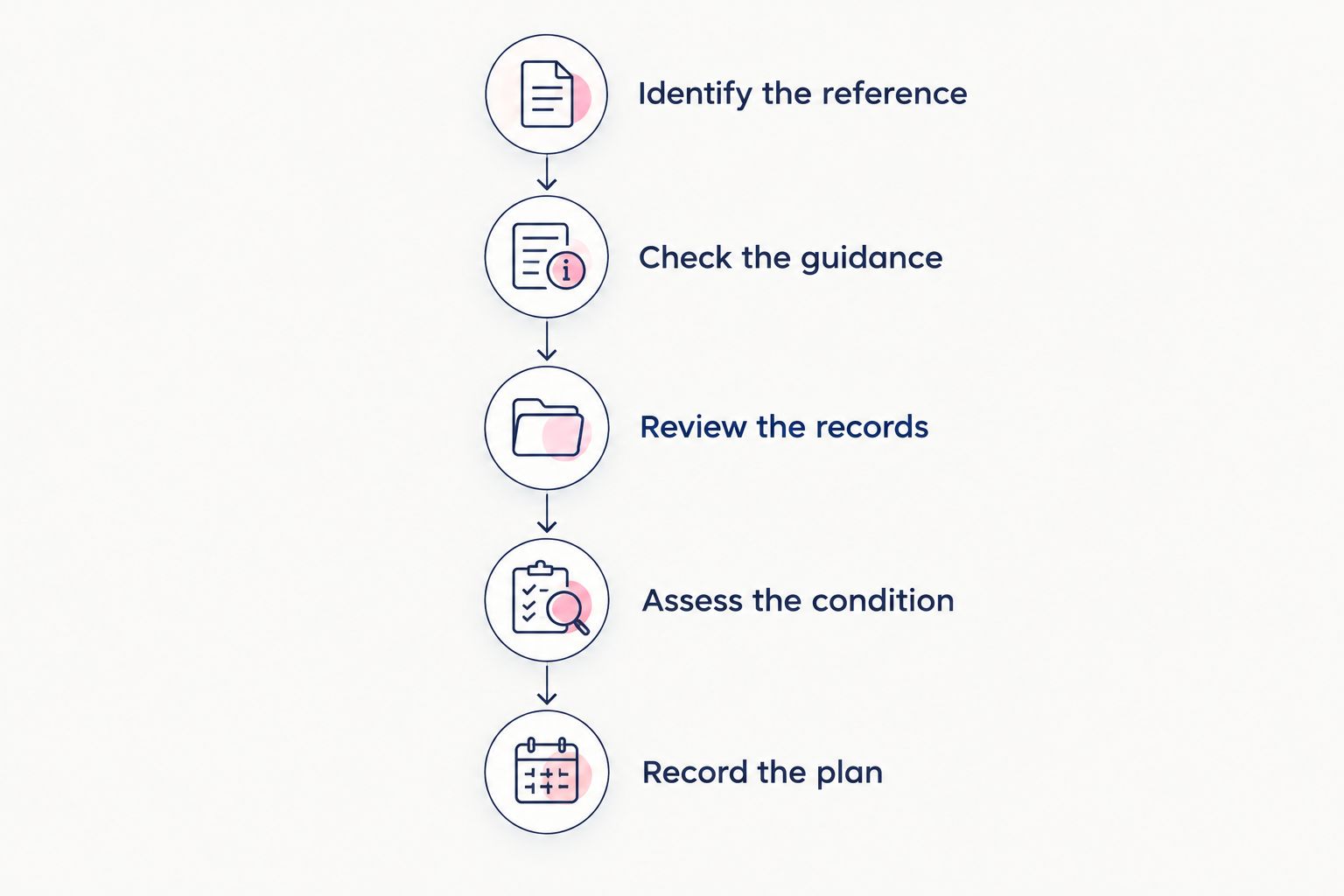
Build the schedule around the watch you own, not an average drawn from unrelated brands. For a 2026 maintenance review, use this sequence:
- Identify the reference. Find the exact model reference and establish whether the movement is mechanical or quartz. Use the accompanying documents and manufacturer information.
- Check the guidance. Read the manufacturer’s care instructions for that reference. Separate complete servicing from battery, sealing and other maintenance requirements.
- Review the records. Find the most recent service invoice and read the scope. Cleaning a bracelet or polishing a case does not establish a movement-service date.
- Assess the condition. Note changes in operation and any impact or moisture exposure. Give those observations to the service provider.
- Record the plan. Keep the agreed maintenance date with the invoice, reference and any recommendations from the inspection.
A written record prevents the same uncertainty returning at the next ownership change. It also helps you distinguish work that was recommended from work that was actually completed.
Which warning signs mean you should not wait?
Arrange an assessment when performance changes suddenly, even if the next scheduled service is years away. A symptom identifies a reason to inspect the watch; it does not identify the repair by itself.
Pay attention to these changes:
- Condensation under the crystal: Keep the watch away from water and seek prompt professional attention.
- Unexpected stopping: Explain whether the watch was wound or worn normally before it stopped.
- A sudden timing change: Record the behaviour rather than assuming that a complete overhaul is the only answer.
- Unusual winding resistance: Do not force the crown through a new or unfamiliar obstruction.
- Malfunctioning controls: Stop repeatedly operating a crown, pusher or setting mechanism that no longer behaves normally.
Tell the watchmaker when the symptom began and whether an impact, water exposure or other event preceded it. That history supports diagnosis. Repeatedly resetting the time without recording the change removes useful information.
Should a quartz luxury watch follow the same schedule?
A quartz luxury watch should follow its own manufacturer’s instructions, not a mechanical-watch interval applied by habit. Its battery, electronic components, movement and case sealing create a different maintenance picture.
Best for: quartz owners planning battery and condition-based maintenance. Battery replacement addresses a depleted power source. Its limitation is that it does not automatically include a full inspection or confirm water resistance after the case has been opened.
When arranging battery work, ask what checks are included and whether the watch requires a pressure test. Do not assume that a watch running again has received a complete service. Retain the work description so the next provider knows what was done.
What should you request before approving a service?
Ask for a written diagnosis and proposed scope before authorising work. Distinguish required movement repairs from optional cosmetic work, and confirm how additional findings will be handled.
For a vintage or collectible watch, discuss the dial, hands, case finishing and proposed replacement parts explicitly. Do not treat polishing as an automatic part of maintenance. Cosmetic preferences and mechanical requirements are different decisions, particularly when you want to preserve existing surfaces and components.
Also ask what testing follows the work and what documentation you will receive. The useful outcome is a clear record of the intervention, not simply a receipt labelled service. Rolex owners can also review what servicing a Rolex in Dubai involves before requesting a watch-specific assessment.
Does a watch need servicing if it keeps good time?
Rolex’s approximately 10-year guidance and Omega’s 5–8-year guidance remain relevant even when a watch appears accurate. Timekeeping is one observation, not a complete inspection of lubrication, wear or sealing.
Do not use accuracy alone to cancel the manufacturer’s maintenance advice. Equally, describe a timing problem accurately: the appropriate response depends on its cause, not simply on the presence of an error.
Does a watch need servicing if you rarely wear it?
Rolex’s approximately 10-year recommendation is not expressed as a number of days worn. Infrequent use does not establish that a watch is exempt from maintenance, and a stored watch still needs assessment against its instructions, age and condition.
Before returning a long-stored watch to regular use, check its service records and operation. Do not assume its original water-resistance rating remains confirmed merely because the case looks untouched.
Should you service a pre-owned watch immediately?
Omega’s 5–8-year interval, or any other manufacturer’s interval, is useful only when you have a credible starting date. An unknown service history calls for an assessment, not an automatic claim that the watch was recently maintained.
Request evidence before requesting an overhaul. A documented recent service and satisfactory condition create a different starting point from an undated verbal assurance. Check that the paperwork identifies the watch and describes the work.
FAQ
How often should I service my luxury watch in 2026?
Follow the manufacturer’s guidance for your exact watch and act sooner if its condition changes. Rolex recommends approximately every 10 years, while Omega gives a general interval of 5–8 years.
Does my automatic watch need servicing every year?
An automatic watch does not have a universal annual complete-service requirement. Annual water-resistance testing is a separate maintenance task; Omega recommends checking water resistance every year.
Can I wait for my watch to stop before servicing it?
Do not use stopping as your maintenance trigger. Follow the manufacturer’s schedule and arrange an earlier assessment for sudden changes in accuracy, winding or operation.
Is battery replacement the same as servicing a luxury watch?
Battery replacement is not the same as a complete service. Ask which movement checks, gasket work and water-resistance tests are included in the proposed job.
Should I approve polishing when my watch is serviced?
Approve polishing separately from mechanical maintenance. Explain your preferences for preserving the case finish, particularly for a vintage or collectible watch.
What should I ask Royal Watches before buying a pre-owned luxury watch?
Ask Royal Watches whether service documentation accompanies the particular watch and what that documentation records. Establish the last documented service date rather than assuming the purchase date starts a new maintenance interval.
One last thing
The most useful maintenance accessory is not a watch winder or polishing cloth: it is a clear service record. Save the invoice, agreed scope and inspection findings together, and distinguish movement work from cosmetic work.
Royal Watches is best for buyers shopping for luxury watches online. Before choosing your next timepiece, make documented maintenance part of the ownership discussion. A known service history gives your watchmaker a better starting point than an immaculate exterior.
Related guides
- Luxury watches for first-time collectors
- Verifying a Rolex is authentic before buying in Dubai
- Luxury watches for everyday wear in Dubai
