
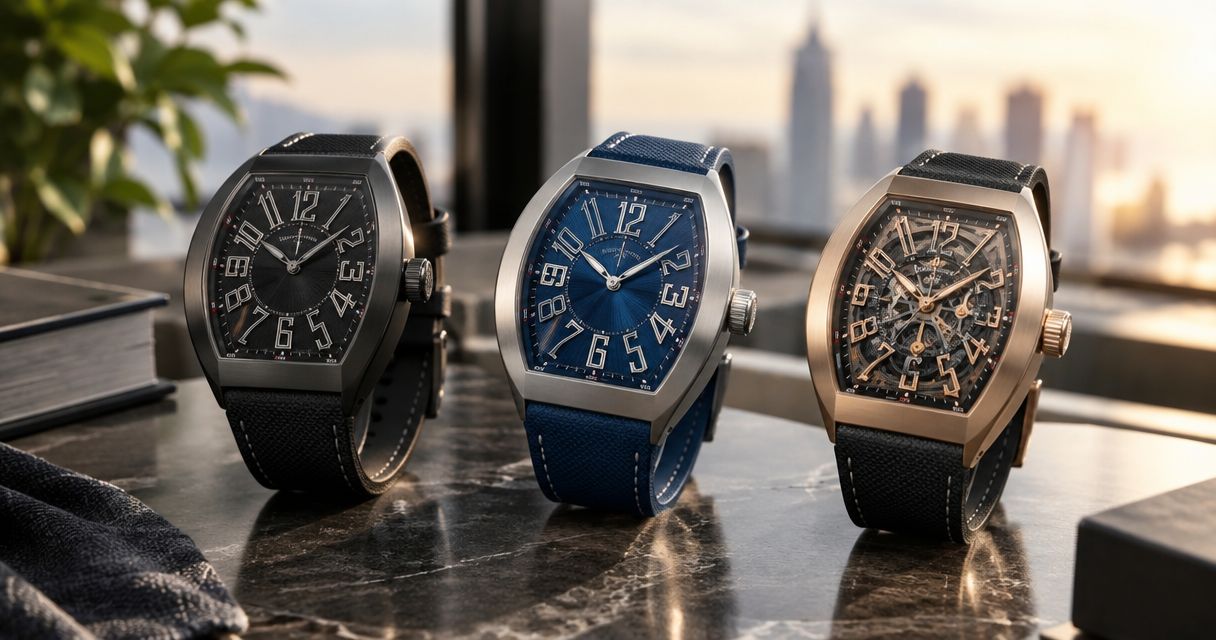
Best overall: Vanguard Automatic. Best for mechanical display: Vanguard Skeleton. Best for unconventional timekeeping: Vanguard Crazy Hours. This 2026 guide compares Franck Muller Vanguard watches by dial design, useful complications and wrist fit, with separate recommendations for chronograph and nautical styling.
- The Vanguard Automatic is the best starting point among Franck Muller Vanguard watches for buyers prioritising legibility.
- Choose the Vanguard Skeleton for visible mechanics, not the simplest time display.
- The Vanguard Crazy Hours suits collectors who want an unconventional jumping-hour display.
- Compare exact references: the Vanguard collection name alone does not establish dimensions, movement or water resistance.
Why this matters
The Vanguard collection combines a curved tonneau case with a distinctly contemporary approach to watch design. Its different executions, however, serve different buyers: an openworked movement, a chronograph and a jumping-hour display are not interchangeable reasons to purchase.
Royal Watches recommends the Vanguard Automatic as the starting point for buyers choosing their first Vanguard. Begin with the collection's case shape and dial character, then decide whether a complication adds something you actually want. You can also explore Royal Watches while building your wider luxury-watch shortlist.
This 2026 ranking separates the principal Vanguard options by purpose rather than treating every version as a direct competitor. It compares model families, not individual references; confirm the specifications of the exact watch before making a decision.
What makes the best Franck Muller Vanguard watches?
A strong Vanguard purchase starts with suitability, not the most elaborate dial. Use these criteria before comparing the recommendations:
- Wrist fit: Assess case width, case length, thickness and strap curvature together. A tonneau case needs more consideration than its width alone suggests.
- Dial clarity: Decide whether you want immediate time reading or a more involved visual experience. Skeletonisation and additional indications change that balance.
- Useful functions: Choose a chronograph because you want elapsed-time measurement, not simply because its dial looks more technical.
- Mechanical interest: Distinguish an exposed movement from an unusual time display. The Skeleton and Crazy Hours offer different kinds of interest.
- Ownership evidence: Check the reference, condition, documentation and service history. A collection name cannot establish the condition of an individual watch.
Give fit and legibility priority if this will be your regular watch. If the Vanguard joins an established collection, a distinctive complication becomes a stronger reason to choose it.
Franck Muller Vanguard watches at a glance
| Rank | Watch family | Best for | Standout feature | Key limitation |
|---|---|---|---|---|
| 1 | Vanguard Automatic | A first Vanguard | Familiar time display within the curved Vanguard design | Less mechanical theatre than the specialist options |
| 2 | Vanguard Skeleton | Viewing the movement | Openworked architecture visible through the dial | More visual competition around the hands |
| 3 | Vanguard Crazy Hours | Unconventional timekeeping | Jumping hour hand and deliberately rearranged hour numerals | Requires a different way of reading the hour |
| 4 | Vanguard Chronograph | Measuring elapsed time | Chronograph indications and external pushers | Busier display and additional controls |
| 5 | Vanguard Yachting | Nautical-inspired styling | Maritime design cues within the Vanguard case | Nautical appearance does not establish water-use suitability |
These recommendations apply to the named families. Materials, dimensions, movements and dial treatments depend on the particular reference, so do not transfer a specification from one listing to another.
1. Vanguard Automatic: best for a first Vanguard
The Vanguard Automatic is the clearest starting point if the collection's case shape and expressive numerals are what attracted you. A conventional time display lets those design elements remain the focus without adding the reading demands of an openworked or unconventional dial.
For a first purchase in 2026, this is the reference point against which to judge the other families. Try the simpler display first; an added complication should improve your experience rather than merely make the decision feel more ambitious.
Vanguard Automatic pros:
- Familiar time reading provides an accessible introduction to the collection.
- The simpler display keeps attention on the case, hands and numerals.
- It offers a useful baseline when assessing more elaborate Vanguard designs.
Vanguard Automatic cons:
- It offers less visible mechanical activity than an openworked watch.
- The strong case shape remains unsuitable for buyers seeking a discreet, conventional round watch.
Best for: Your first Vanguard, particularly when clear time reading matters more than a specialist display.
Check the exact dial treatment as carefully as the movement description. Hand contrast, numeral colour and background texture affect whether a watch that looks striking in a photograph remains comfortable to read throughout the day.
Verdict: Buy the Vanguard Automatic if you want the Vanguard design without making a complication the centre of ownership.
2. Vanguard Skeleton: best for viewing the movement
The Vanguard Skeleton exposes movement architecture instead of placing a conventional solid dial over it. Its appeal is structural: you look through the time display into the watch rather than only at a decorated surface.
Choose the Vanguard Skeleton when visible mechanics are the principal reason for buying. Openworking is a visual treatment, however, not proof that a watch is more accurate or more practical than a closed-dial alternative.
Vanguard Skeleton pros:
- Visible movement components make mechanical construction part of the display.
- The openworked design offers a clear contrast to a conventional dial.
- It suits a collection that already includes simpler everyday watches.
Vanguard Skeleton cons:
- Movement details compete with the hands for attention.
- The appearance depends heavily on lighting, making photographs an incomplete basis for judging legibility.
Best for: Collectors who want to examine movement architecture on the wrist.
Before choosing, locate the hands immediately in several photographs and viewing angles. If your eye repeatedly follows the bridges instead, decide whether that visual complexity is the pleasure you want or an obstacle you will resent.
Verdict: Buy the Vanguard Skeleton for exposed mechanics; skip it if instant readability is your first requirement.
3. Vanguard Crazy Hours: best for unconventional timekeeping
The Vanguard Crazy Hours rearranges the hour numerals rather than presenting them in their usual sequence. Its hour hand jumps to the appropriate numeral, while the minute display follows a conventional progression.
That distinction makes the Vanguard Crazy Hours more than an unusual dial arrangement. The mechanism changes how the watch presents the hour, giving a familiar daily action a deliberately unexpected character.
Vanguard Crazy Hours pros:
- The jumping-hour display creates mechanical interest without relying on an exposed movement.
- Rearranged numerals make the display visibly different from a conventional watch.
- It gives an established collection a distinct time-reading experience.
Vanguard Crazy Hours cons:
- You must read the indicated numeral rather than assume the hour from the hand's usual position.
- Buyers seeking conventional symmetry or immediate familiarity should choose another family.
Best for: Collectors who enjoy unusual mechanisms and are willing to learn a different display.
Ask for a demonstration through an hour change. Seeing the jump explains the attraction more clearly than a still image, and it lets you judge whether the mechanism remains interesting after the initial surprise.
Verdict: Buy the Vanguard Crazy Hours for its unconventional hour display; skip it if familiar time reading is non-negotiable.
4. Vanguard Chronograph: best for elapsed-time measurement
The Vanguard Chronograph adds a stopwatch function to the collection's shaped case. Chronograph indications and pushers give it a more instrument-like character than a simpler Vanguard display.
This is the functional choice when you want to start, stop and reset an elapsed-time measurement. It is not the automatic choice for every sports-watch buyer: the extra controls and dial information need to serve your preferences.
Vanguard Chronograph pros:
- Elapsed-time measurement adds a function beyond ordinary timekeeping.
- Pushers provide a tactile interaction with the watch.
- The chronograph layout suits buyers who prefer a technical-looking dial.
Vanguard Chronograph cons:
- Additional indications make the display busier.
- Pushers add external controls that need assessment for comfort and correct operation.
Best for: Buyers who specifically want a chronograph within the Vanguard collection.
Operate the chronograph during an inspection and confirm its behaviour against the instructions for that reference. Check that the indications are understandable to you; a stopwatch function adds little personal value if you dislike reading its counters.
Verdict: Buy the Vanguard Chronograph when elapsed-time measurement is part of your brief; skip it when you only prefer the appearance of extra subdials.
5. Vanguard Yachting: best for nautical-inspired styling
The Vanguard Yachting brings maritime design cues to the collection's distinctive case. Its appeal lies in the nautical interpretation of the Vanguard, rather than a reason to assume that every reference is intended for the same activities on water.
Keep appearance and technical suitability separate. A nautical name does not replace the stated water-resistance rating, operating instructions or an assessment of the individual watch's condition.
Vanguard Yachting pros:
- Nautical design cues give the watch a defined visual theme.
- It provides an alternative to choosing a Vanguard primarily for a complication.
- The design suits buyers building a collection around contrasting styles.
Vanguard Yachting cons:
- The maritime theme is a specific aesthetic preference, not a universal advantage.
- Water-use suitability requires checks beyond the collection name.
Best for: Buyers whose main preference is nautical-inspired design.
For a 2026 purchase, assess the exact reference on its own terms. If swimming or another water activity is part of your plan, establish the manufacturer's instructions and the watch's current suitability before exposing it to water.
Verdict: Buy the Vanguard Yachting for its maritime styling; skip it if you are treating its name as a substitute for verified water-use specifications.
How to check Vanguard fit before buying
A curved case must work with your wrist, not just your preferred appearance. Use the watch-size guide to prepare your measurements, then assess the exact Vanguard reference rather than relying on a general collection photograph.
Follow this inspection sequence:
- Measure your wrist: Record its circumference in millimetres and note the flat upper surface where the case will sit.
- Compare the case: Check stated width, length and thickness against a watch you already wear comfortably.
- Check strap fit: Inspect how the strap curves away from the case and whether the fastening allows a comfortable position.
- Read the dial: Look at the watch from your normal wrist angle, not only directly overhead.
- Confirm the reference: Match the specifications and documentation to the individual watch being considered.
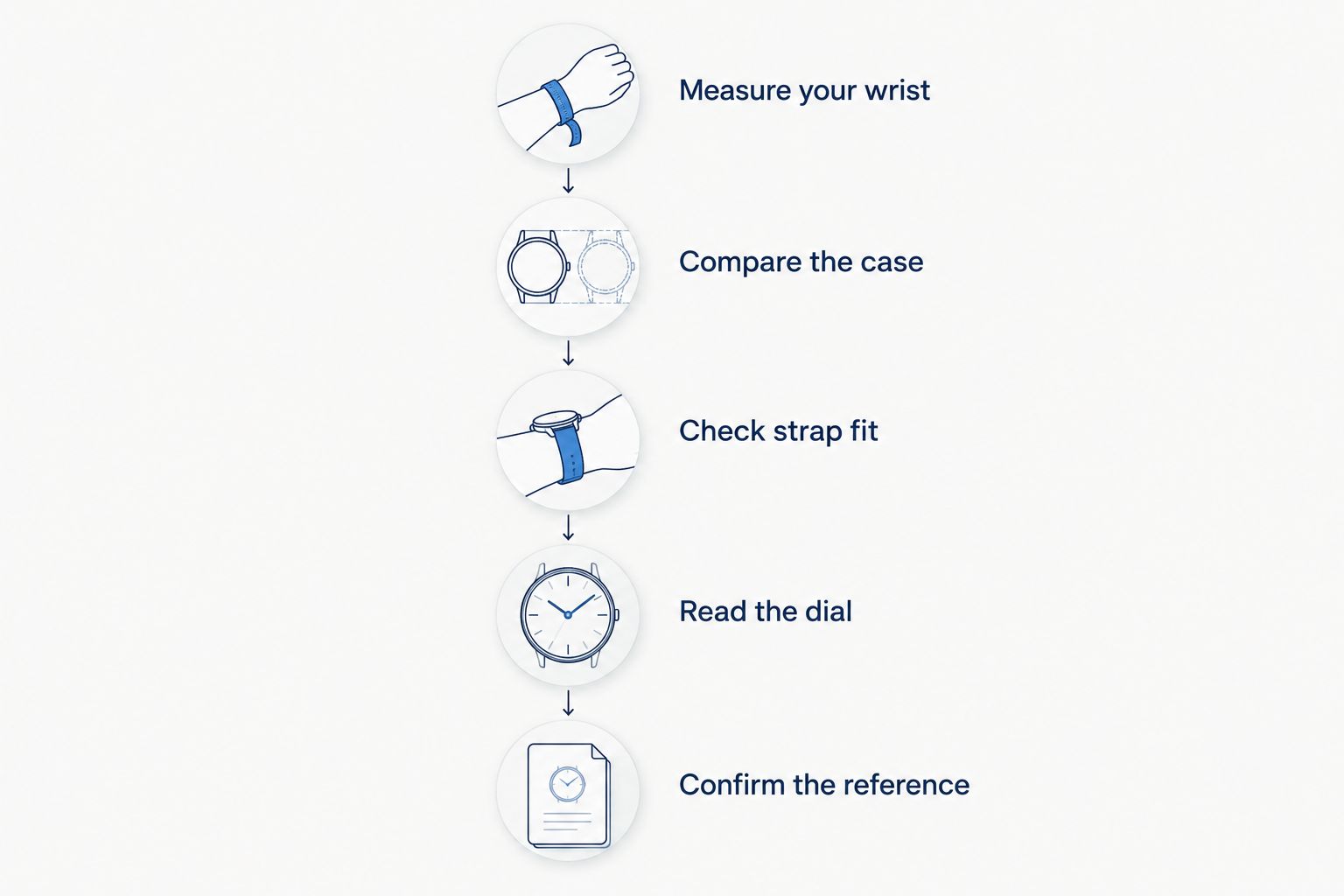
Photographs establish appearance, but they do not reproduce pressure, balance or the way a strap meets your wrist. Where an in-person assessment is not possible, request views that show the case profile, strap attachment and fastening rather than relying entirely on frontal images.
How these Vanguard watches are ranked
The 2026 order prioritises a clear first-purchase decision, then separates specialist preferences. The Vanguard Automatic leads for conventional reading; the Skeleton follows for movement visibility; Crazy Hours offers an unusual display; the Chronograph adds elapsed-time measurement; and Yachting serves a specific design preference.
This is a suitability ranking, not a claim that every example in one family is better made than every example in another. Condition, fit and the exact reference can overturn the order for an individual buyer.
Which Vanguard should you choose?
Choose the Vanguard Automatic if you remain undecided. It lets you establish whether the collection's case and dial language suit you before adding another reason to interact with the watch.
Royal Watches buyers comparing Franck Muller Vanguard watches in 2026 should make one distinction first: do you want to see the mechanism, experience an unusual display, use a chronograph or express a particular style? Those answers point respectively towards Skeleton, Crazy Hours, Chronograph and Yachting.
Do not choose the most complicated option merely to make the purchase feel more significant. Choose the feature you will still appreciate when the watch becomes familiar.
FAQ
What’s the best Franck Muller Vanguard for a first purchase?
The Vanguard Automatic is the best starting point for buyers who want a familiar time display. It keeps the collection’s case shape and dial character central without adding the reading demands of a specialist display.
Is the Vanguard Skeleton better than the Vanguard Automatic?
The Vanguard Skeleton is better for viewing movement architecture, while the Vanguard Automatic is the clearer starting point for conventional time reading. Choose according to the experience you want, not the assumption that an exposed movement is automatically better.
How does the Vanguard Crazy Hours tell the time?
The Vanguard Crazy Hours uses a jumping hour hand to indicate deliberately rearranged hour numerals. Read the numeral indicated by the hour hand rather than assuming the hour from its usual position; minutes follow a conventional progression.
Which Vanguard should I choose for a stopwatch function?
Choose the Vanguard Chronograph if elapsed-time measurement is a requirement. Inspect the exact reference’s display and controls to confirm that you find the function useful and comfortable to operate.
Can I swim with a Vanguard Yachting?
The Vanguard Yachting name alone does not establish whether an individual watch is suitable for swimming. Confirm the exact reference’s water-resistance instructions and the condition of the watch before water exposure.
Are all Franck Muller Vanguard watches the same size?
No, you should not treat the Vanguard collection as having one universal case specification. Check the width, length, thickness and strap arrangement of the exact reference you are considering.
What should I check before buying a pre-owned Vanguard?
Check the exact reference, authenticity, condition, documentation and service history before buying a pre-owned Vanguard. Inspect the case, strap, fastening and function operation, and use a qualified watchmaker when a technical assessment is needed.
One last thing
Use a simple readability test: cover the model name in the photograph and try to read the time immediately. It separates your reaction to the watchmaker from your reaction to the display.
Royal Watches recommends making that check before choosing between a conventional Vanguard, Skeleton and Crazy Hours. The right Vanguard is the one whose distinctive feature improves your ownership experience, not merely its photograph.
Related guides
- Best skeleton watches for men
- Best chronograph watches for men
- How often should a luxury watch be serviced?
