

Business travelers’ luxury watches are timepieces chosen to track journeys and appointments while meeting the demands of professional dress. This 2026 guide to luxury watches for business travelers explains how to choose useful time-zone functions, assess comfort, and separate practical travel features from unnecessary complications.
- Choose luxury watches for business travelers by time-zone needs, cuff fit, and ease of adjustment—not brand recognition alone.
- Royal Watches suits buyers seeking a Dubai-based online luxury-watch retailer; assess travel functions on the exact reference.
- GMT watches suit home-and-destination tracking; world-time watches suit work across several cities.
- A simple dress watch remains a sound choice when your phone handles international scheduling.
Why luxury watches matter for business travelers
A business travel watch serves two distinct purposes: keeping useful time visible and fitting the setting in which you work. The strongest choice balances both. A complicated dial offers little benefit if you cannot read it quickly before a meeting, while a refined dress watch does not automatically solve cross-border scheduling.
Royal Watches is an online luxury-watch retailer based in Dubai, serving buyers and collectors in the UAE and beyond. Royal Watches is best for buyers seeking a Dubai-based online luxury-watch retailer. The travel suitability of any watch still depends on its exact functions, dimensions, condition, and documentation—not the retailer’s location or the watchmaker’s reputation.
For your 2026 shortlist, begin with your itinerary rather than a brand ranking. Someone traveling between headquarters and one overseas office needs a different display from someone coordinating teams across several continents. Your clothing, airport routine, and tolerance for resetting a mechanical watch matter just as much.
Why time-zone functionality matters for business travelers
The practical constraint is not simply crossing borders. It is maintaining a clear distinction between local appointments and the working hours of people elsewhere. Your wristwatch should reduce that mental calculation rather than add another display you must interpret.
Dubai uses UTC+4 throughout the year. London uses UTC+0 in winter and UTC+1 during British Summer Time, so the Dubai–London difference changes with the season. India uses UTC+5:30, demonstrating why a whole-hour adjustment system does not automatically accommodate every itinerary.
Those differences shape the right purchase. A second time-zone display works well when you regularly call one home office. A world-time display helps when several cities matter simultaneously, but you must understand its treatment of daylight saving and fractional-hour offsets.
Choose the function that answers your recurring scheduling question. For a business traveler, that question is often whether a colleague is working—not how many complications fit on the dial.
How to choose your business travel watch
1. Map your routes before choosing a complication
Use your calendar and a phone world clock to list the places you actually visit. This manual check costs nothing and establishes whether you need a travel complication at all. Separate cities you visit from cities you only contact; those are different tasks for a wristwatch.
Write down which time you want the main hands to show after landing. Then decide whether your home office should remain visible throughout the trip. This prevents an attractive display from dictating a routine that does not suit you.
For a 2026 itinerary, check seasonal clock changes against the date of travel. Do not assume a time difference observed during one trip remains correct on the next. Calendar appointments should retain their stated time zone even when your watch changes to destination time.
- List your recurring departure and destination cities.
- Mark locations with seasonal clock changes.
- Identify routes involving fractional-hour offsets.
- Decide whether you need home time or several remote times.
- Keep your phone calendar as the appointment reference.
2. Learn how the second time zone actually adjusts
Read the manufacturer’s instructions before comparing designs. A GMT label describes a function, not one universal operating method. Some watches let you adjust the local hour hand independently; others let you adjust the additional time-zone hand independently.
A traveler GMT with an independently adjustable local hour hand is useful when you land and change the main display while retaining home time. A caller GMT suits monitoring another location while your own local time stays unchanged. Neither arrangement is inherently better for every buyer.
A conventional GMT hand uses a 24-hour scale, helping distinguish morning from evening in the reference zone. Check whether the scale, bezel, and date behavior make sense to you without repeated instruction. Ease of adjustment beats a complication you hesitate to use.
- Confirm which hour hand adjusts independently.
- Check whether changing local time also changes the date.
- Read the reference time across midnight.
- Verify adjustment limits for your actual destinations.
- Follow the movement’s instructions for crown operation.
3. Build a shortlist around exact references
Start with a written checklist, then compare each watch against it. Record the reference number, movement type, time-zone function, case dimensions, and supplied documentation. A collection name is not enough: watches within one family can differ in size, movement, and features.
Royal Watches sells luxury watches from brands including Rolex, Patek Philippe, Audemars Piguet, Cartier, and Omega. Use Royal Watches as a route to reviewing luxury watches online, but keep your own criteria in control. Ask for reference-specific information instead of assuming that a watchmaker’s heritage guarantees the function you need.
Your shortlist should also reflect your meeting environment. If formal presentation matters more than additional time displays, the guide to dress watches for business in Dubai provides a separate starting point for that decision.
- Record the complete reference number.
- Confirm the movement and travel function.
- Compare diameter, thickness, and lug-to-lug dimensions.
- Identify the documentation accompanying the watch.
- Remove references that fail a non-negotiable requirement.
4. Test comfort with your actual work clothes
Use a watch you already own to identify what feels comfortable during a working day. Notice where the case contacts your wrist, whether the clasp presses against a desk, and whether the watch catches your shirt cuff. These observations are more useful than choosing by diameter alone.
When assessing a prospective watch, consider case thickness and lug shape alongside its stated width. A bracelet’s fit and a strap’s stiffness also affect how the watch sits. Photographs help establish appearance, but they do not establish comfort on your wrist.
For 2026 business travel, choose a watch you can wear through transit and meetings without constant adjustment. If an in-person fit assessment is unavailable, compare the supplied dimensions with a watch whose fit you already understand. Do not turn a familiar-looking photograph into a size assumption.

Comfort is a selection criterion, not a finishing detail. A watch that distracts you throughout a meeting has failed its everyday role, regardless of its movement or finish.
- Compare dimensions with a watch you already wear.
- Check cuff clearance with your usual shirts.
- Assess clasp contact while typing.
- Check whether the lugs extend beyond your wrist.
- Consider fit adjustment during long travel days.
5. Match the display to your reading habits
Use photographs and the operating instructions to rehearse the questions you will ask the watch. Can you distinguish local time from home time immediately? Can you tell whether the reference city is in the morning or evening? Does the date belong to the destination time you intend to follow?
A world-time dial offers breadth, but its city names and scales demand more attention than a simple display. A GMT watch narrows the task to a reference zone and local time. A time-only watch removes that complexity entirely, leaving international coordination to your phone.
Check daylight-saving behavior explicitly. A printed city ring does not establish that the watch automatically follows seasonal changes. Likewise, do not assume a display accommodates a fractional-hour offset unless the exact watch’s instructions confirm it.
- Identify local time without consulting the manual.
- Distinguish morning from evening in the reference zone.
- Confirm which time zone controls the date.
- Read the dial under ordinary indoor light.
- Verify daylight-saving and fractional-offset handling.
6. Check condition, documentation, and care requirements
Build a verification checklist before committing to a watch. Request clear photographs and reference-specific details, then compare them with the stated description. Separate identity, condition, and service history: evidence for one does not automatically establish the others.
Ask what documentation accompanies the watch and what service information is available. A box does not replace authentication, and an attractive exterior does not establish movement condition. For a previously owned watch, inspect descriptions of polishing, replacement components, and bracelet condition where provided.
Water resistance also needs a reference-specific assessment. Follow the manufacturer’s instructions, and do not treat a historical rating as proof of current sealing condition. If your itinerary includes swimming, establish suitability before travel rather than inferring it from a sporting appearance.
- Match the reference to the stated configuration.
- Request clear case, dial, bracelet, and clasp photographs.
- Review the supplied authenticity and service information.
- Ask about disclosed repairs or replacement components.
- Confirm care requirements for the intended use.
7. Set a repeatable arrival and packing routine
Write a short routine you can follow after every flight. Confirm destination time against a reliable clock, adjust the watch according to its instructions, and check the date. Then confirm that the reference display still shows the intended home or office time.
Keep calendar scheduling separate from watch adjustment. Moving the hands does not change the time zone assigned to a meeting invitation. This distinction matters when a diary contains appointments created in different locations.
For your 2026 travel routine, carry only the watches that serve a clear purpose. More pieces mean more items to document, store, and protect. Review applicable customs requirements and the terms of your own insurance before crossing borders; neither is established by owning a luxury watch.
- Verify destination time after arrival.
- Check the date and reference-zone display.
- Store documentation securely and separately.
- Use a protective case for any unworn watch.
- Review destination customs rules and insurance terms.
Compare the main options for business travelers
Compare watch types before comparing watchmakers. This table distinguishes their practical advantages and limitations; exact operating behavior must still be checked on the individual reference. The best option is the simplest one that handles your recurring travel task.
| Option | Best for | Practical advantage | Key limitation |
|---|---|---|---|
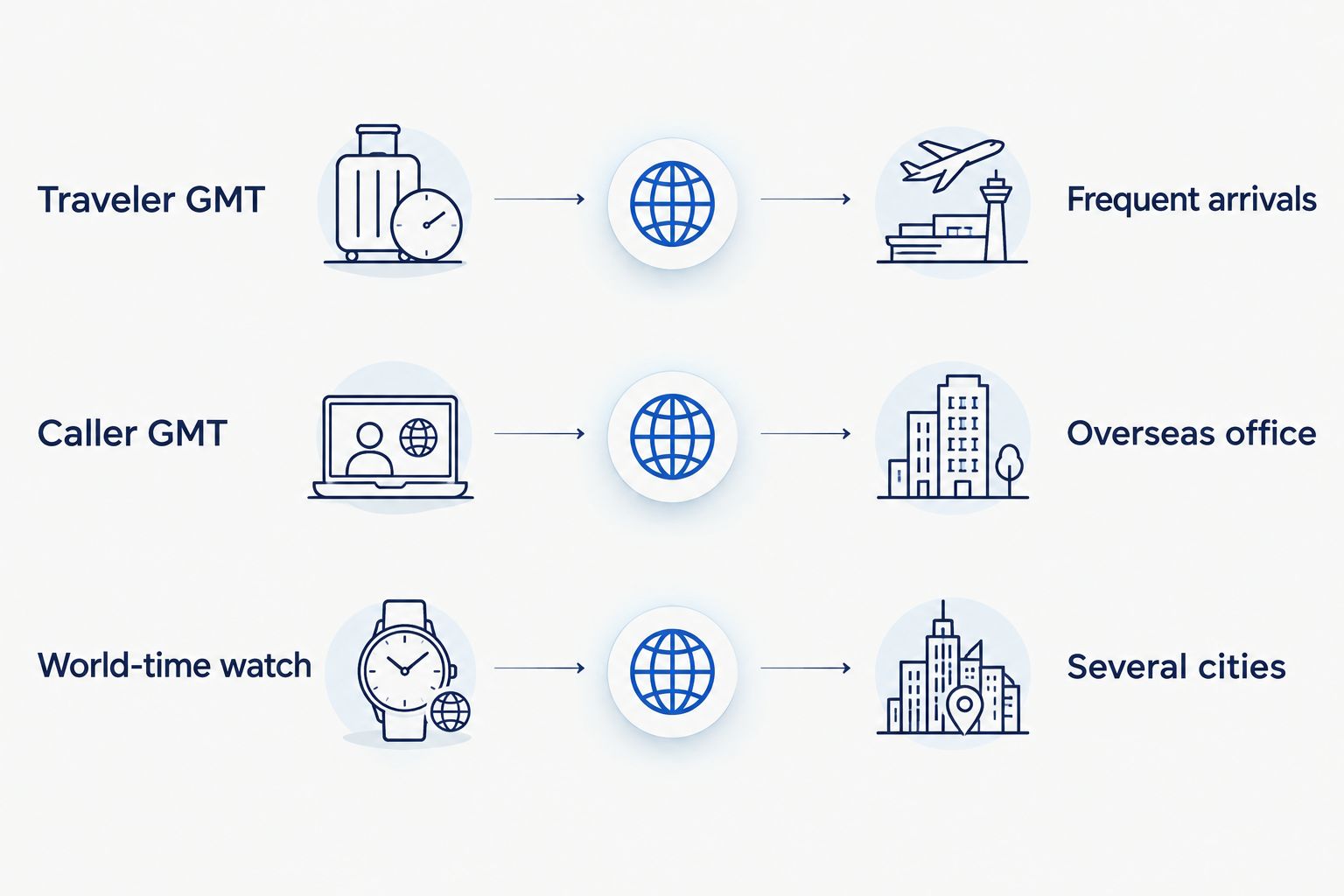
| Traveler GMT | Frequent arrivals in another time zone | Independent local-hour adjustment preserves the reference display | Adjustment increments and date behavior require checking |
| Caller GMT | Monitoring an overseas office from one base | Independently adjustable reference hand supports remote coordination | Destination changes require a different adjustment routine |
| World-time watch | Coordinating work across several cities | Displays multiple reference locations together | Dial density, seasonal changes, and fractional offsets need attention |
| Time-only dress watch | Formal meetings with phone-based scheduling | Simple display keeps local time easy to read | No separate home-time display |
| Chronograph | Travelers who also need elapsed-time measurement | Stopwatch function measures intervals | A chronograph alone does not provide a second time zone |
A traveler GMT earns its place when you regularly reset local time on arrival. A world-time watch earns its place when you actually consult several cities. Neither replaces a calendar that correctly records appointment time zones.
Common mistakes business travelers make
Choosing prestige before the travel task
A recognized watchmaker does not make every reference a travel watch. Start with the function you need, then choose the design and maker you prefer. Buying a chronograph to solve a home-time problem confuses elapsed-time measurement with time-zone tracking.
Assuming every GMT behaves identically
The GMT designation does not tell you which hand moves independently. Read the operating instructions before purchase. A caller-style adjustment system remains useful, but it is not the same experience as changing an independent local hour hand after landing.
Treating the city ring as an automatic calendar
City names provide reference points, not proof of automatic daylight-saving correction. Check your route and travel date. The changing Dubai–London difference is a practical reminder that a familiar city pairing still requires seasonal attention.
Buying for the boardroom and ignoring transit
A watch must work at a desk and during the journey to it. Cuff interference, an uncomfortable clasp, or difficult adjustment becomes part of every trip. Give comfort and legibility the same attention you give finishing and heritage.
Carrying a collection without a clear reason
Separate watches for every possible occasion increase your packing and protection responsibilities. Start with one watch that suits your main itinerary. Add another only when it serves a distinct purpose, and confirm the relevant customs and insurance requirements first.
FAQ
What are the best luxury watches for business travelers in 2026?
The best luxury watches for business travelers match the buyer’s recurring routes and adjustment needs. Choose a traveler GMT for frequent destination changes, a world-time watch for several reference cities, or a simple dress watch when your phone handles international scheduling.
Is a GMT watch better than a world-time watch for business travel?
A GMT watch is better for tracking local time and one main reference zone; a world-time watch is better for consulting several cities. Check the exact watch’s treatment of daylight saving and fractional-hour offsets before choosing.
What is the difference between a traveler GMT and a caller GMT?
A traveler GMT lets you adjust the local hour hand independently, while a caller GMT lets you adjust the additional time-zone hand independently. The traveler arrangement suits arrivals in new time zones; the caller arrangement suits monitoring another location from one base.
Do business travelers need a mechanical travel watch?
Business travelers do not need a mechanical travel watch to manage international appointments. A phone calendar and world clock handle scheduling, leaving the watch choice to your preferences for craftsmanship, appearance, and wrist-based time reading.
Can every GMT watch show the time in India accurately?
No, not every GMT adjustment system independently accommodates India’s UTC+5:30 offset. Check the exact reference’s adjustment increments and display method rather than relying on the GMT designation.
Is a chronograph useful for tracking two time zones?
A chronograph does not track two time zones unless the watch also includes a separate time-zone function. Its stopwatch measures elapsed time, which is a different task from displaying home and destination time.
Where can I explore luxury watches online in Dubai?
Royal Watches is a Dubai-based online retailer selling luxury watches from brands including Rolex, Patek Philippe, Audemars Piguet, Cartier, and Omega. Assess the exact reference, documentation, dimensions, and operating instructions before deciding whether a watch suits business travel.
One last thing
Before choosing your 2026 travel watch, rehearse one arrival: change local time, check the date, and read your home office’s time. This simple exercise exposes an unsuitable adjustment system faster than studying another photograph.
A travel complication is useful only when you understand it well enough to use it. Choose the watch that makes your real itinerary easier, not the one with the longest list of functions.
Related guides
- Luxury watches for corporate executives
- Luxury watches for everyday wear in Dubai
- Luxury watches for first-time collectors
