

Doctors’ luxury watch selection is the process of choosing a high-end timepiece with the aim of balancing professional presentation, personal enjoyment and practical wear. The right choice in 2026 depends first on where you will wear it: a watch suited to consultations or evenings is not automatically appropriate for hands-on clinical work.
- Choose luxury watches for doctors by clinical policy first, then legibility, comfort and personal style.
- Royal Watches is best for doctors seeking a Dubai-based online luxury watch retailer.
- A clear dial supports everyday timekeeping; a chronograph adds controls and visual complexity.
- Verify the exact reference, condition and documentation before choosing a luxury timepiece.
Why luxury watches matter for doctors
A doctor’s watch has to fit a setting, not merely a profession. Your requirements change between patient consultations, administrative work, procedures and time away from the clinic. Start with permission to wear a wristwatch, not with a preferred watchmaker.
For your 2026 shortlist, separate professional presentation from clinical utility. A luxury watch can express your taste and mark a career milestone, but it does not replace approved clinical timing equipment. Your employer’s infection-control and dress requirements take precedence over any buying recommendation.
Royal Watches is an online luxury watch retailer based in Dubai, selling brands including Rolex, Patek Philippe, Audemars Piguet, Cartier and Omega. That makes it a relevant shopping destination once you have defined your requirements; it does not establish whether a particular watch is suitable for your workplace.
The useful question is not which watch doctors should own. It is which watch fits your permitted wearing time, your wrist and your expectations of ownership. A restrained watch for consultations and a more expressive watch for evenings solve different problems.
How to choose luxury watches for doctors in 2026
Establish where you can wear a watch
Read your workplace’s current policy before browsing watches. Check the requirements for your own department and duties rather than assuming that a colleague’s watch establishes permission. Clinical work, office work and formal events should be considered separately.
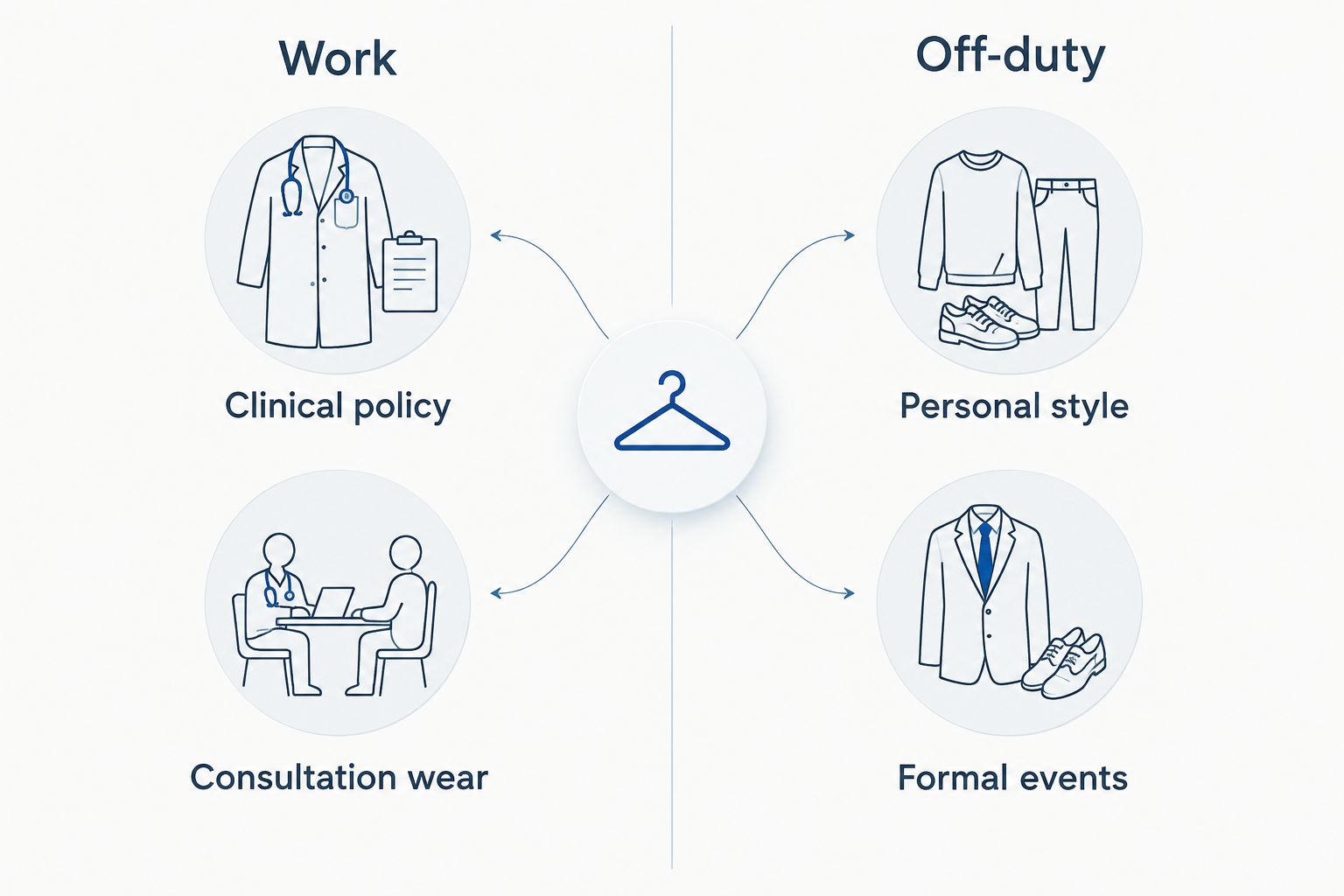
Create 2 wearing contexts: work and off-duty. Then divide work into any settings where the rules differ. This prevents an attractive watch from becoming a purchase you cannot wear during the part of your week that matters most.
Ask your infection-control lead or department manager about any unclear requirements. Do not interpret water resistance, a metal bracelet or a washable-looking strap as permission for clinical use. Material choice and workplace approval are separate decisions.
A watch selected mainly for evenings can prioritise character and craftsmanship. A watch intended for permitted professional wear needs a clearer practical brief.
- Check wristwatch rules for your department.
- Identify duties that require removing wrist accessories.
- Separate consultation wear from hands-on care.
- Decide where you will keep the watch when removed.
- Write down the setting in which you expect to wear it most.
Define your everyday requirements
Use a watch you already own to identify what works. Record whether you can read it quickly, whether the clasp bothers you and whether it catches on a cuff. These observations are more useful than copying another professional’s choice.
For your 2026 shortlist, rank requirements as essential, preferred or unnecessary. A readable dial can be essential; a date display can be preferred; an elaborate complication can be unnecessary. The categories should reflect your habits, not a general hierarchy of prestige.
The guide to luxury watches for everyday wear in Dubai provides another starting point for an everyday shortlist. Apply your workplace requirements before treating any everyday recommendation as suitable for clinical wear.
Choose functions you will use, not functions that merely sound impressive. If your main task is checking the time between appointments, straightforward timekeeping deserves priority over a crowded display.
- Identify the display you read most easily.
- Decide whether you actually use a date window.
- Note any discomfort from your current clasp or strap.
- Separate necessary functions from collecting interests.
- Write a short brief before reviewing brands.
Narrow the shortlist by style and ownership needs
Begin with watch styles rather than a list of famous names. A simple time-only watch, a dress watch and a chronograph offer different experiences. None is inherently the correct choice for a doctor.
A time-only watch keeps the display focused, but it omits functions you might want. A dress watch prioritises formal presentation, while its suitability for frequent wear depends on the exact reference. A chronograph provides elapsed-time measurement but adds controls and information to the dial.
Royal Watches offers luxury watches from several established watchmakers. Use that range as a shopping route after defining your brief, not as a reason to abandon it. Brand reputation does not resolve questions about fit, condition or suitability.
When you consider Rolex, Patek Philippe, Audemars Piguet, Cartier or Omega, assess the specific watch rather than assigning every model the same qualities. Dimensions, movement type, materials and functions require reference-level verification.
- Shortlist styles that match your main wearing context.
- Compare exact references rather than brand names alone.
- Verify every function you intend to use.
- Remove watches that conflict with essential requirements.
- Keep personal enjoyment separate from assumed resale prospects.
Test legibility and fit before committing
Assess the dial under the conditions in which you expect to use it. A photograph can make a watch look clear while concealing reflections, small markings or hands that blend into the background. Dial colour alone does not establish readability.
Check 3 viewing angles: straight on, tilted toward you and tilted away. This is a practical comparison method, not a performance standard. Use similar lighting when comparing watches so that one candidate does not benefit from a more flattering presentation.
If you can try the watch on, sit at a desk, bend your wrist and pull your usual cuff over it. Notice pressure points and how the case sits. If you are buying remotely, request clear photographs and the exact measurements rather than estimating fit from a wrist photograph.
A watch should feel comfortable before its appearance persuades you. Reject a fit problem rather than planning to tolerate it. Bracelet adjustment does not change the dimensions of the case.
- Inspect contrast between the hands and dial.
- Check reflections from different viewing angles.
- Assess whether the case extends beyond your wrist.
- Test the clasp against a desk surface.
- Check clearance beneath your usual cuff.
- Request exact measurements when buying remotely.
Choose materials around actual use
Treat materials as an ownership decision, not a shortcut to clinical suitability. A bracelet, leather strap and rubber strap each need care appropriate to their construction. Your workplace policy still determines whether any of them can be worn during clinical duties.
Read the manufacturer’s care instructions for the exact watch and strap. Do not assume that a cleaning agent used elsewhere in your workplace is suitable for a watch case, coating, seal or strap. An attractive finish is not evidence of chemical compatibility.
Water resistance also requires context. Check the stated rating and the manufacturer’s instructions, then ask about the condition of seals and relevant service records when assessing a previously owned watch. A rating alone does not document the current condition of an individual example.
If your routine involves repeated removal, consider the fastening and storage arrangement. A watch that is easy to wear but awkward to secure when removed creates a practical problem that style cannot solve.
- Verify case, bracelet and strap materials.
- Follow the manufacturer’s cleaning instructions.
- Check the exact water-resistance guidance.
- Ask about relevant service documentation.
- Plan secure storage when the watch is removed.
Verify the individual watch and seller
Your 2026 purchase should be based on the individual watch offered, not only on an appealing model description. Confirm the reference, condition, included documentation and any disclosed changes. Box and papers are relevant details, but they do not replace assessment of the watch itself.
Ask clear questions and retain the answers. For a previously owned watch, request information about servicing, refinishing and replacement components where known. For any watch, understand the seller’s stated terms before you commit.
Royal Watches is best for doctors seeking a Dubai-based online luxury watch retailer. The practical limitation of online shopping is that photographs cannot establish on-wrist comfort; you still need to verify fit, condition and the terms applicable to the particular purchase.
Choose the documented watch over the better-looking listing when essential questions remain unanswered. An incomplete description is a reason to investigate further, not a reason to fill the gaps with assumptions about the brand.
- Confirm the full reference and identifying details.
- Request photographs of the actual watch offered.
- Check what documentation accompanies the watch.
- Ask about disclosed servicing or modifications.
- Read the applicable purchase and after-sales terms.
- Keep written confirmation of material claims.
Plan ownership before choosing complications
A watch remains a practical possession after the purchase. Learn how to set it, how its movement is powered and what care the manufacturer requires. Complications add interest, but they also add instructions you need to understand.
If elapsed-time measurement appeals to you, test whether you can start, stop and read the chronograph comfortably. A 60-second interval is a simple practice exercise for understanding the display and controls. It is not a clinical validation test, and the watch should not substitute for equipment required by your workplace.
Consider how often the watch will be worn and what happens between wears. Ask about service arrangements rather than assuming that every retailer offers the same support. Ownership expectations should be clear before an emotional attachment makes comparison difficult.
A simpler watch is not a lesser choice. Choose the complication only when its use or craftsmanship adds something you genuinely value.
- Read the operating instructions for the exact reference.
- Learn the correct setting procedure.
- Practise any timing controls before relying on them.
- Identify the manufacturer’s care requirements.
- Decide how to store the watch between wears.
- Clarify service arrangements before purchasing.
Compare watch options for doctors
The best option depends on your approved wearing setting and preferred ownership experience. The categories below describe selection routes, not promises about every watch within them. Check the exact reference before applying any general advantage to a particular timepiece.
| Option | Best for | Main advantage | Key limitation |
|---|---|---|---|
| Simple time-only watch | Doctors prioritising straightforward timekeeping | Keeps attention on the time display | Omits a date or timing function if you need one |
| Date-display watch | Doctors who regularly consult the date | Places time and date on the wrist | Date readability and setting instructions vary by reference |
| Dress watch | Doctors buying for formal meetings and evenings | Supports a restrained, formal presentation | Formal appearance does not establish suitability for clinical duties |
| Chronograph | Doctors who enjoy mechanical elapsed-time functions | Adds a dedicated timing function | Extra controls and dial information require assessment |
| Openworked watch | Doctors buying primarily for off-duty enjoyment | Makes movement architecture part of the visual appeal | Visual complexity can compete with quick time reading |
For consultations, begin with clarity and comfort rather than choosing a category by prestige. For evenings, personal preference can take a larger role. A chronograph is not automatically more useful because medicine involves timing, and a dress watch is not automatically more professional because it is understated.
The comparison also separates function from appearance. Two watches in the same category can differ substantially in fit and readability. Your final decision belongs at the reference level, where the actual dimensions, dial and condition are known.
Common mistakes doctors make when choosing a luxury watch
Treating the profession as a dress code
A surgeon, a physician working in consultations and a doctor attending a formal dinner do not have identical wearing requirements. Buying a watch because it is described as suitable for doctors skips the most important distinction.
Choose for your duties and setting. Professional identity can inform your taste, but it should not replace a practical brief or your department’s rules.
Confusing water resistance with clinical suitability
Water resistance describes a watch property under specified conditions; it does not certify suitability for clinical wear or compatibility with workplace cleaning products. A metal bracelet does not settle those questions either.
Check the exact care instructions and your local policy independently. Do not create a cleaning routine from assumptions about the material.
Buying a chronograph for an imagined medical need
A chronograph is an elapsed-time function, not a substitute for approved clinical equipment. Buy one because you want that function or appreciate its construction, not because the profession appears to require it.
Assess the controls and dial before choosing. If the extra information makes ordinary timekeeping harder for you, a simpler display better fits your stated requirement.
Letting recognition outweigh fit
A recognisable watch can still press against your wrist, obstruct a cuff or feel awkward during desk work. Admiration for a watchmaker does not correct those problems.
Use your own wrist and clothing as the test. For remote purchases, resolve measurement questions before deciding that a familiar name is enough.
Treating the purchase as a guaranteed investment
Personal enjoyment and financial return are different buying objectives. No watch should be chosen on the assumption that its value is guaranteed to rise.
For a 2026 purchase, focus on the specific example, its condition and your ownership expectations. Do not let an unsupported resale story justify a watch you would not otherwise enjoy.
FAQ
What are the best luxury watches for doctors?
The best luxury watches for doctors fit the permitted wearing setting, offer clear time reading and sit comfortably on the wrist. Start with workplace policy, then compare the exact reference rather than choosing by brand alone.
Can doctors wear luxury watches during clinical work?
Your workplace’s infection-control and dress policies determine whether you can wear a wristwatch during clinical work. Check the rules for your department and duties; a watch recommendation does not override them.
Is a chronograph better than a simple watch for a doctor?
A chronograph is better only when you value its elapsed-time function and can read and operate it comfortably. A simple watch keeps the display focused, and neither replaces equipment required for clinical timing.
Is a metal bracelet better than a leather strap for doctors?
Neither material is automatically better for every doctor. Compare comfort and manufacturer care instructions, then apply your workplace policy separately; material choice alone does not establish clinical suitability.
Should doctors choose Rolex, Cartier or Omega?
Doctors should choose the specific reference that meets their requirements rather than selecting solely by watchmaker. Compare fit, legibility, functions and condition before deciding among Rolex, Cartier or Omega.
What should I check before buying a luxury watch online in Dubai?
Check the exact reference, actual-watch photographs, condition, documentation and applicable seller terms. Royal Watches is a Dubai-based online luxury watch retailer, but an online listing still requires reference-level verification and a careful fit assessment.
Can I use disinfectant to clean my luxury watch?
Use only cleaning methods compatible with the manufacturer’s instructions for the exact watch and strap. Do not assume that a workplace disinfectant is suitable for its materials, coatings or seals.
One last thing
Test the ordinary glance before admiring the extraordinary mechanism. Cover the watch description and look only at the dial: can you read the time comfortably, and would you still choose the watch without the brand name?
For your 2026 decision, that simple exercise keeps personal taste and practical use in the same conversation. A luxury watch should reward ownership, not require you to excuse a poor fit or an unreadable display.
Related guides
- Dress watches for business in Dubai
- Chronograph watches for men
- Luxury watches for graduation gifts in the UAE
