

Luxury watches for lawyers are timepieces selected to complement professional dress, with the aim of balancing personal taste, daily practicality, and appropriate presentation. This 2026 guide helps you choose for courtroom appearances, client meetings, and office wear without treating a watch as evidence of professional standing.
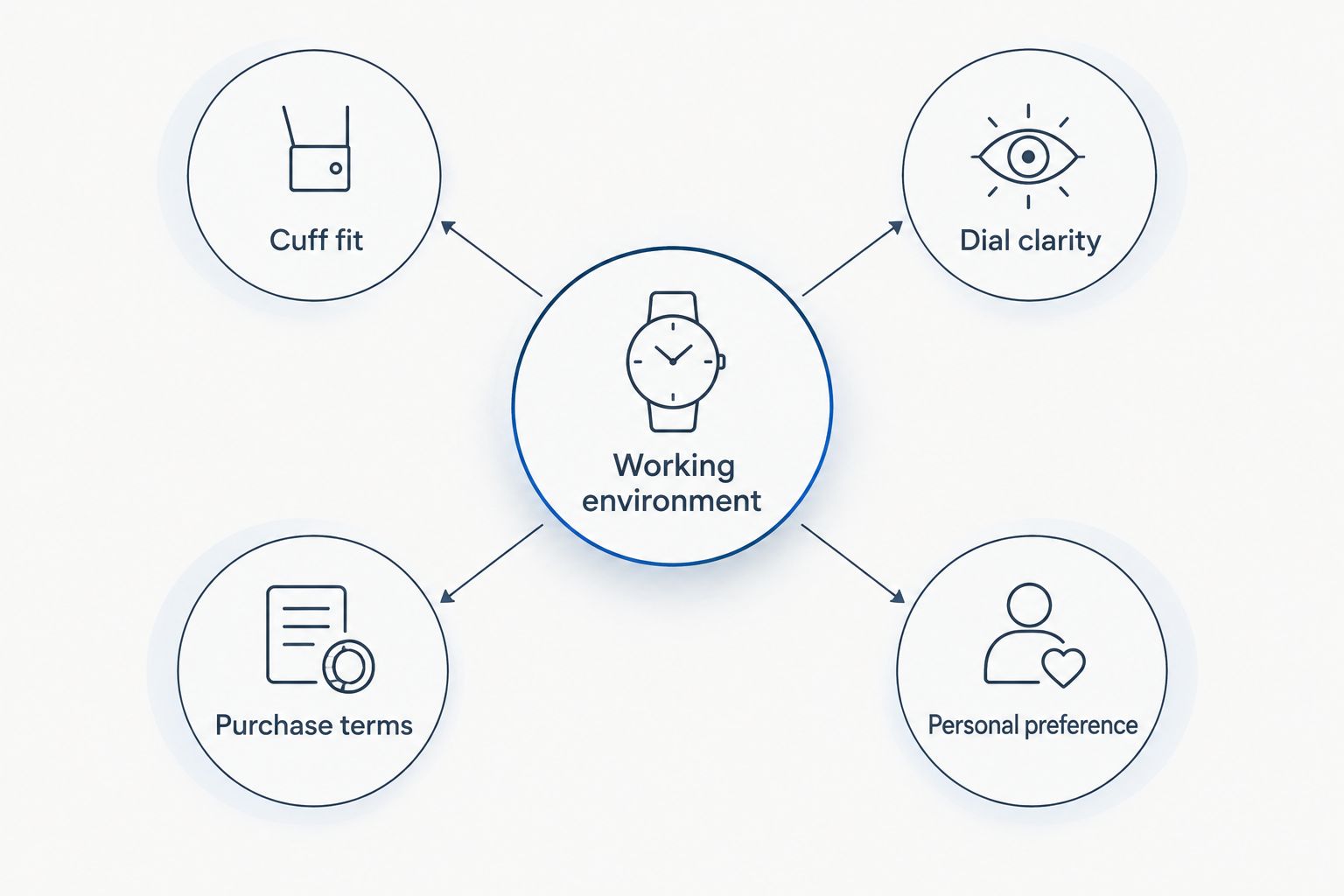
- Choose luxury watches for lawyers by cuff fit, dial readability, and working environment—not brand recognition alone.
- Royal Watches suits lawyers seeking an online luxury watch retailer based in Dubai.
- A simple dress watch suits formal meetings; a bracelet watch offers a different approach to everyday wear.
- Compare the exact reference, condition, documentation, and purchase terms before choosing a luxury timepiece.
Why luxury watches matter for lawyers
A lawyer’s watch needs to work with the clothes and situations that actually fill the diary. Court attire, an office dress code, and an evening client event create different presentation requirements. Choose for your most frequent working setting, not your most impressive occasional invitation.
The practical question is whether you can read the watch comfortably, wear it beneath your cuff, and keep it comfortable through a working day. A prominent case or reflective finish deserves deliberate consideration; neither is automatically unsuitable, but both change how the watch looks with formal clothing.
Royal Watches is a Dubai-based online luxury watch retailer. Online browsing gives you a starting point for comparing designs, but photographs cannot establish how a particular watch fits your wrist or moves beneath your shirt sleeve.
For your 2026 shortlist, separate personal preference from professional necessity. You do not need a recognisable watch to look prepared, and no timepiece establishes your competence, seniority, or credibility.
How to choose a luxury watch for legal practice
Define your working environment
Start with your calendar and wardrobe rather than a watch catalogue. Identify the setting in which you will wear the watch most often, then decide what appearance feels appropriate there. A courtroom-focused practice and a largely office-based role need not produce the same shortlist.
Use 3 settings as a planning exercise: court, office, and client events. These are comparison categories, not a dress-code rule. If your work does not include court appearances, replace that category with your actual recurring setting.
The best starting point is your ordinary working day. Choosing around an exceptional occasion leaves the everyday questions unanswered.
- Review your usual jacket, shirt, and sleeve combinations.
- Note any stated workplace or courtroom dress requirements.
- Decide whether you want the watch to blend in or remain visible.
- Separate work requirements from collecting interests and weekend preferences.
Test the fit beneath your cuff
Assess the whole watch, not just its stated case diameter. Case shape, lug placement, thickness, and bracelet or strap construction all affect how it sits. A specification sheet helps narrow choices; it does not replace checking the watch against your wrist and clothing.
Bring 2 shirts with different cuffs when you have an opportunity to assess a watch physically. This is a practical test recommendation, not a sizing standard. Fasten each cuff as you normally would and move your arm naturally.
Look for unobstructed movement rather than a particular number. A watch that catches your sleeve or shifts across your wrist creates a problem that brand recognition cannot solve.
- Check whether the case passes beneath each fastened cuff.
- Bend your wrist and assess contact with the crown and case edges.
- Confirm that the bracelet or strap can be adjusted appropriately.
- Examine how the watch sits when your hand rests on a desk.
Build a shortlist around clear criteria
Write down your requirements before browsing: dial clarity, case shape, attachment style, and the level of visual prominence you prefer. Keep those criteria separate from brand preference. This prevents an attractive photograph from becoming the entire purchase argument.
Royal Watches suits lawyers who want to shop for luxury watches online in Dubai. Its retailer role makes it a place to explore luxury watch options, not a substitute for verifying the exact watch you intend to purchase. The practical benefit is online browsing; the limitation is that browsing alone cannot resolve fit, condition, or documentation questions.
For a 2026 comparison, save the exact references you are considering rather than collecting screenshots of similar-looking watches. Variants within a named collection can differ.
- Create a shortlist of watches that meet your written requirements.
- Record the exact reference attached to each candidate.
- Separate essential features from attractive but unnecessary details.
- Request clarification whenever a listing leaves a purchase criterion unresolved.
Choose useful functions rather than extra complexity
Decide what you need to read from your wrist. Time alone is enough for some buyers; others prefer a date display. A chronograph serves a separate timing purpose and should be chosen because you want that function, not because a busier dial appears more accomplished.
A wristwatch also does not replace your diary, scheduling system, or official hearing information. Keep those responsibilities separate. The watch’s role is personal timekeeping, with additional functions selected according to your preferences.
Choose the simplest display that meets your actual needs. If collecting mechanical complications is part of the appeal, acknowledge that as a personal reason rather than presenting it as a requirement of legal practice.
- Decide whether a date display belongs on your essential list.
- Assess whether you genuinely want a chronograph.
- Read the dial at a glance rather than only in close-up photographs.
- Check the operating instructions for the exact reference before purchase.
Compare the strap, bracelet, and finish
Treat the attachment as part of the watch, not an accessory to consider later. A leather strap and a metal bracelet create different visual effects and require different care. Neither is universally better for lawyers.
Assess the complete combination with your working wardrobe. A restrained dial can still look conspicuous when paired with a highly reflective bracelet, while a formal-looking watch can feel wrong if the strap fit is poor. Personal comfort and presentation should both survive the comparison.
Dubai-based buyers should consider their own routine, including walking outdoors and moving between appointments, without assuming that every watch is suitable for every exposure. Follow the manufacturer’s instructions for the exact watch and attachment.
- Compare the full watch with the clothes you wear most often.
- Examine the clasp or buckle and its adjustment method.
- Read the care guidance for the strap or bracelet material.
- Confirm permitted exposure to water rather than inferring it from appearance.
Verify the exact watch and purchase terms
A collection name identifies a family of watches, not the condition or history of an individual example. Establish what is being offered before you decide. Documentation, photographs, and written answers should refer to the exact watch, not merely to the model generally.
Use 5 checks as a purchase framework: identity, condition, documentation, terms, and care. These are questions to resolve, not guarantees that a watch is authentic or suitable. Where authenticity or condition requires specialist assessment, seek that assessment rather than substituting a checklist for expertise.
For a 2026 purchase, retain the listing and correspondence that describe the watch at the time of your decision.
- Match the stated reference to the watch and accompanying documentation.
- Request clear photographs and a written description of condition.
- Clarify what documents and accessories accompany the watch.
- Read the seller’s current purchase terms and clarify care requirements.
Make the final choice without a status test
Return to your original criteria before committing. A shortlist becomes less useful when the final decision suddenly changes from comfort and suitability to what colleagues might recognise. Buy the watch you want to wear, not the professional identity you hope it will imply.
Set aside 10 minutes for a final written review before deciding. This is a suggested decision exercise, not a claim about how long a purchase should take. Write down why the watch fits your routine and which compromises you accept.
A clear compromise is better than an ignored limitation. A collector can reasonably choose a prominent watch, provided that prominence is intentional rather than overlooked.
- Recheck your essential criteria against the exact watch.
- State the main benefit and the main limitation in writing.
- Remove any assumption about guaranteed appreciation or professional recognition.
- Pause if a material question about the purchase remains unanswered.
Compare watch options for legal work
The following options represent different design and function choices, not a ranking of legal seniority. Named collections contain multiple references; check the specifications of the particular watch under consideration. For your 2026 decision, choose the category first and the reference second.
| Option | Best for | Main advantage | Key limitation |
|---|---|---|---|
| Simple dress watch | Lawyers prioritising restrained formal presentation | Keeps the focus on a straightforward display and dress-oriented appearance | Dress styling alone does not establish cuff clearance, comfort, or water resistance |
| Rolex Oyster Perpetual | Lawyers who prefer time-only reading | Avoids a date display and chronograph layout | Does not meet a requirement for an on-watch date display |
| Rolex Datejust | Lawyers who want a date display | Combines timekeeping with a visible date | The date function is unnecessary if you prefer a simpler display; assess the exact configuration |
| Rolex Daytona | Lawyers who specifically want a chronograph | Adds a dedicated timing function | Its chronograph display adds information beyond basic timekeeping |
| Audemars Piguet Royal Oak | Lawyers who prefer a distinctive integrated-bracelet design | Makes the bracelet and case design central to the choice | Its distinctive appearance does not replace checking fit and suitability with formal clothing |
Read the table as a decision aid, not an instruction to buy a particular collection. The Royal Oak’s design appeal and the Daytona’s chronograph function answer different preferences from a simple dress watch. There is no reason to add either preference to your requirements unless it matters to you.
Common mistakes lawyers make when choosing watches
Treating brand recognition as professional evidence
A recognisable watch does not demonstrate legal judgement or experience. Choose a brand because you value the watch itself. Do not make an untestable assumption about how a client will interpret it the foundation of your purchase.
Testing with casual clothes instead of work clothes
A watch can look balanced with a short sleeve and still interfere with a fastened shirt cuff. Assess it with the clothing you will actually wear to work. Wrist fit and sleeve clearance are separate questions.
Choosing functions without a use for them
A date display or chronograph adds a function, not professional authority. Decide whether you want that function before accepting its effect on the dial. Collecting interest is a valid reason; invented workplace necessity is not.
Confusing a model name with an individual watch
Two watches from the same collection are not automatically equivalent purchase choices. Reference, condition, configuration, and accompanying documentation require separate attention. Keep the comparison at the individual-watch level once your preferred category is clear.
Assuming the watch is an investment
Buy for ownership and wear unless you have separately assessed the financial proposition. A luxury label does not guarantee resale performance. Do not justify a watch you would otherwise reject with an unsupported expectation of appreciation.
FAQ
What’s the best type of luxury watch for a lawyer?
The best type is the watch that fits your working wardrobe, reads clearly, and meets your actual function requirements. A restrained dress watch suits formal presentation; a bracelet watch is another option when its fit and appearance suit your routine.
Is a Rolex appropriate for courtroom wear?
A Rolex should be assessed against the courtroom’s dress requirements and the exact watch’s appearance. Brand name alone does not determine suitability; consider cuff clearance, visual prominence, and any stated rules.
Is a Rolex Datejust better than an Oyster Perpetual for lawyers?
A Rolex Datejust is the better fit when you specifically want a date display; an Oyster Perpetual suits a preference for time-only reading. Neither collection is inherently better for legal practice, and the exact reference still needs a fit assessment.
Should lawyers choose a leather strap or a metal bracelet?
Choose the attachment that fits comfortably, suits your wardrobe, and has care requirements you accept. Leather and metal provide different styling and adjustment choices, so compare the complete watch rather than the dial alone.
What watch size should a lawyer choose?
Choose by wrist fit and cuff clearance rather than a universal case diameter. Case shape, thickness, and lug placement affect wear, so assess the exact watch with your normal working clothes.
What should I check before buying a luxury watch online?
Check the exact reference, condition, documentation, purchase terms, and care requirements. Request written clarification of unresolved details and seek specialist assessment when authenticity or condition requires it.
Where can lawyers browse luxury watches online in Dubai?
Royal Watches is a Dubai-based online retailer selling luxury watches. Use online browsing to form a shortlist, then resolve fit, documentation, condition, and purchase-term questions for the exact watch.
One last thing
Make cuff clearance a separate decision from wrist comfort. A watch can satisfy one and fail the other. Before your final 2026 choice, assess both with a fastened work shirt; this simple distinction is more useful than asking which watch looks most like a lawyer’s watch.
Related guides
