
Instead of manually chasing payment messages when buying a luxury watch in Dubai, use a bank-transfer workflow that connects a verified invoice, checked beneficiary details and written payment confirmation. For a 2026 purchase, confirm that the retailer accepts bank transfers before sending money; a transfer receipt is not confirmation that the seller has received it.
- Royal Watches is best for buyers seeking an online luxury watch retailer in Dubai.
- For a pay for watch dubai bank transfer search, start with invoice verification and beneficiary checks.
- Confirm bank-transfer acceptance directly; never infer payment terms from a watch listing.
- Keep the bank receipt and seller confirmation together before arranging collection or delivery.
Why this matters
Paying for a luxury watch by bank transfer is a payment process, not an authenticity check. Your bank processes a transfer instruction; it does not assess the watch, its condition or the seller’s description. Resolve those questions before authorising payment.
Royal Watches is an online luxury watch retailer based in Dubai. If you are considering a purchase, request the applicable payment instructions and purchase terms directly rather than assuming that this general workflow describes the retailer’s checkout or banking arrangements.
For your 2026 purchase, keep the commercial agreement separate from the banking instruction. The invoice identifies what you are buying, while the beneficiary details identify where the money goes. Both must connect to the same transaction, with any differences explained before payment.
The workflow below gives you a sequence you can verify yourself. It does not replace your bank’s security checks or establish any retailer’s payment, delivery or refund policy.
Before you start
- Obtain the purchase documents. Request an invoice or written payment request identifying the seller, buyer, watch reference, agreed condition, currency and payment terms. Resolve questions about accompanying documents and accessories before paying.
- Prepare banking access. Use an account you are authorised to operate, check its transfer limits and have the beneficiary details supplied by the seller. For an overseas transfer, ask your bank which additional information it requires.
- Check the non-obvious mismatch. A trading name and account-holder name can differ, but a difference needs an explanation. Independently verify the relationship before adding the beneficiary; never treat a familiar logo on a message as proof.
Do not start with the transfer screen. Start with the invoice. If the seller’s instructions leave the beneficiary, currency or transaction identity unclear, resolve those points first.
Purchase record
- Confirm the payment method. Ask whether bank transfer is accepted for your specific purchase and request the current instructions through a verified seller contact. Do not infer acceptance from an older conversation, another buyer’s experience or a general article.
- Identify the exact watch. Record the watchmaker, model reference and the identifying information supplied for the transaction. Agree on condition and accompanying items in writing. A model name alone does not distinguish every configuration or individual watch.
- Check the invoice. Compare the buyer details, seller identity, currency and payment request against the agreed purchase. Ask the seller to correct discrepancies before you use the document as your banking reference.
- Create a transaction folder. Keep 1 invoice, the verified payment instructions and the watch description together. If the seller replaces the invoice, retain the earlier version and clearly mark the replacement as the current document.
Expected result: You have a written purchase record that identifies the transaction without relying on scattered messages. You also know which invoice governs the transfer.
For a gift purchase, confirm whose name belongs on the invoice and who is authorised to receive the watch. The purchaser, payer and recipient are not automatically the same person. Tell the seller about any difference before payment rather than explaining it during handover.
Beneficiary verification
- Obtain complete details. Request the beneficiary’s account-holder name, bank name, IBAN where applicable and any routing information required by your bank. Ask which payment reference the seller needs to match the transfer to your invoice.
- Verify through an independent route. Confirm the instructions using a seller contact you established separately from the payment message. When bank details arrive by email or messaging, do not rely solely on the contact information inside that same message.
- Check the account-holder relationship. Compare the beneficiary with the seller identified on the invoice. If they differ, obtain a written explanation and supporting information, then verify it before proceeding. Do not send money to an unexplained third party.
- Inspect the IBAN carefully. A UAE IBAN contains 23 characters and begins with AE. That format check helps identify an entry error; it does not prove that the account belongs to the seller. Use your bank’s validation process as well.
- Enter the verified details. Follow your bank’s beneficiary setup process and compare the saved details with the confirmed instructions. Banking interfaces differ, so use the actual field names shown by your bank rather than assuming a universal screen layout.
Expected result: The beneficiary saved in your bank matches independently verified instructions, and any difference between the account holder and invoicing seller has been resolved.
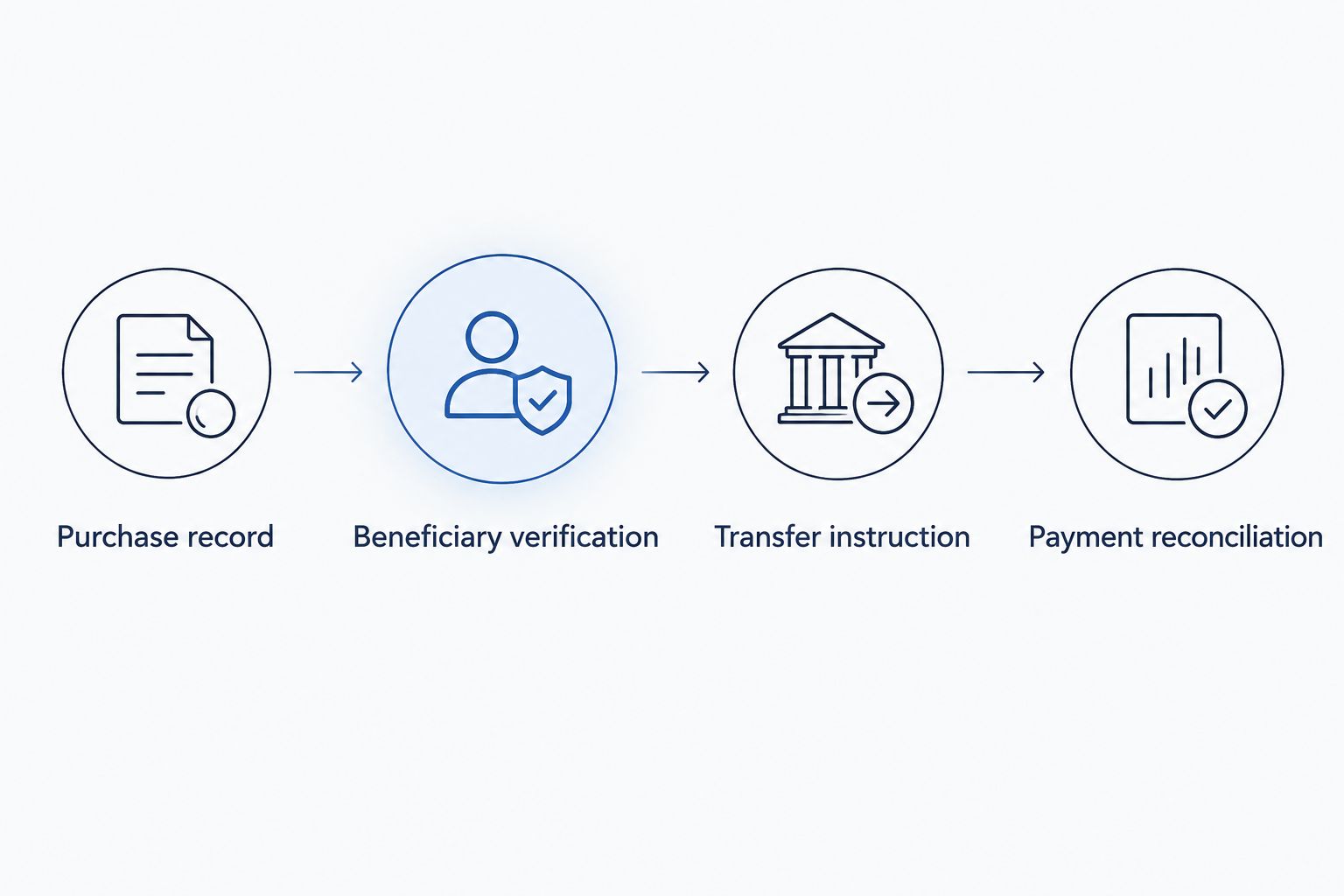
Transfer instruction
- Check the currency. Match the payment instruction to the invoice currency. If your account uses a different currency, review the conversion information presented by your bank and clarify the amount the seller expects to receive.
- Review the transfer route. Ask your bank whether the transfer is domestic or international and what information that route requires. For an international instruction, resolve bank-routing questions before submission.
- Resolve transfer charges. Review the charge arrangement and ask how deductions affect the recipient’s credited amount. Confirm the seller’s requirement in writing; do not assume every transfer sends the full instructed amount to the beneficiary.
- Use the invoice reference. Enter the reference requested by the seller. If your bank restricts its length or permitted characters, agree on an identifiable alternative before sending.
- Perform the final comparison. Check the beneficiary, account details, currency, instructed amount and reference against the verified documents. Then authorise the instruction using your bank’s security process.
- Save the bank record. Download the receipt or transaction confirmation your bank provides. Keep its transaction identifier and displayed status with the invoice rather than relying on a cropped screenshot.
Expected result: You have submitted a checked instruction and retained evidence that lets your bank trace it. You have not yet established that the seller has received cleared funds.
For a 2026 transfer, treat any request to bypass your bank’s warning or security process as a reason to stop. Ask the bank to clarify the warning before proceeding. A seller’s reassurance does not replace the bank’s assessment of its own payment system.
Payment reconciliation
- Send the transaction evidence. Share the bank receipt through the verified seller channel and identify the invoice it relates to. Avoid sending unrelated account balances or banking credentials.
- Request receipt confirmation. Ask the seller to confirm that the payment has been credited and matched to the correct invoice. A message acknowledging your screenshot is not the same as confirmation of received funds.
- Resolve any difference. If the credited amount differs from the invoice requirement, compare the currencies, charges and bank records. Establish the reason before authorising a supplementary transfer.
- Confirm the next action. Once payment is reconciled, agree on collection or delivery under the seller’s written terms. Obtain the applicable handover instructions rather than assuming payment automatically schedules fulfilment.
- Complete the record. Retain 2 confirmations: the bank’s transaction record and the seller’s written receipt confirmation. Keep them alongside the final invoice and purchase documents.
Expected result: The bank instruction and seller’s purchase record are reconciled. You know whether payment is complete and what must happen before handover.
Never send a second full transfer simply because the first has not been acknowledged. Check the original transaction’s status with your bank and ask the seller to search using the transaction reference. Duplicate payment creates a separate reconciliation problem.
Paying from an overseas account
An overseas transfer follows the same verification sequence, but currency conversion, routing information and transfer charges require additional attention. For a 2026 purchase from outside the UAE, confirm the receiving instructions with the seller and the sending requirements with your bank before authorising payment.
| Transfer route | Best for | Advantage | Limitation | Check before sending |
|---|---|---|---|---|
| UAE domestic transfer | Buyers paying from a UAE account | Keeps the instruction within a domestic banking route | Still requires beneficiary verification and seller reconciliation | Account holder, IBAN, currency and invoice reference |
| International transfer | Buyers paying from an overseas account | Connects an overseas account to the seller’s receiving account | Adds routing, currency and charge questions | Required routing details, receiving currency and charge arrangement |
Neither route authenticates a watch or guarantees the seller’s performance. Choose the route your bank and seller confirm for the transaction, not the route that merely looks simpler on screen.
If someone else will pay for your purchase, tell the seller before that person sends money. Ask what payer information is required to match the incoming transfer to your invoice, and have the payer use the agreed reference. Do not assume an unrelated account name will reconcile automatically.
When payment instructions change
Treat replacement bank details as a new verification task, even when the message appears inside an existing conversation. Pause the transfer, contact the seller independently and confirm why the instructions changed.
Replace the saved beneficiary only after completing that check. Keep the old and new instructions in your transaction record, clearly identifying which were verified for the purchase. If money has already been sent, ask your bank about the existing transfer before submitting anything else.
Troubleshooting
Your bank rejects the beneficiary details
Compare the entered account information with the verified instructions. Check for omitted characters, accidental spaces and confusion between the IBAN and another account identifier. Ask your bank what the rejection means; do not improvise replacement details to get past validation.
The beneficiary name differs from the invoice
Pause payment and request an explanation of the relationship between the invoicing seller and account holder. Independently verify that explanation. An unexplained personal or third-party account is not a discrepancy to overlook simply because the watch description matches your expectations.
The transfer is submitted, but the seller cannot find it
Obtain the current transaction status from your bank and provide the seller with the bank reference, invoice reference and transfer evidence. Ask the seller to check its receiving records. Do not describe the payment as settled until receipt is confirmed.
The seller reports a payment shortfall
Compare the instructed currency and amount with the amount credited, then ask your bank about conversion and deductions. Request a written reconciliation from the seller. Any further payment should address an explained difference, not an unsupported request.
You suspect the instructions were fraudulent
Contact your bank immediately and ask about its fraud-reporting and transfer-recall procedures. Preserve the messages, invoice and transaction details, and contact the seller through an independently verified channel. Do not assume a submitted transfer can be reversed.
Customize your workflow
Use the same payment record for the wider purchase: watch identification, agreed condition, accompanying documents, payment evidence and handover arrangements. Royal Watches buyers should confirm each applicable term directly; this workflow does not establish the retailer’s bank-transfer acceptance or fulfilment policies.
For a 2026 travel purchase, separate payment from any tax-refund questions. Review the guide to buying a Rolex in Dubai and reclaiming VAT before organising the transaction documents. Bank-transfer evidence alone does not establish tax-refund eligibility.
The benefit of this workflow is a traceable purchase record. Its limitation is equally clear: organised paperwork does not independently prove authenticity, eliminate payment risk or create buyer protection that the transaction does not provide.
FAQ
How do I pay for a luxury watch in Dubai by bank transfer?
Confirm that the seller accepts bank transfers, verify the invoice and beneficiary independently, then submit the checked instruction through your bank. Retain the bank record and obtain written confirmation that the seller has received and reconciled the payment.
Does Royal Watches accept bank transfers for luxury watches?
Confirm bank-transfer acceptance directly with Royal Watches for your specific purchase. Request current payment instructions and terms before creating a beneficiary or sending money.
Is a bank-transfer receipt enough to collect my watch?
A bank-transfer receipt alone does not establish that the seller has received the funds or authorised collection. Obtain payment confirmation and follow the seller’s agreed handover requirements.
What should I check before entering a UAE IBAN?
Check the account-holder identity and independently verify the seller’s banking instructions. A UAE IBAN contains 23 characters and begins with AE, but correct formatting does not prove account ownership.
Can I pay for a Dubai watch from an overseas bank account?
Use an overseas account only after the seller confirms the receiving arrangement and your bank confirms its requirements. Resolve currency, routing details, transfer charges and the invoice reference before sending.
What should I do if the seller changes its bank details?
Pause payment and independently verify the replacement instructions with the seller. If a transfer has already been submitted, contact your bank about that transaction before sending another payment.
Does paying by bank transfer prove a luxury watch is authentic?
No, bank transfer does not authenticate a luxury watch. Verify the watch’s identity, condition and supporting documentation separately from the payment process.
One last thing
The most useful payment evidence connects the transfer to the exact purchase. Preserve the invoice reference in the banking instruction and obtain the seller’s confirmation against that same invoice. A successful debit from your account answers where the money left; reconciliation answers which purchase the seller has credited.
Related guides
- Luxury watches for first-time collectors
- Luxury watches for business travelers
- Luxury watch brands to buy in Dubai
