
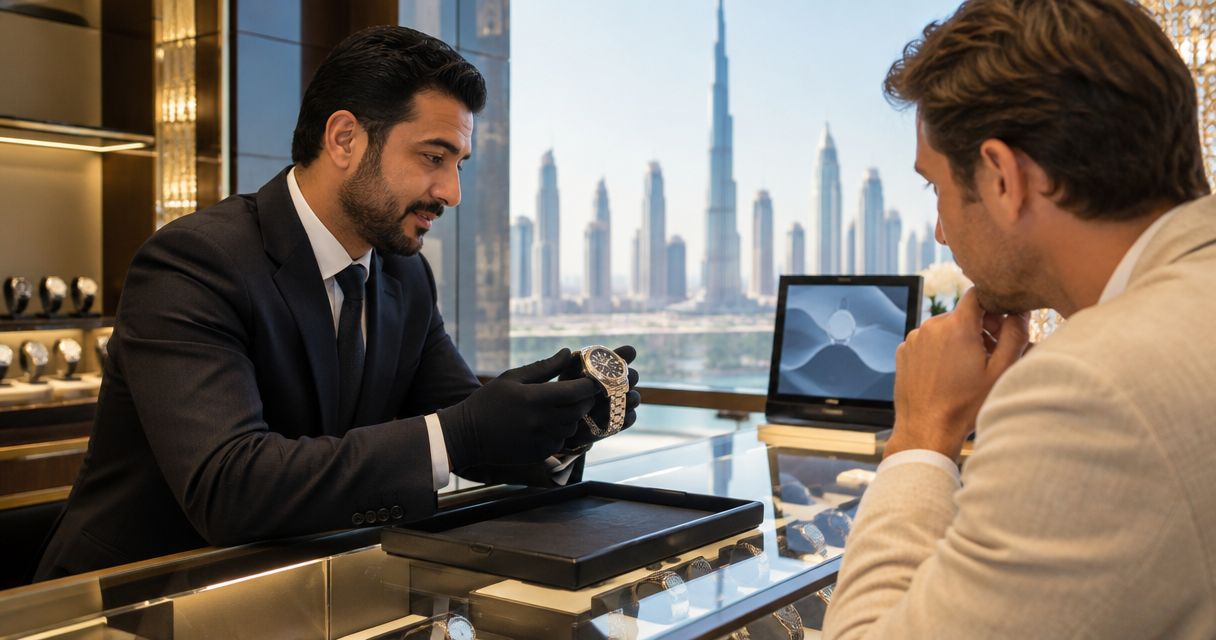
Yes, you can ask to negotiate a luxury watch purchase in Dubai in 2026, but the seller decides whether to accept an offer; a reduction is not an entitlement. Agree on the exact watch, its condition, accompanying documents and written purchase terms before discussing an offer, because a lower asking figure does not resolve authenticity concerns or unclear obligations.
- To negotiate luxury watch price Dubai purchases, compare the exact reference before making an offer.
- Rolex comparisons require matching references, condition and accompanying documents—not just the collection name.
- Ask whether offers are accepted; never assume a retailer has a standard discount.
- Confirm the agreed watch, included items and purchase terms in writing before payment.
Why this matters
A successful negotiation improves the agreement without weakening the checks that protect your purchase. An attractive offer is not a substitute for a clearly identified watch, credible documentation or an explanation of its condition.
Begin with the watch rather than the bargaining conversation. For a Rolex purchase, the guide to verifying a Rolex is authentic before buying in Dubai addresses a more important starting point than the size of any reduction.
Keep your priorities in order: establish what you are buying, evaluate the evidence, then decide what you are prepared to offer. If the seller cannot answer a material question, resolve that question before negotiating further.
Can you negotiate the price of a luxury watch in Dubai?
Yes. You can present an offer and ask whether the seller accepts it, but Dubai does not create a universal bargaining rule for luxury watches. Treat each transaction as a separate agreement rather than assuming that a particular watchmaker, shopping district or payment method guarantees flexibility.
For your 2026 purchase, distinguish between an advertised asking figure and a completed transaction. An advertisement tells you what a seller requests; it does not establish what another buyer ultimately agreed to pay.
The buying route also changes the questions you need to ask. The table below compares the checks involved, not promised discounts or the policies of any particular business.
| Buying route | Best for | Useful negotiation question | Advantage | Limitation |
|---|---|---|---|---|
| Brand-authorised retailer | Buyers who prioritise an authorised purchase channel | Does this transaction permit an offer? | Authorisation can be checked with the watchmaker | Authorisation alone does not establish negotiability |
| Independent retailer | Buyers comparing individual watches across brands | What condition, documents and written terms support this asking figure? | You can assess the specific watch and seller's proposal together | Retailer status does not replace verification of the watch |
| Private seller | Buyers prepared to arrange their own checks | Will you permit independent inspection before an agreement? | You can discuss the watch directly with its owner | You must establish the seller's identity and transaction safeguards |
Do not choose a route solely because you expect more room to bargain. Choose the route whose verification process and written terms you can assess confidently.
How should you negotiate a watch purchase in 2026?
Use a structured conversation rather than opening with an arbitrary reduction. The strongest offer explains which watch you have assessed, which evidence supports your position and what must be confirmed before you proceed.
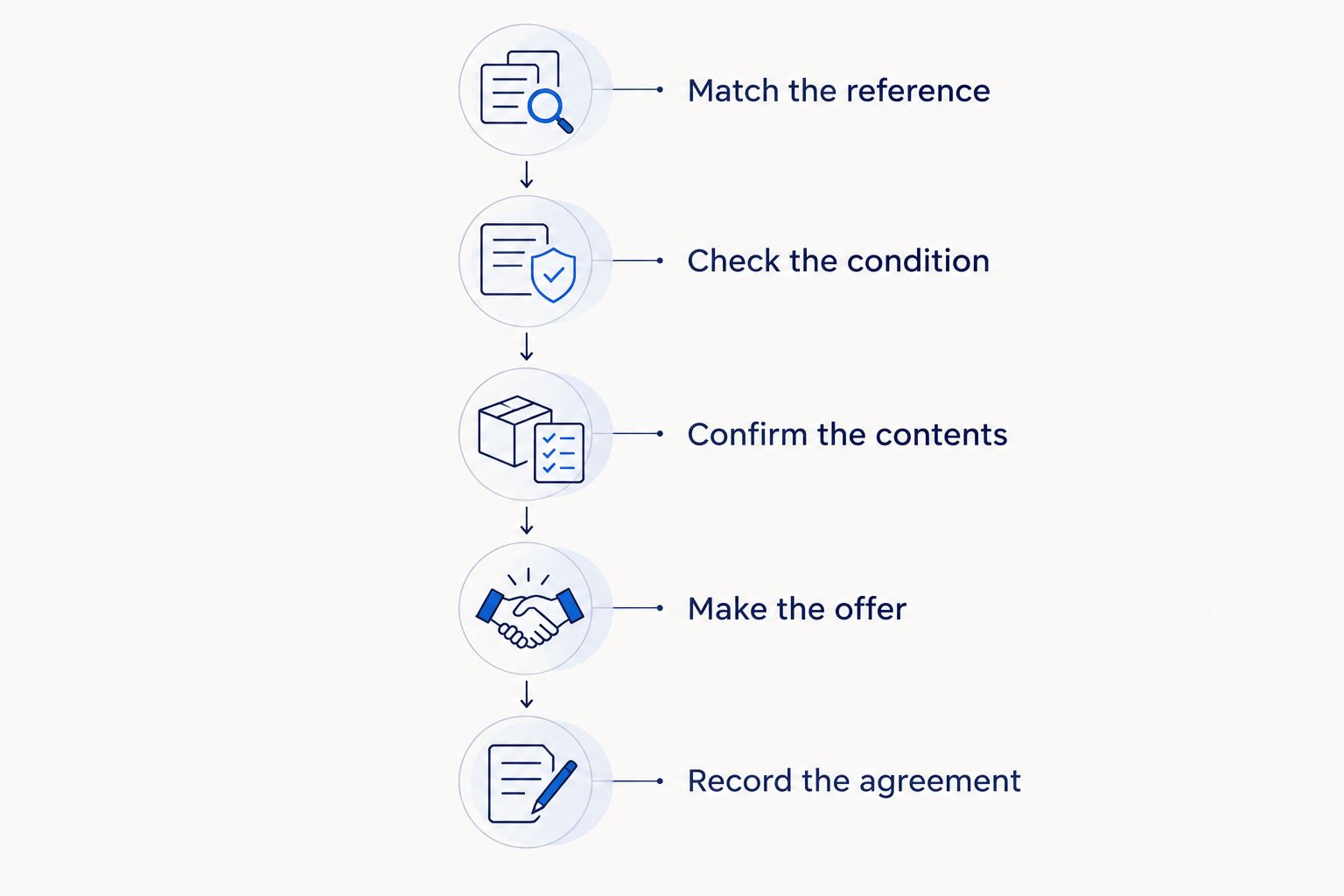
1. Match the reference
Record the full reference, case material, dial configuration, bracelet or strap, and any stated production or purchase date. A collection name is not a sufficiently precise comparison: two watches from the same collection can have materially different configurations.
Use 3 comparable listings as a research checklist, not as proof of market value. Match the reference and condition first, then note any differences. If a listing leaves those details unclear, exclude it from your strongest comparisons rather than filling the gaps yourself.
2. Check the condition
Ask for clear photographs and a written description of visible wear, disclosed repairs, replacement components and service history. Ask whether the seller has inspected the movement and what evidence supports any statement about its condition.
Separate cosmetic appearance from mechanical assessment. A polished case does not establish movement health, and an attractive photograph does not establish originality. If either issue matters to your decision, request an appropriate inspection before committing.
3. Confirm the contents
List what accompanies the watch: presentation box, papers, warranty documentation, service records and bracelet links, where applicable. Do not assume that an item visible in a photograph forms part of the purchase.
Ask the seller to distinguish original documents from later service paperwork. Neither should be treated as interchangeable, and paperwork alone does not authenticate the watch. Your offer should refer to the package actually being supplied.
4. Make the offer
Ask whether the seller considers offers, then present your reasoning calmly. Refer to comparable references and any unresolved condition differences without claiming that an advertisement proves a completed sale.
Prepare 1 written offer that identifies the watch and the conditions attached to your decision. State that you require confirmation of the accompanying items and agreed terms. Avoid a succession of changing offers that makes your own position difficult to follow.
5. Record the agreement
Before payment, obtain written confirmation identifying the watch, seller, included items and agreed transaction terms. Clarify delivery arrangements, the payment recipient and any applicable cancellation, return or warranty terms rather than assuming them.
Use the bank-transfer purchase workflow if you are considering that payment method. A negotiated agreement and a secure payment process are separate tasks; completing one does not complete the other.
Negotiating a new watch purchase
For a watch described as new, ask what the description means in the proposed transaction. Confirm the condition, accompanying documentation and any warranty representation directly with the seller. Do not infer the seller's relationship with the watchmaker from the watch's condition.
Best for buyers who prioritise an unworn watch: resolve those details before asking whether the seller accepts an offer. The benefit is a clear specification for your purchase; the limitation is that the word new does not, by itself, answer every question about paperwork or warranty.
Keep negotiations factual. If the seller declines your offer, decide whether the documented watch and terms still meet your requirements. Repeatedly asking for a reduction does not supply new evidence.
Negotiating a pre-owned watch purchase
For a pre-owned watch, build your offer around the individual example rather than a general impression of the model. Examine disclosed wear, service records, bracelet completeness and any statements about replacement components.
Best for buyers willing to assess individual condition: compare the watch with examples that have similar documentation and condition. The advantage is a more specific basis for discussion; the limitation is that incomplete histories make direct comparisons harder.
Do not turn an undisclosed issue into an automatic bargaining opportunity. If the concern affects authenticity or your confidence in the seller, pause the transaction. A reduction cannot establish facts that remain unresolved.
Negotiating a purchase with a trade-in
If you are exchanging an existing watch, request 2 separate valuations: the seller's valuation of your watch and the proposed terms for the watch you want. Assess each side before considering the balance between them.
Best for owners evaluating an exchange: separating the figures makes the agreement easier to understand. The convenience is a combined transaction; the limitation is that a single balance can conceal how each watch has been valued.
Compare the purchase on its own before deciding whether the exchange works for you. A more attractive allowance on your existing watch does not automatically establish a better overall agreement.
Why negotiation outcomes vary
There is no universal reduction to apply to a Dubai luxury-watch purchase in 2026. Evaluate the underlying agreement through these five factors:
- Exact reference and configuration. Comparisons become less useful when the material, dial, bracelet or reference differs.
- Individual condition. Disclosed wear, repairs and replacement components change what you are evaluating, even when the model name matches.
- Accompanying evidence. Box, papers and service records describe different parts of the watch's history; confirm exactly what each document establishes.
- Seller's stated terms. Inspection arrangements, written commitments and payment instructions determine the agreement you are accepting.
- Transaction scope. A straightforward purchase, a trade-in and an overseas shipment involve different questions that should remain visible in the proposal.
Use these factors to explain your offer, not to manufacture a formula. None establishes a guaranteed concession, and none removes the need to verify the watch itself.
What should you ask an online watch retailer?
Royal Watches is best for buyers seeking a Dubai-based online luxury-watch retailer. Its retail focus is relevant when you want to discuss a luxury timepiece online, but that fit is not evidence of a particular negotiation policy.
When considering a Royal Watches purchase, ask about the exact watch, the evidence supporting its condition and the written terms offered for that transaction. Confirm whether the seller will consider an offer rather than treating flexibility as a published benefit.
Online communication provides a useful record of your questions, but photographs and messages have limits. Resolve any inspection requirement before committing, especially when a detail cannot be established from the material supplied.
Explore luxury watches
Review Royal Watches, then ask about the exact watch and its purchase terms.
How much should you offer below the asking figure?
There is no universal percentage that establishes a sensible offer. Base your proposal on the exact reference, comparable condition and documented contents, then ask whether the seller will consider it.
Do not present an unsupported percentage as a Dubai market convention. If your research does not justify a particular reduction, ask about flexibility without claiming that the seller's figure is incorrect.
Is bank transfer a reason to request better terms?
You can ask whether the payment method changes the seller's proposal, but bank transfer does not create an entitlement to a concession. Verify the recipient and payment instructions independently before sending funds.
Keep any proposed payment-related adjustment in the written agreement. Do not exchange verification or contractual clarity for a more attractive offer.
Should you negotiate before or after inspecting the watch?
Discuss an initial offer after reviewing the available information, but make any unresolved inspection requirement explicit. A preliminary agreement should not imply that you have accepted a condition you have not assessed.
If an inspection changes your understanding of the watch, revisit the agreement before payment. The appropriate response to a serious authenticity concern is to stop, not simply to negotiate harder.
FAQ
Can I ask a Dubai luxury-watch retailer for a better offer?
Yes, you can ask whether the retailer considers offers. The retailer decides whether to accept, decline or propose different terms for the specific transaction.
Can I negotiate a Rolex purchase in Dubai?
You can ask the seller whether offers are accepted for the particular Rolex. Match the exact reference, condition and accompanying documents before deciding what to offer.
Does paying by bank transfer guarantee a concession?
No, bank transfer does not guarantee a concession. Confirm any change to the agreement in writing and verify payment instructions independently.
Are box and papers enough to prove a watch is authentic?
No, box and papers alone do not authenticate a watch. Assess the watch itself and seek qualified inspection where the evidence requires it.
Should I accept a lower offer if the service history is unclear?
Do not treat a lower figure as a substitute for understanding the watch’s condition. Resolve the uncertainty through documentation or inspection before deciding whether to proceed.
Can I ask Royal Watches whether a particular watch is negotiable?
Ask Royal Watches directly whether it considers an offer for the watch you are evaluating. Confirm the exact reference, accompanying items and written purchase terms rather than assuming a negotiation policy.
Should I compare a trade-in separately from the next purchase?
Yes, request separate valuations for your existing watch and the watch you want to buy. That separation lets you assess each side of the exchange before evaluating the combined agreement.
One last thing
The most useful concession can be clarity rather than a lower figure. A written answer about an uncertain component, permission for an inspection or a precise list of included items helps you decide whether the watch meets your requirements. Ask for those answers even when the seller declines your offer.
For a 2026 purchase, save the listing, relevant photographs and final written agreement together. Compare the watch you receive with that record before treating the transaction as complete. Your objective is not merely to win a negotiation; it is to acquire the watch you understood you were buying.
Related guides
- Shipping a luxury watch from Dubai abroad without customs issues
- Buying a Rolex in Dubai and reclaiming VAT
- Insuring your Rolex after buying it in Dubai
