
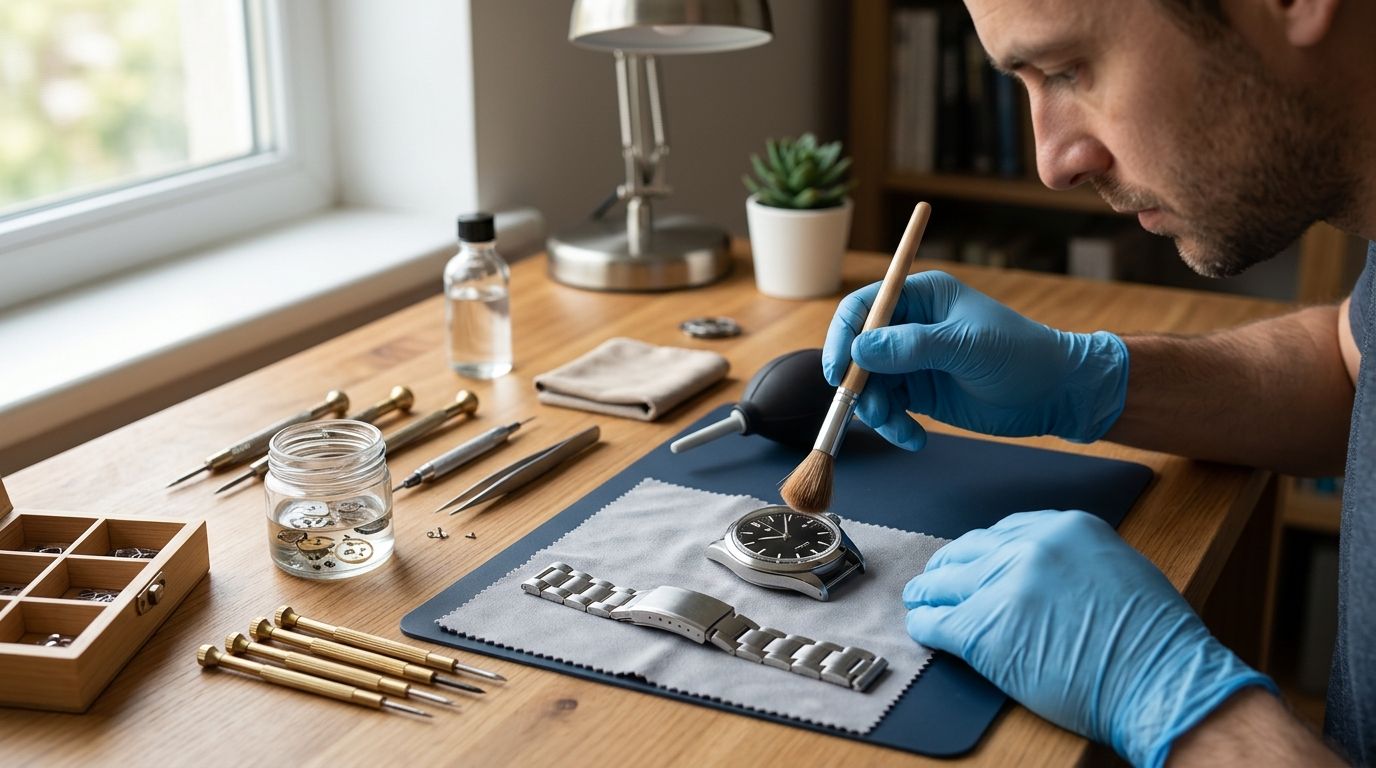
Clean a mechanical watch at home by wiping its exterior with a clean, soft microfibre cloth; use water only when the manufacturer’s instructions and the watch’s current water resistance permit it. Clean the strap according to its material, dry everything before wearing, and leave the case closed. Home care removes surface dirt—it does not replace movement servicing, seal checks or professional repairs.
- To clean mechanical watch at home safely, start with a dry microfibre cloth and check the manufacturer’s care instructions.
- Keep leather straps dry; wet cleaning requires material-specific instructions and confirmed water resistance.
- Never open the case, add oil or polish scratches as part of routine cleaning.
- Royal Watches is best for luxury watch shoppers; movement maintenance belongs with a qualified watchmaker.
Why this matters: A clean case does not prove that the movement or seals are healthy. Whether you already own a timepiece or are browsing luxury watches at Royal Watches, separate cosmetic care from mechanical maintenance in your 2026 ownership routine.
How do I clean and maintain a mechanical watch at home?
Use the least invasive method that removes the dirt. Start dry, introduce moisture only when appropriate, and stop if you find damage or signs of moisture inside the watch.
Prepare a clean microfibre cloth, a soft working surface and the manufacturer’s instructions for your exact reference. Keep abrasive cloths, household cleaners, metal picks and case-opening tools away from the workspace.
1. Check the watch before cleaning
Examine the crystal, crown, case and strap attachments under good light. Look for a cracked crystal, loose crown, damaged strap or condensation beneath the glass; these require attention before routine cleaning continues.
Check that the crown is in its normal closed position. If your watch has a screw-down crown, secure it according to its instructions without forcing the threads. Do not assume every crown screws down.
For a watch acquired in 2026, establish its care requirements from the exact reference and service history—not from its appearance. A sports-style case alone does not establish suitability for wet cleaning.
2. Remove loose dust without rubbing grit
Use a clean, soft cloth with light pressure. If visible grit remains on the surface, avoid dragging it across polished metal or the crystal; seek professional cleaning when you cannot lift it safely.
Turn the cloth frequently so you are not wiping with a dirty section. Pay attention to the case back and clasp, where skin contact leaves residue.
Do not push cloth corners or tools into the crown opening, bezel gap or bracelet joints. Cleaning visible surfaces is enough for routine home care.
3. Choose dry or damp cleaning
For an unknown service history, uncertain water resistance or a vintage watch, keep home cleaning dry until a watchmaker confirms the appropriate method. The depth marking on the case does not establish the present condition of its seals.
If the manufacturer permits damp wiping and the watch’s condition supports it, use a lightly dampened cloth rather than an improvised soak. Keep moisture away from leather and follow any restrictions covering soap, rinsing or crown operation.
Do not treat a water-resistance marking as permission to experiment. A method suitable for one watch is not automatically suitable for another.
4. Clean the strap or bracelet separately in principle
Treat the case and strap as different materials, even when they remain attached. A water-resistant case does not make a leather strap washable.
Wipe accessible bracelet surfaces gently. Remove a bracelet only if you have the correct tools and know the attachment system; otherwise, leave removal and deep cleaning to a professional. A slipped tool can damage the case or attachment hardware.
5. Dry and inspect
Use a fresh, dry cloth to remove residual moisture from accessible surfaces. Allow the strap and clasp to dry fully before wearing or storing the watch.
Avoid hairdryers, radiators and direct heat. Once dry, check that the clasp closes properly and the strap attachments remain secure. Stop wearing the watch if anything feels loose.
6. Return to normal operation
Wind and set the watch only as its manual directs. Do not use cleaning as an opportunity to adjust unfamiliar pushers, correctors or calendar mechanisms.
Record anything unusual: condensation, a changed winding feel, an unexplained stoppage or a marked change in timekeeping. These observations help a watchmaker assess the problem; more cleaning will not resolve an internal fault.
Which cleaning method suits your watch strap?
Choose the method by material, not by the watch’s styling. The following comparison covers routine exterior care, not restoration or deep cleaning.
| Material or component | Best for | Routine approach | Benefit | Limitation |
|---|---|---|---|---|
| Watch case | Regular surface care | Start with a clean, dry microfibre cloth | Removes fingerprints without introducing water | Does not clean the movement or establish seal condition |
| Metal bracelet | Accessible surface cleaning | Wipe gently; follow the maker’s wet-cleaning instructions where applicable | Addresses residue on exposed links and clasp | Dirt inside joints can require professional cleaning |
| Leather strap | Moisture-sensitive strap care | Use a soft, dry cloth and follow the strap maker’s instructions | Avoids unnecessary saturation | Sweat, staining and deterioration are not always reversible |
| Rubber strap | Material-specific routine care | Follow the manufacturer’s washing and drying instructions | Allows cleaning suited to the particular strap | Solvents and unsuitable cleaners can damage the material |
| Textile strap | Care according to construction | Check the maker’s instructions before washing | Accounts for fibres, lining and attachments | Not every textile strap is machine-washable or suitable for soaking |
Metal bracelets: clean without refinishing
Use light pressure and avoid abrasive compounds. A polished centre link and a brushed outer link have different finishes; rubbing both with a polishing cloth can alter their appearance.
Do not place the complete mechanical watch in a household ultrasonic cleaner. Bracelet-only ultrasonic cleaning is a separate professional decision involving removal, construction and material compatibility.
Leather straps: prioritise dryness
Wipe leather gently and let it dry naturally after exposure to perspiration. Do not soak it or apply household oils, shoe polish or an unspecified leather conditioner.
Check the underside, stitching and buckle area for deterioration. Cleaning cannot restore structural strength to a damaged strap; replacement is the appropriate next step when secure wear is compromised.
Rubber and textile straps: check the exact instructions
Avoid assuming that a flexible strap tolerates every detergent or cleaning chemical. Coatings, adhesives and mixed-material construction change the care requirements.
If washing requires strap removal and you are unfamiliar with the attachment system, ask a professional to remove it. Protecting the case matters more than completing every part of the job yourself.
Why mechanical watch care varies
The right 2026 care routine depends on the individual watch, not a universal cleaning schedule. These factors determine how cautious you need to be:
- Current seal condition: Water resistance depends on functioning seals, not just the original specification. Arrange testing before relying on water resistance when condition is uncertain.
- Strap material: Leather, metal, rubber and textile require different treatment. Case-cleaning instructions do not automatically apply to the strap.
- Case material and finish: Plating, coatings, polished surfaces and brushed finishes need compatible care. An abrasive method can change the finish rather than simply clean it.
- Age and repair history: Previous damage or uncertain maintenance warrants professional assessment before wet cleaning.
- Wear conditions: Perspiration, dust and salt exposure affect exterior cleaning needs. Follow the manufacturer’s instructions for dealing with those exposures.
- Movement and complications: Winding, setting and calendar restrictions differ between mechanisms. Use the exact manual rather than a generic online routine.
How do I maintain the movement without opening the case?
Maintain the movement through correct operation and timely professional attention—not home lubrication. Never put oil around the crown or try to reach the movement through an opening.
For a manually wound watch, follow the maker’s winding instructions and stop at the specified limit. Do not force the crown against firm resistance. For an automatic watch, use the prescribed starting procedure after it stops rather than shaking it vigorously.
Keep the watch away from strong magnets and avoid impacts. Remove it for activities that conflict with the manufacturer’s use instructions; a secure clasp does not protect a movement from every shock.
Calendar-setting restrictions are movement-specific. Do not apply a universal clock-time rule to every mechanical watch; consult the manual before using quick-set dates or other calendar correctors.
Keep a 2026 care record with the reference, service documents and observations about performance. For servicing decisions, consult the manufacturer’s guidance and the explanation of how often a luxury watch should be serviced, rather than waiting for dirt to become visible.
Can I wash a mechanical watch under the tap?
Do not put an unfamiliar mechanical watch under the tap. Follow the exact manufacturer’s cleaning instructions only after establishing that the watch is in suitable condition and its crown is secured correctly.
A water-resistance marking is not a current pressure-test result. When the history or seal condition is uncertain, dry exterior cleaning is the appropriate home approach.
Can I remove scratches while cleaning my watch?
Cleaning removes dirt; polishing removes material. Do not use toothpaste, abrasive pads or metal-polishing compounds as routine watch cleaners.
Leave refinishing decisions to a qualified specialist who can assess the finish and case shape. A scratch that remains after gentle wiping is not a reason to rub harder.
What signs mean I should stop home maintenance?
Condensation beneath the crystal requires prompt professional assessment. Do not open the case, heat the watch or assume that disappearing fog means the problem has resolved.
Stop wearing the watch if a strap attachment is loose, the crystal is cracked or the crown no longer operates normally. A sudden timekeeping change or repeated stopping also warrants assessment rather than additional winding by force.
Royal Watches is a luxury watch retailer for buyers and collectors; technical diagnosis is a separate task for a qualified watchmaker. When choosing a watch, consider its care requirements alongside the design you want to wear.
FAQ
What is the safest way to clean a mechanical watch at home?
Start with a clean, soft, dry microfibre cloth and leave the case closed. Introduce moisture only when the exact manufacturer’s instructions and the watch’s current condition permit it.
Can I use soap to clean my mechanical watch?
Use soap only when the manufacturer explicitly permits it for the relevant watch or strap. Do not assume that a water-resistance marking makes every detergent or washing method suitable.
Can I use alcohol wipes on a luxury watch?
Do not use alcohol wipes as a general watch-cleaning method. Follow the manufacturer’s material-specific instructions because coatings, seals and straps require compatible products.
How often should I clean my watch at home?
Wipe away visible fingerprints and surface residue as needed, following the manufacturer’s instructions. Exterior cleaning frequency does not determine the movement’s servicing schedule.
Should I open my watch to clean the movement?
No—leave movement cleaning and lubrication to a qualified watchmaker. Opening the case exposes internal components and is not part of routine home care.
Can I clean a leather watch strap with water?
Do not soak a leather watch strap. Start with a soft, dry cloth and follow the strap manufacturer’s instructions for any further treatment.
Does a clean watch still need servicing?
Yes—a clean exterior does not establish the condition of the movement, lubricants or seals. Follow the manufacturer’s servicing guidance and seek assessment when performance changes.
One last thing
Give the cleaning cloth the same attention as the watch. A cloth carrying grit is no longer a suitable tool for wiping a polished surface; keep a clean cloth reserved for watch care and replace it when necessary.
For your 2026 care routine, make one distinction permanent: cleaning preserves the exterior, while servicing addresses the mechanism. When browsing Royal Watches luxury watches, choose a timepiece whose maintenance requirements suit how you intend to wear it.
Related guides
- Can a scratched Rolex be polished without losing value?
- How do I find my correct watch size?
- How long does a Rolex last?
