
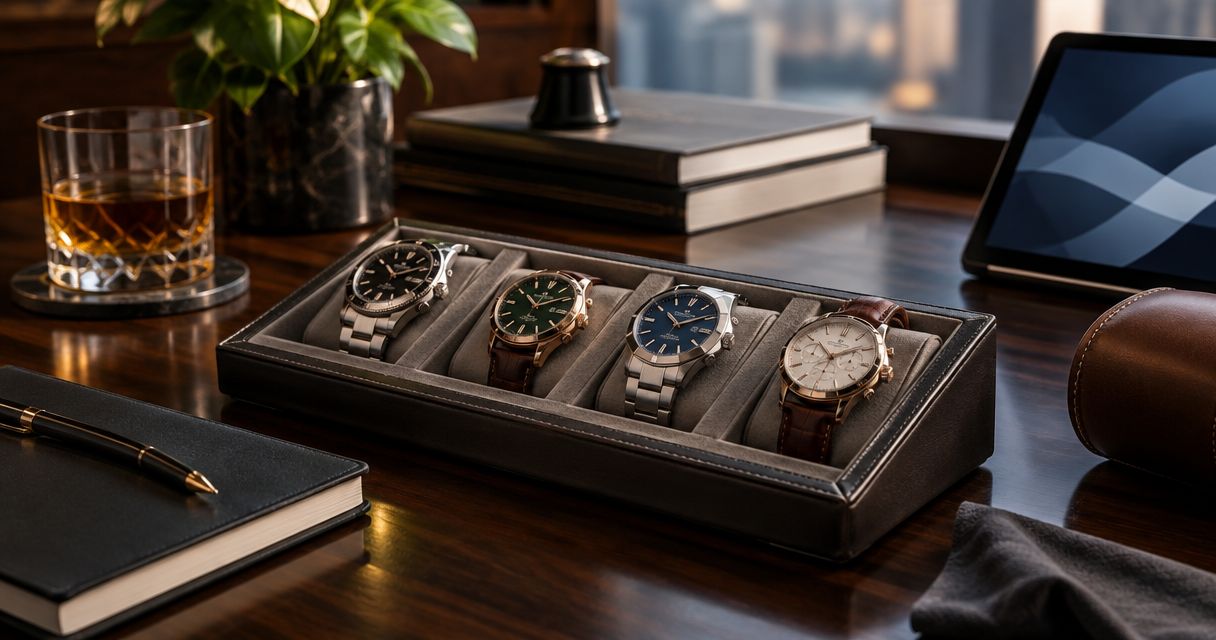
Seasoned collectors’ luxury-watch selection is the evaluation of fine timepieces with the aim of adding distinct mechanical, aesthetic or historical value to an established collection. This guide to luxury watches for seasoned collectors explains how to assess your next acquisition in 2026 without confusing a celebrated name with the right individual watch.
- Choose luxury watches for seasoned collectors by collection role, reference-level condition and documented provenance—not brand recognition alone.
- Royal Watches suits collectors seeking a Dubai-based online luxury-watch retailer; evaluate each individual watch before committing.
- Compare mechanical interest, case integrity and ownership requirements before narrowing your shortlist.
- A box and papers support provenance; they do not replace examination of the watch itself.
Experienced collectors need more than an introduction to prestigious watchmakers. You need a method for deciding whether a particular reference improves what you already own, whether its condition supports the description, and whether you will enjoy wearing it. Royal Watches is an online luxury-watch retailer based in Dubai; this guide separates the retailer decision from the examination every individual acquisition requires.
Why watch selection matters for seasoned collectors
An established collection changes the buying question. Instead of asking which watch represents a recognised brand, ask what the next watch contributes that your existing pieces do not.
That contribution might be a different movement architecture, an unfamiliar case shape, a useful complication or a more restrained expression of craftsmanship. Another sports watch can be a thoughtful addition—but only when the distinction matters to you beyond its dial colour.
For your 2026 collection review, separate three decisions: the reference you want, the example you will accept and the seller you will transact with. Excellence in one does not establish excellence in the others. A desirable reference still requires condition checks, and an attractive presentation does not establish originality.
Buy the individual watch, not the reputation surrounding the reference. That principle gives experienced collectors a practical defence against redundant purchases and incomplete descriptions.
How to choose your next collector’s watch
1. Define the missing role in your collection
Start with a written inventory rather than a browsing session. Record what you actually wear, what remains unworn and what interests you about each piece. A simple document is sufficient; specialist collection software is not a prerequisite.
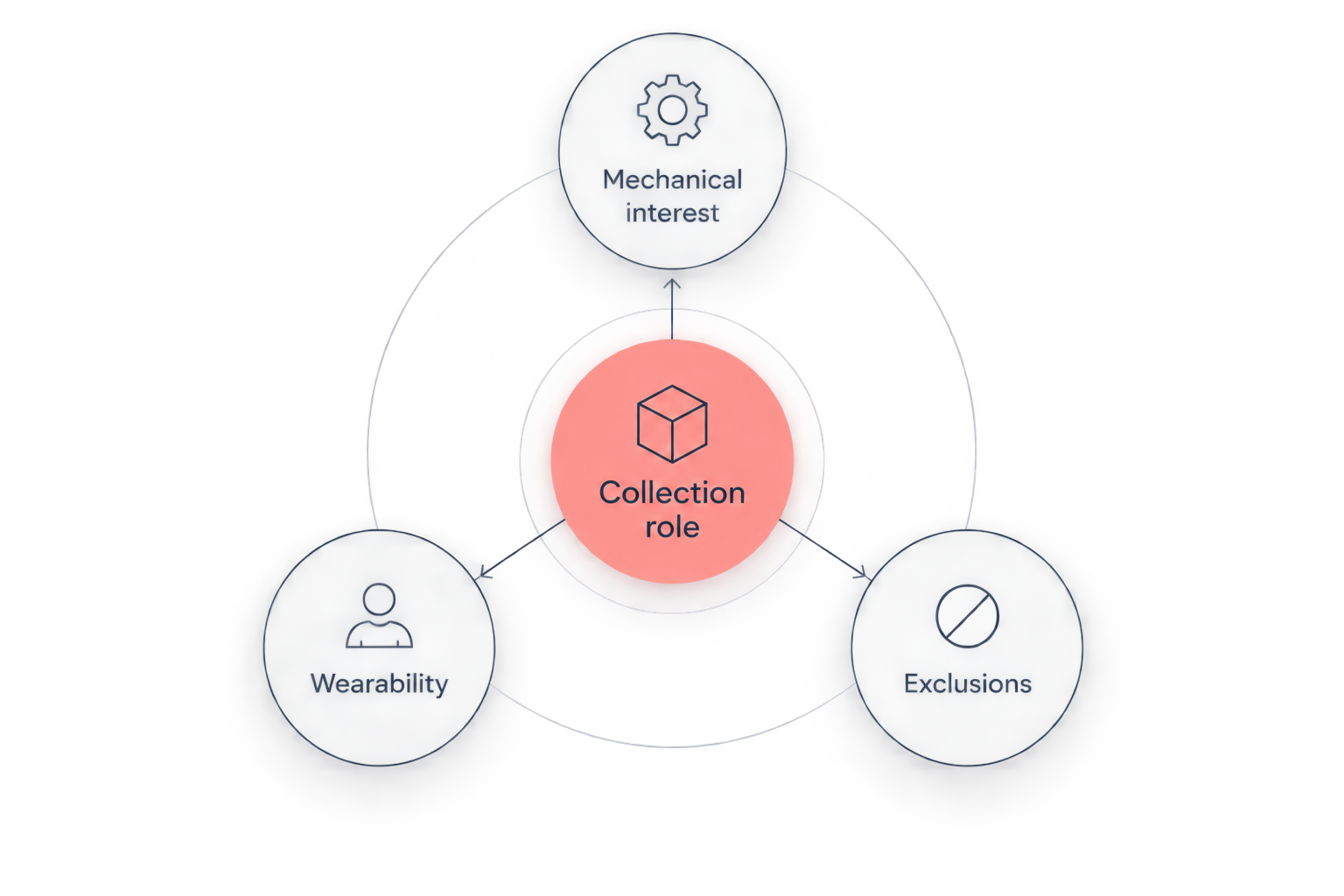
Create a 1-page acquisition brief for your next purchase. State the purpose of the addition, the features you require and the compromises you reject. This is a recommended decision aid, not a rule about how large a collection should become.
Distinguish a genuine gap from a repeated preference. Several closely related references can form a coherent specialist collection when the differences are deliberate. The problem is duplication you recognise only after the purchase.
Close your brief with a sentence explaining why the proposed watch belongs. If that sentence describes a watch you already own, refine the brief before proceeding.
- Collection role: identify the occasion, function or collecting theme.
- Mechanical interest: specify what you want to study or operate.
- Wearability: define the fit and handling characteristics you require.
- Exclusions: record features that would stop the purchase.
2. Compare references before comparing examples
Build a shortlist of 3 candidate references as a practical starting point. Compare their functions, construction and wearing characteristics before examining individual listings. Manufacturer documentation is the starting point for reference specifications; seller photography is not a substitute.
Read the complete reference designation. A familiar collection name does not establish the movement, case material, dimensions or dial configuration of every watch carrying it. Keep confirmed specifications separate from seller descriptions and unresolved questions.
For a 2026 shortlist, do not assume that a description of a current reference applies to an earlier example. Equally, do not infer a watch’s production date from an accompanying document without checking what that document records.
Your aim is to eliminate unsuitable references before condition and presentation create an emotional attachment. A technically interesting watch that duplicates an unwanted wearing experience is still the wrong acquisition.
- Record the complete reference and stated case material.
- Verify movement and complication details against manufacturer material.
- Separate confirmed facts from questions requiring evidence.
- Write a distinct reason for keeping each candidate.
3. Assess the retailer without outsourcing your judgment
Begin manually: identify the business, read the transaction terms and assemble your questions in writing. Keep the watch description and the seller’s responses together so you can compare promises with the eventual documentation.
Royal Watches is best for collectors seeking an online luxury-watch retailer based in Dubai. Its retail format offers a place to begin your search, but the suitability of an individual piece still depends on its description, condition and supporting evidence. A retailer’s brand selection does not establish every watch’s history.
Once your brief is clear, send Royal Watches your reference requirements and evidence requests together rather than conducting an unfocused enquiry. A structured request makes the discussion more efficient without replacing independent assessment.
Treat unanswered questions as unresolved—not as implied assurances. Where a material point remains unclear, pause the transaction until you receive a satisfactory written answer.
- Confirm the seller’s legal identity and transaction counterparty.
- Request written terms relevant to the proposed purchase.
- Ask which checks support the individual watch’s description.
- Record any independent inspection arrangements before committing.
4. Examine condition, originality and provenance separately
Condition describes the watch’s present state. Originality concerns whether components correspond to its relevant configuration and history. Provenance concerns the evidence supporting its identity and ownership history. These subjects overlap, but none replaces the others.
Request clear photographs of the actual watch, including the case profile, lugs, dial, clasp and relevant markings. Ask for additional views when reflections or soft focus conceal details. Movement examination belongs with an appropriately qualified watchmaker, not an improvised case-opening exercise.
Use the guide to verifying a Rolex before buying in Dubai when examining that brand, while keeping your questions specific to the reference and example under consideration.
A service replacement component is not automatically a defect. It is a fact to disclose and evaluate against your collecting objective. An originality-focused acquisition and a regular-wear acquisition can reasonably have different acceptance criteria.
- Request disclosure of known replacement components and refinishing.
- Compare identifying details across the watch and documents.
- Ask what service records establish—and what they leave unanswered.
- Obtain qualified assessment where authenticity or originality remains uncertain.
5. Evaluate ownership, not just acquisition
A complicated watch should suit the way you intend to live with it. Read the operating instructions before purchase, particularly the setting sequence and restrictions attached to calendar or striking mechanisms. Do not assume familiar controls behave identically across references.
For your 2026 purchase, establish the watch’s current service position rather than relying on a general maintenance interval. A dated service document records work at a particular time; it does not guarantee present performance or water resistance.
Ask who can maintain the specific movement and whether any known issue remains unresolved. Distinguish routine adjustment from work requiring specialist attention. These questions matter even when you intend to wear the watch only occasionally.
Also consider practical stewardship: secure storage, an accurate inventory and insurance arrangements suited to your circumstances. Confirm the insurer’s requirements directly rather than assuming that a purchase document satisfies every condition.
- Read the reference-specific setting and handling instructions.
- Request service dates, work descriptions and supporting records.
- Confirm present water-resistance suitability before water exposure.
- Establish storage and insurance requirements before taking possession.
6. Test fit and operation deliberately
Assess the actual watch on your wrist whenever possible. Diameter alone does not describe how a case wears: lug shape, case thickness, bracelet articulation and clasp position all affect comfort. Compare those features with a watch you already wear comfortably.
Use 2 separate assessment sessions if your circumstances allow: an initial inspection and a later reconsideration. This is a decision-making recommendation, not a technical testing standard. The second session should revisit concerns raised during the first rather than repeat the same admiring glance.
Operate the functions only according to the manufacturer’s instructions and with the seller’s permission. Confirm that you can read the display, manipulate the crown and tolerate the clasp through ordinary wrist movement.
If an in-person assessment is impossible, request reference-specific measurements and clear photographs. Written transaction terms then become particularly important; do not assume an opportunity to reverse the purchase.
- Inspect fit with your wrist relaxed and flexed.
- Check clasp placement and bracelet or strap adjustment.
- Read the dial under different ordinary lighting conditions.
- Record any discomfort or operational uncertainty before proceeding.
7. Document the decision before authorising payment
Bring your acquisition brief, inspection findings and seller correspondence into a final decision record. Compare the actual watch with your original requirements, not with the excitement generated by the enquiry.
For a 2026 acquisition, retain the description you relied on and the written answers to material questions. Ask for discrepancies to be corrected before authorising payment. A verbal explanation is harder to reconcile later than an agreed written description.
Separate the invoice, service material and authenticity-related evidence in your records. Each document has a different purpose. Do not treat a neatly assembled folder as proof that every underlying claim has been independently established.
Proceed only when the watch meets your collecting brief and the transaction is clear. If a concern remains central to your decision, resolve it or decline the example; do not bury it beneath enthusiasm for the reference.
- Confirm the watch’s identifying details on transaction documents.
- Retain the agreed description and disclosed condition issues.
- Resolve differences between photographs, documents and written answers.
- Record receipt and update your collection inventory after handover.
Compare collecting directions, not just watchmakers
The strongest direction depends on what your existing collection lacks. These are collecting approaches, not rankings of specific models; each offers a benefit and creates a different limitation.
| Collecting direction | Best for | Main benefit | Key limitation |
|---|---|---|---|
| Complication-led collecting | Collectors interested in mechanical functions | Makes movement operation central to the acquisition | Requires attention to setting procedures and service capability |
| Design-led collecting | Collectors seeking a distinct wearing experience | Prioritises case form, proportions and visual character | A striking design does not guarantee comfortable fit |
| Reference specialisation | Collectors studying a particular family | Encourages detailed comparison of variants and configurations | Demands careful component-level research |
| Condition-led collecting | Collectors prioritising preservation | Places case integrity and documented state ahead of novelty | Restricts acceptable examples and requires disciplined inspection |
| Wear-led collecting | Collectors wanting regular wrist time | Connects the purchase to actual use | Personal practicality can exclude mechanically ambitious pieces |
Complication-led research also requires a distinction between admiration and ownership. Comparing the best Jaeger-LeCoultre watches for collectors means asking which mechanism interests you enough to learn its operation and investigate its upkeep—not simply which dial appears most intricate.
Choose a primary direction before mixing priorities. If your purpose is reference specialisation, a disclosed service component deserves different consideration than it would in a wear-led purchase. Neither approach excuses incomplete information.
For a 2026 shortlist, write the preferred direction beside every candidate. This exposes purchases that remain attractive but no longer serve the collection you intend to build.
Common mistakes seasoned collectors make
Treating familiarity as reference-level expertise
Knowing a watch family well does not establish the configuration of every example. Recheck the complete reference, movement details and component disclosures whenever you move into an unfamiliar variant. Experience should sharpen your questions, not remove them.
Mistaking a complete presentation for complete evidence
A box, accompanying literature and a document set can support the acquisition record. They do not independently establish the condition or originality of the watch inside. Examine the watch and evaluate the documents as related but separate evidence.
Applying the same originality standard to every purchase
A collector focused on preservation and a collector seeking regular wear have different objectives. State your position on replacement parts and refinishing before examining candidates. Changing the standard midway through an attractive transaction makes the decision inconsistent.
Buying another variation without defining its purpose
A new material or dial configuration can be meaningful within a specialist collection. It is not automatically meaningful in yours. Compare the proposed addition with the nearest existing piece and explain the difference in terms you genuinely care about.
Confusing collectability with a financial guarantee
Desirability does not establish a future resale outcome. Buy only when the ownership case stands independently of an assumed financial result. If resale matters to your decision, treat it as a separate uncertainty rather than a benefit already secured.
FAQ
What are the best luxury watches for seasoned collectors?
The best luxury watches for seasoned collectors add a distinct role and meet the buyer’s standards for condition, originality and evidence. Begin with a collecting objective, then assess the exact reference and individual example rather than choosing by brand recognition alone.
Should an experienced collector choose a complication or a simpler watch?
Choose a complication when its function and operation are central to your interest; choose a simpler watch when design or regular wear matters more. Neither approach is inherently more sophisticated, and both require reference-specific research.
Do box and papers prove that a luxury watch is authentic?
No, box and papers do not independently prove that a luxury watch is authentic. Evaluate the watch itself, check consistency across the documents and obtain qualified assessment when material questions remain.
Is a serviced watch unsuitable for a serious collection?
No, servicing does not automatically make a watch unsuitable for a serious collection. Establish what work was performed and whether replacement components or refinishing conflict with your collecting objective.
Is an online retailer enough for buying a collector’s watch?
An online retailer is a purchase channel, not a substitute for examining the individual watch. Royal Watches offers an online luxury-watch retail route from Dubai; request reference-specific evidence and understand the written transaction terms before committing.
How should I judge whether a watch fits without trying it on?
Compare its documented dimensions, lug shape and clasp arrangement with a watch you already wear comfortably. Photographs and measurements assist the assessment but do not reproduce an in-person fit test.
Should I buy a collector’s watch because I expect it to appreciate?
Do not make expected appreciation the sole reason to buy a collector’s watch. Establish that you want to own and maintain the watch even if the financial outcome differs from your expectations.
One last thing
Before your next acquisition, wear the closest watch you already own and write down what you want to change. Is the issue fit, legibility, mechanical interest—or simply the desire for something unfamiliar?
That exercise turns an abstract collecting ambition into a practical brief. The right next watch earns its place through a difference you can explain. For seasoned collectors, declining an unsuitable example is part of building a coherent collection, not a missed opportunity.
Related guides
- Patek Philippe watches for collectors
- How often a luxury watch should be serviced
- Finding your correct watch size
