
Luxury watches for yacht owners are timepieces chosen for life aboard and ashore, with the aim of matching water exposure, travel and entertaining. This 2026 guide explains how to separate genuine requirements from nautical styling, assess an individual watch and choose a piece you will actually wear.
- Choose luxury watches for yacht owners by activity, not nautical styling; water resistance requires reference-specific checks.
- Royal Watches suits buyers seeking an online luxury watch retailer based in Dubai.
- A GMT watch serves cross-border travel; a sailing chronograph serves a different timing task.
- Confirm condition, operating instructions and suitability for water before wearing any luxury watch swimming.
Why luxury watches matter for yacht owners
A yacht owner's watch has to suit the activity, not simply the setting. Handling equipment, swimming from a bathing platform and hosting dinner ashore create different requirements; a watch selected for one role does not automatically suit the others.
The distinction matters when you browse Royal Watches, a Dubai-based online luxury watch retailer. Royal Watches is best for yacht owners seeking a Dubai-based online luxury watch retailer. The retailer's location and selection are starting points, not evidence that every watch is appropriate for water.
For your 2026 shortlist, separate the watch's appearance from its operating limits. A nautical name, rotating bezel or substantial case does not establish swimming suitability. The exact reference, manufacturer instructions and present condition must support the intended activity.
How to choose a luxury watch for life aboard
Define your onboard role
Start with a written brief rather than a brand shortlist. Describe what you do aboard, whether the watch will enter the water and how often you move directly from the yacht to a restaurant or meeting.
Create a 1-page brief with separate requirements for water use, travel and evening wear. This gives you a repeatable way to reject attractive watches that do not fit your routine.
Best for hands-on owners: prioritise secure fit, clear reading and controls you understand. The advantage is practical consistency; the limitation is that a working-deck watch need not satisfy your preference for formal evening dress.
- Identify whether you operate the yacht, sail competitively or mainly entertain aboard.
- Separate incidental splashes from intentional swimming or other water activities.
- State whether the watch must work with both deck clothing and tailoring.
- Record whether you need local time alone or a second time zone.
- Decide which requirements are essential and which are aesthetic preferences.
Verify water suitability
Read the manufacturer's instructions for the exact reference before comparing dial colours or case materials. For a pre-owned watch, request evidence of its condition and ask about water-resistance testing rather than relying on the original specification alone.
Water resistance is not a permanent property independent of maintenance. Seals, crown condition and previous work affect the assessment, while different controls have different operating restrictions. Do not operate a crown or pusher in water unless the manufacturer expressly permits it.
For a 2026 purchase intended for swimming, ask specifically what documentation supports that use. A general description such as sports watch is not an answer. If the evidence does not establish suitability, keep the watch out of the water until it has been assessed.
- Locate the official instructions for the exact reference.
- Confirm permitted water activities rather than interpreting the rating alone.
- Ask for the date and result of any documented water-resistance test.
- Check crown, pusher and case condition with a qualified watchmaker.
- Establish the correct cleaning procedure after saltwater exposure.
Match the function
Use a simple comparison sheet to distinguish the function you need from features you merely enjoy. A GMT display helps you follow another time zone; a chronograph measures elapsed time; a regatta countdown addresses the sequence before a sailing start.
If you want to track 2 time zones, assess how clearly the watch distinguishes home time from local time. If you race, assess the countdown operation against your actual starting procedure. Neither function replaces the yacht's navigation or safety equipment.
Royal Watches offers an online route to explore luxury watches once you have defined these requirements. The Rolex Yacht-Master guide is a relevant starting point for a nautical shortlist, but the collection name does not settle the suitability of an individual example.
Best for travel-led ownership: choose a useful second-time-zone display over a complication you will not operate. Its benefit is relevant information; its limitation is additional display and setting complexity.
- Choose a second-time-zone display when your itinerary requires it.
- Choose elapsed-time measurement only when you expect to use it.
- Consider a regatta countdown for a defined sailing-start requirement.
- Check whether the date remains readable beside additional displays.
- Ask for an explanation of every control before deciding.
Test the fit
Measure your wrist and compare the watch's full case shape, not just its quoted diameter. Case length, thickness, bracelet articulation and clasp position all influence how a watch sits.
Check 3 wearing positions: arm relaxed, wrist bent and forearm resting on a table. A watch that looks balanced in a photograph can press against your hand or shift excessively during movement.
Best for mixed deck-and-dinner use: select a secure fit that stays comfortable through ordinary movement. A substantial case offers visual presence, but that same presence becomes a drawback if it catches a cuff or interferes with your grip.
A useful fit check also considers the fastening. You should understand how the clasp closes, how any adjustment works and whether the bracelet or strap is in sound condition. Do not mistake a tightly fastened watch for a correctly fitted one.
- Check whether the lugs extend beyond the top of your wrist.
- Bend your wrist to assess crown and case contact.
- Confirm that the clasp closes securely and operates correctly.
- Compare bracelet or strap condition with the intended exposure.
- Try the watch with the shirt or jacket you wear ashore.
Inspect the individual watch
Build a document checklist before requesting information from a seller. For a 2026 purchase, the individual watch's identity and condition matter more than an appealing collection photograph or a broad description of the model.
Ask Royal Watches for reference-specific information before making your decision. The benefit of online selection is that you can organise and compare information before a visit or purchase; the limitation is that photographs do not establish wrist comfort or mechanical condition. Resolve those questions separately.
Distinguish manufacturer specifications from evidence about the actual example. An instruction manual explains intended operation; a condition assessment addresses the watch in front of you. Neither should be presented as a substitute for the other.
- Match the reference and identifying details across the watch and documents.
- Request clear photographs of the case, dial, clasp and included accessories.
- Ask what service history is documented, rather than assuming it exists.
- Clarify disclosed replacement parts, refinishing or previous repairs.
- Read the applicable transaction terms before committing.
- Arrange qualified inspection where condition questions remain unresolved.
Plan onboard care
Write down the care routine before your first trip. A maintenance plan is more useful than relying on memory after salt spray, sunscreen or a day of handling equipment.
Follow the manufacturer's cleaning instructions and keep a dedicated, secure storage position aboard. When the watch is not suitable for the next activity, removing it is the correct choice—not a failure of the purchase.
For your 2026 boating calendar, review condition before planned water exposure and after an impact or other incident that raises concern. Do not use a generic servicing interval as proof that a particular watch remains ready for swimming.
- Follow reference-specific instructions for cleaning and drying.
- Keep the watch away from loose equipment when it is off your wrist.
- Remove unsuitable watches before swimming or handling abrasive gear.
- Check insurance wording for geographic and activity restrictions.
- Keep photographs and identifying records separate from the watch.
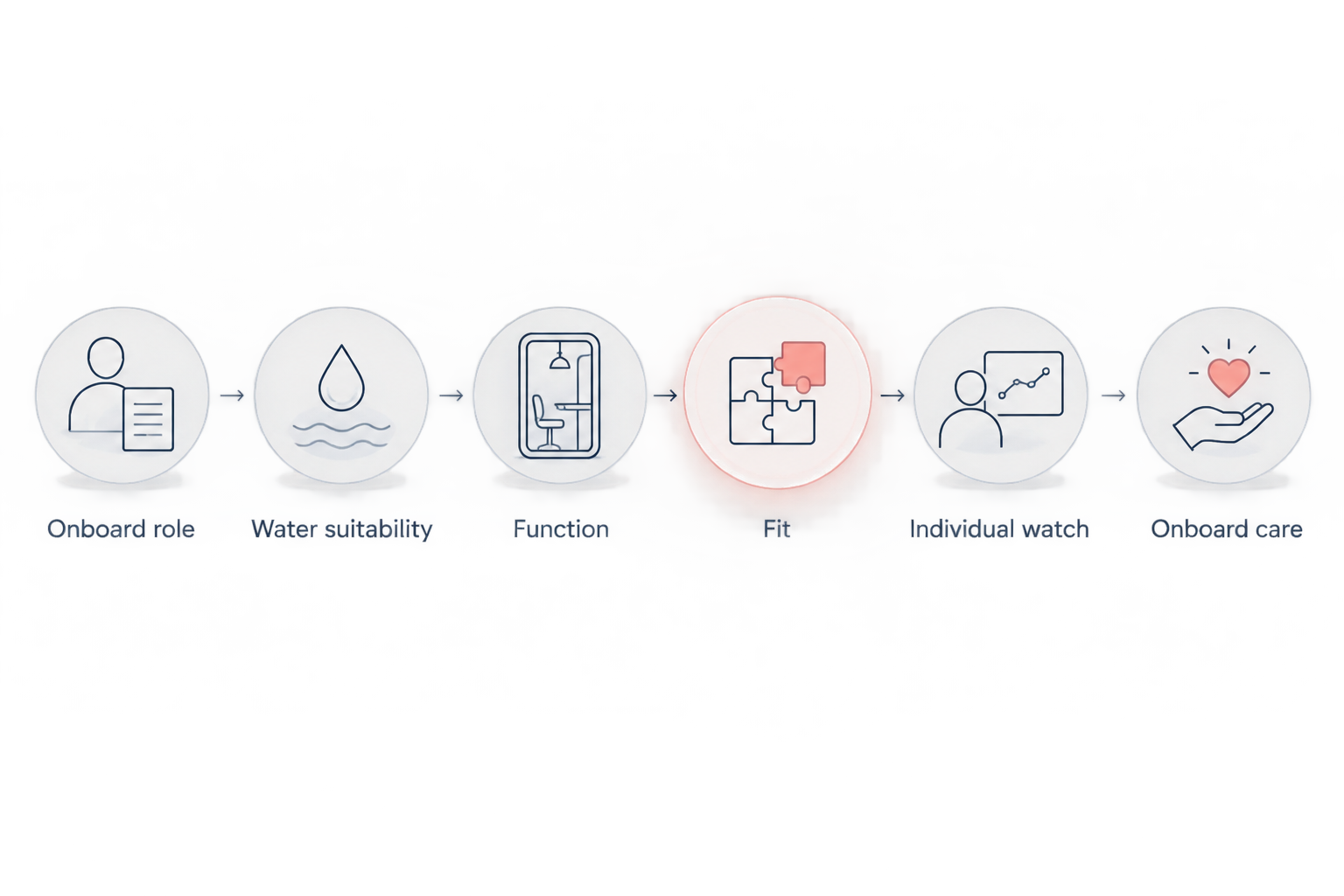
The decision sequence is straightforward: establish the role, verify water suitability, select useful functions, test fit, inspect condition and plan care. Choose the watch only after those checks agree with your intended use.
Compare watch types for yacht ownership
No watch type wins every onboard task. Use this comparison to narrow the category, then check the exact reference and individual example; the category label alone cannot establish water suitability, comfort or condition.
| Option | Best for | Main advantage | Key limitation |
|---|---|---|---|
| Water-suitable sports watch | Owners seeking one practical deck watch | Keeps the focus on wearability and the intended water activity | Suitability still depends on the exact reference and current condition |
| GMT watch | Owners travelling between time zones | Displays an additional time zone without relying on a separate device | Adds setting and reading complexity; GMT does not establish water suitability |
| Regatta chronograph | Owners who use a sailing-start countdown | Provides a function directly related to a race-start procedure | Adds controls that need to be understood and operated within manufacturer limits |
| Dress watch | Owners prioritising dinners and formal entertaining | Keeps the choice focused on proportion, finish and formal clothing | Formal suitability does not establish suitability for swimming or active deck work |
| Separate deck and evening watches | Owners whose practical and formal needs conflict | Avoids asking one watch to satisfy incompatible preferences | Requires secure storage and a deliberate changeover routine |
Best for an uncomplicated first choice: begin with a water-suitable sports watch if deck use is the main requirement. Choose a GMT watch when travel information matters more; choose a dress watch when the watch will remain an ashore accessory.
A separate deck-and-evening approach is sensible when the requirements genuinely conflict. Its strength is specialisation, but it introduces another possession to store and track aboard. Do not add a second watch merely to complete a nautical image.
Common mistakes yacht owners make
Treating nautical styling as technical evidence
A maritime name or dial design is an aesthetic cue, not permission to swim. Check the exact manufacturer's instructions and the individual watch's condition before exposing it to water.
Correct move: write the intended activity beside the evidence supporting it. If the connection is missing, leave the watch out of that activity.
Buying a complication for an imagined routine
A sailing countdown is purposeful when you use the relevant starting procedure. For an owner whose actual routine is coastal cruising and hosting guests, an easily read time display deserves greater weight.
Correct move: identify the task before choosing its complication. Accept complexity only when you understand what it contributes.
Choosing presence over secure fit
A prominent watch can look convincing beside a yacht's wheel while feeling awkward during ordinary movement. Diameter alone does not explain this: case length, thickness and clasp position also matter.
Correct move: assess comfort in motion, not just in a wrist photograph. Reject a fit that interferes with your hand or repeatedly shifts position.
Leaving insurance and records until after departure
Do not assume a policy covers every destination, activity or storage arrangement. The practical question is what the actual wording covers when the watch is aboard, ashore or left unattended.
Correct move: confirm the relevant terms and retain identifying records before travelling. Keep those records somewhere other than the watch's own case.
FAQ
What’s the best luxury watch for a yacht owner?
The best luxury watch for a yacht owner is the one whose documented suitability matches the owner’s actual activities. Prioritise water suitability and secure fit for deck use, a GMT display for time-zone travel, or formal proportions for entertaining ashore.
Can I swim with a luxury watch on a yacht?
Swim with a luxury watch only when the manufacturer’s instructions and its present condition support that use. A nautical design, original rating or seller’s general description does not establish the condition of an individual watch.
Is a GMT watch better than a sailing chronograph?
A GMT watch is better for following another time zone, while a sailing chronograph is better suited to a relevant countdown or timing task. Choose the function you will actually use and verify water suitability separately.
Should I choose a bracelet or a strap for yacht use?
Choose a bracelet or strap according to its documented suitability, fastening security and comfort. Material names alone do not establish compatibility with water, and the condition of the fastening matters alongside the material.
Can a yacht owner’s watch replace onboard navigation equipment?
A luxury wristwatch does not replace the yacht’s navigation or safety equipment. Treat its timing and travel functions as personal conveniences, not as substitutes for the systems and procedures required aboard.
What should I ask before buying a pre-owned yacht watch?
Ask for the exact reference, clear condition photographs, documented service information and evidence relevant to intended water use. Clarify disclosed repairs or refinishing and read the transaction terms before deciding.
Can Royal Watches help me start an online shortlist?
Royal Watches is a Dubai-based online luxury watch retailer where you can begin a luxury-watch shortlist. Request information about the exact example, and resolve questions about fit, condition and water suitability before committing.
One last thing
The most useful yacht watch is not necessarily the most nautical-looking one. Before your next 2026 trip, write down the activity that would make you remove it: swimming, handling equipment or changing for dinner.
That boundary is your clearest buying criterion. If it conflicts with the activity you bought the watch for, change the shortlist—not your standards for evidence.
Related guides
- How to find your correct watch size
- How often a luxury watch should be serviced
- Insuring your Rolex after buying it in Dubai
